Tree Removal Permits in Shoreline: What the City Code Requires
Shoreline, WA — March 27, 2026
Shoreline regulates tree removal more strictly than most cities in the region. This guide breaks down the permit requirements, exceptional tree protections, and replacement rules homeowners need to know.
Why Does Shoreline Regulate Tree Removal So Strictly?
Shoreline is a fully built-out urban city of 57,000 residents wedged between Seattle's northern boundary at 145th Street and the Snohomish County line at 205th Street. Unlike rural communities such as Sultan or Gold Bar where tree removal is largely unregulated, Shoreline adopted its tree preservation code specifically because development pressure was eliminating the mature tree canopy that defines the city's character. The city's name itself comes from the Shoreline School District, but the forested appearance of neighborhoods like Innis Arden, Ridgecrest, and the Interurban Trail corridor is what most residents associate with living here. Shoreline's code under SMC 20.50.290 through 20.50.370 establishes a regulatory framework that covers every significant tree on private property — not just trees in critical areas or development sites. This means a homeowner who simply wants to remove a large Douglas fir from their backyard faces a permit process that would not apply in most other cities in the region.
- Shoreline's tree code applies to all significant trees on private property — not just development sites
- Significant tree threshold starts at 6 inches DBH — lower than most neighboring cities
- Exceptional trees (24 inches DBH for most species) face additional protections
- Replacement planting requirements can mandate 2 to 3 new trees per tree removed
Significant Trees vs. Exceptional Trees in Shoreline
Shoreline's code creates two tiers of tree protection. Understanding which category your tree falls into determines the permit process:
- Significant Trees (6+ Inches DBH): Any tree with a trunk diameter of 6 inches or greater measured at 4.5 feet above grade (diameter at breast height) qualifies as a significant tree under Shoreline's code. This is a low threshold — a Doug fir reaches 6 inches DBH in as few as 15 to 20 years in western Washington's climate. On a typical 7,500-square-foot lot in Ridgecrest or Echo Lake, there may be 5 to 15 significant trees. Removal of significant trees requires a tree removal permit and potentially replacement plantings.
- Exceptional Trees (24+ Inches DBH): Trees with a trunk diameter of 24 inches or more — or trees listed on the city's Heritage Tree Registry — receive heightened protection. A 24-inch Douglas fir is typically 60 to 80 years old and 80 to 100 feet tall. In Shoreline's older neighborhoods like Innis Arden and Hillwood, many lots have multiple exceptional trees. Removing an exceptional tree requires demonstrating that it is hazardous, dead, or dying — aesthetic preferences and view concerns are generally not sufficient justification.
- Trees in Critical Areas: Shoreline's critical areas include steep slopes over 40 percent grade, wetlands, stream corridors, and their buffers. Trees within critical areas face the strictest protections — removal typically requires a critical area study by a qualified professional and may trigger additional environmental review. Several neighborhoods along Thornton Creek and the Hidden Lake area contain critical area designations that affect tree removal options.
- Development vs. Non-Development Permits: The permit process differs depending on whether tree removal is part of a construction project. Non-development tree removal — a homeowner simply wanting to remove a tree — follows the standard permit track. Development-related removal, such as clearing for an ADU, addition, or new construction, triggers Shoreline's tree retention requirements, which can mandate preserving a minimum percentage of significant trees on the lot.
How the Shoreline Tree Removal Permit Process Works
Here is what homeowners in Shoreline can expect when they need to remove a regulated tree. For broader development work, permitted land-clearing projects should be coordinated with the approved site plan and tree-retention conditions rather than treated as routine removals:
- Application Requirements: The permit application requires a site plan showing all significant trees on the lot, identification of the specific trees proposed for removal, the reason for removal, and photographs. For exceptional trees, you may need an arborist report documenting the hazard condition. The application is submitted to the Shoreline Planning and Community Development department.
- Review Timeline: Standard tree removal permits in Shoreline typically take 2 to 4 weeks for review. Complex cases — exceptional trees, critical area trees, or development-related removal — can take 4 to 8 weeks. Emergency hazard removals can be authorized more quickly, but the city still expects notification and documentation even for emergency situations.
- Replacement Planting Requirements: When Shoreline approves a tree removal, they typically impose replacement planting conditions. The standard ratio is one to three replacement trees per significant tree removed, depending on the size and species. Replacement trees must be at least 2-inch caliper (trunk diameter at planting) for deciduous species or 6 feet tall for conifers, and they must be planted on the same lot. Some homeowners can pay into the city's tree fund if their lot cannot accommodate replacement plantings.
- Penalties for Unpermitted Removal: Shoreline enforces its tree code. Removing a significant tree without a permit can result in fines up to three times the appraised value of the tree — which for a large Douglas fir can mean $10,000 to $30,000 or more. The city has assessed these penalties, and the code specifically addresses retroactive permits and increased replacement requirements for unauthorized removals.
Working Within Shoreline's System: Step by Step
Here is how we help Shoreline homeowners navigate the tree removal process from initial concern to completed work:
- On-Site Assessment and Tree Inventory: We visit your Shoreline property, identify every significant and exceptional tree on the lot, and evaluate the specific trees you are concerned about. We measure DBH, document the condition, and photograph any hazard indicators — decay, lean, root damage, crown dieback. This documentation becomes the foundation for your permit application.
- Permit Strategy Discussion: We explain which trees require permits, which might qualify for removal based on hazard conditions, and what the replacement requirements will likely be. For exceptional trees, we discuss whether an arborist report is needed and what the report should address. We help you understand the realistic timeline so you can plan accordingly.
- Permit Application Support: While we do not submit permit applications on your behalf, we provide the site documentation, tree measurements, photographs, and condition assessments that the application requires. Many Shoreline homeowners use our assessment documentation directly in their applications, which streamlines the review process because the information is thorough and professionally formatted.
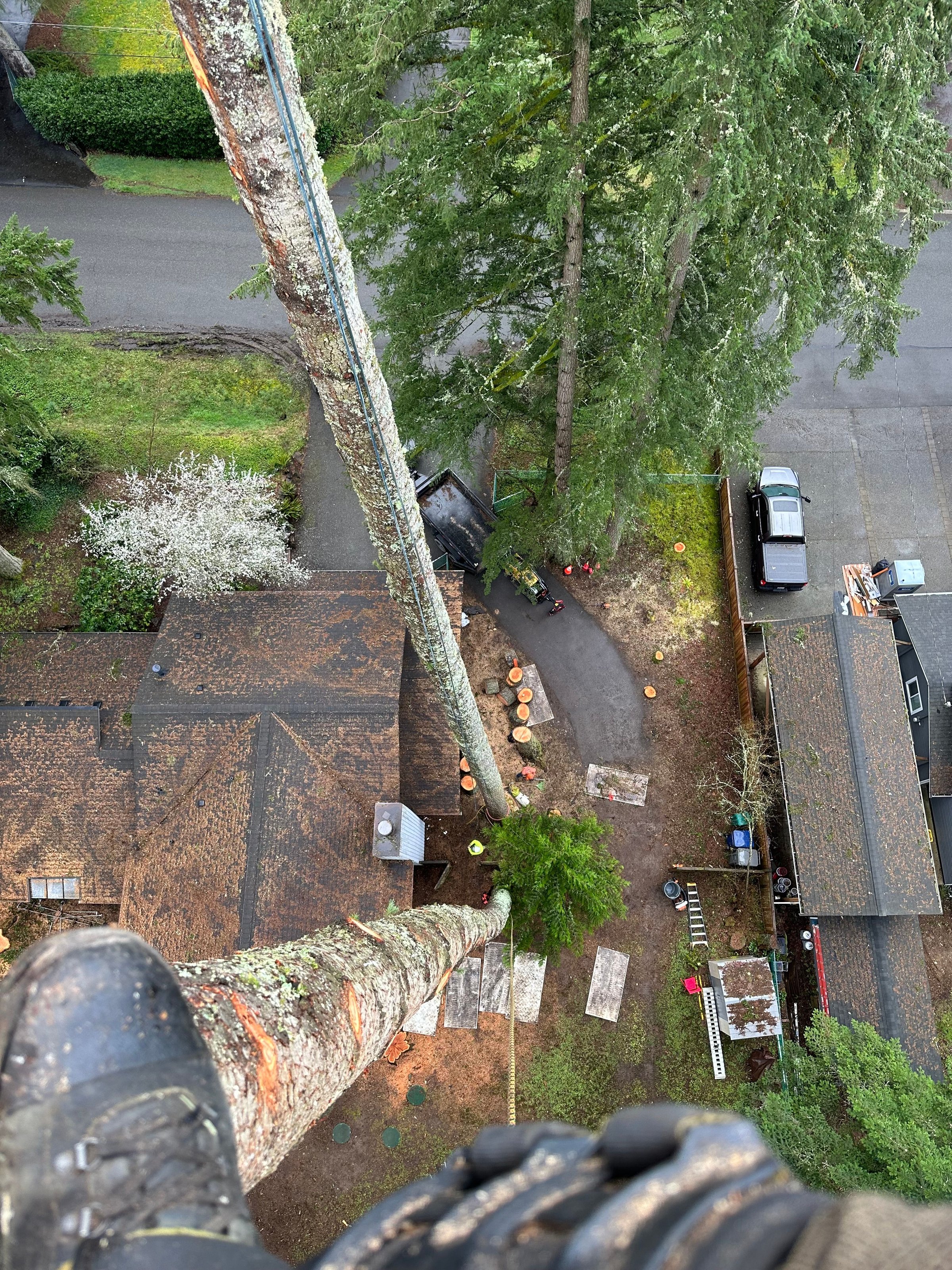
- Permitted Removal Execution: Once your permit is approved, we schedule the removal. On Shoreline's typically 7,500 to 10,000 square foot lots, most trees require sectional rigging because there is insufficient open space for felling. We work within the permit conditions, including protecting any trees required to be retained, and managing noise within Shoreline's allowed work hours of 7 AM to 9 PM on weekdays.
- Replacement Planting Coordination: We help you understand the replacement planting requirements specified in your permit and can coordinate with local nurseries for appropriate species. The city inspects replacement plantings, so they need to meet the specified size, species, and location requirements.
Shoreline Tree Permit Questions
- Do I need a permit to trim a tree in Shoreline?
- Standard pruning — removing up to 25 percent of a tree's canopy for crown cleaning, deadwood removal, or clearance — does not require a permit in Shoreline. However, heavy crown reduction that removes more than 25 percent of the canopy, or topping, can trigger code enforcement action because it may be classified as tree damage rather than maintenance. If you are trimming rather than removing, standard professional pruning is generally exempt.
- What if a tree is damaging my foundation in Shoreline?
- Root intrusion causing structural damage to a foundation, sewer lateral, or retaining wall can qualify as a hazard condition supporting a removal permit. You will need documentation of the damage — a foundation contractor's assessment or a plumber's camera inspection of the sewer line is typically sufficient evidence. The city evaluates whether root barrier installation or root pruning could address the problem without removing the tree before approving full removal.
- Can my Shoreline HOA override the city's tree code?
- No. Shoreline's municipal tree code supersedes HOA rules. An HOA cannot authorize removal of a tree that requires a city permit, and conversely, an HOA cannot prevent removal of a tree that the city has permitted for removal. Neighborhoods like Innis Arden, Hillwood, and Richmond Highlands have active community associations, but tree removal authority rests with the city. If your HOA requires tree maintenance, ensure the proposed work complies with city regulations.
- What happens if a storm knocks down a tree in Shoreline — do I still need a permit?
- A tree that has already fallen is no longer standing, so it does not require a removal permit. You can cut it up and remove it from your property. However, if a storm damages a tree that is still standing but now leans dangerously, the city's emergency provisions allow expedited removal — but you should notify the city and document the hazard condition with photos before and during the work. We handle emergency storm response in Shoreline and manage the documentation process.
- How does Shoreline's tree code compare to Seattle's regulations just south of 145th Street?
- Shoreline's code is similar in structure to Seattle's tree protection ordinance but applies to a different city context. Seattle requires permits for exceptional trees (those over 24 inches DBH in most cases) and has heritage tree protections. Shoreline's significant tree threshold starts at 6 inches DBH — lower than Seattle's general trigger — making Shoreline's reach broader for routine tree work. The replacement planting ratios and fee-in-lieu provisions also differ between the two cities. Homeowners near the 145th Street border sometimes assume Seattle rules apply in Shoreline or vice versa — they do not. Each city administers its own code independently.
- Can I top my tree instead of removing it in Shoreline?
- Topping — cutting the main leader and upper canopy to reduce height — is strongly discouraged by arborists and can actually trigger Shoreline's code enforcement. The city considers topping a form of tree damage rather than maintenance because it destroys the tree's natural structure, creates weak regrowth that is more hazardous than the original canopy, and often kills the tree over time. Crown reduction — a different technique that shortens the tree by cutting back to lateral branches at natural junctions — is an accepted alternative that reduces height while maintaining tree health. We never top trees and instead use reduction cuts when homeowners need height management.
- What are the most common tree removal reasons approved by Shoreline?
- Based on our experience working in Shoreline's Innis Arden, Ridgecrest, and Meridian Park neighborhoods, the most commonly approved removal reasons are: hazardous condition documented by an arborist (leaning trunk, root plate failure, advanced decay), construction conflict with a building permit where the tree cannot be retained within the building envelope, root damage to foundations or sewer laterals confirmed by a contractor, and dead or dying trees that no longer provide canopy value. View enhancement alone is rarely sufficient for exceptional tree removal, though the city may approve removal of significant trees for view improvement with adequate replacement planting commitments.
Need to Remove a Tree in Shoreline?
K&J Tree Works helps Shoreline homeowners understand and navigate the city's tree code. We provide thorough on-site assessments with documentation that supports your permit application. Call (425) 223-7904 or request an estimate online. Monday through Saturday, 8 AM to 5 PM.