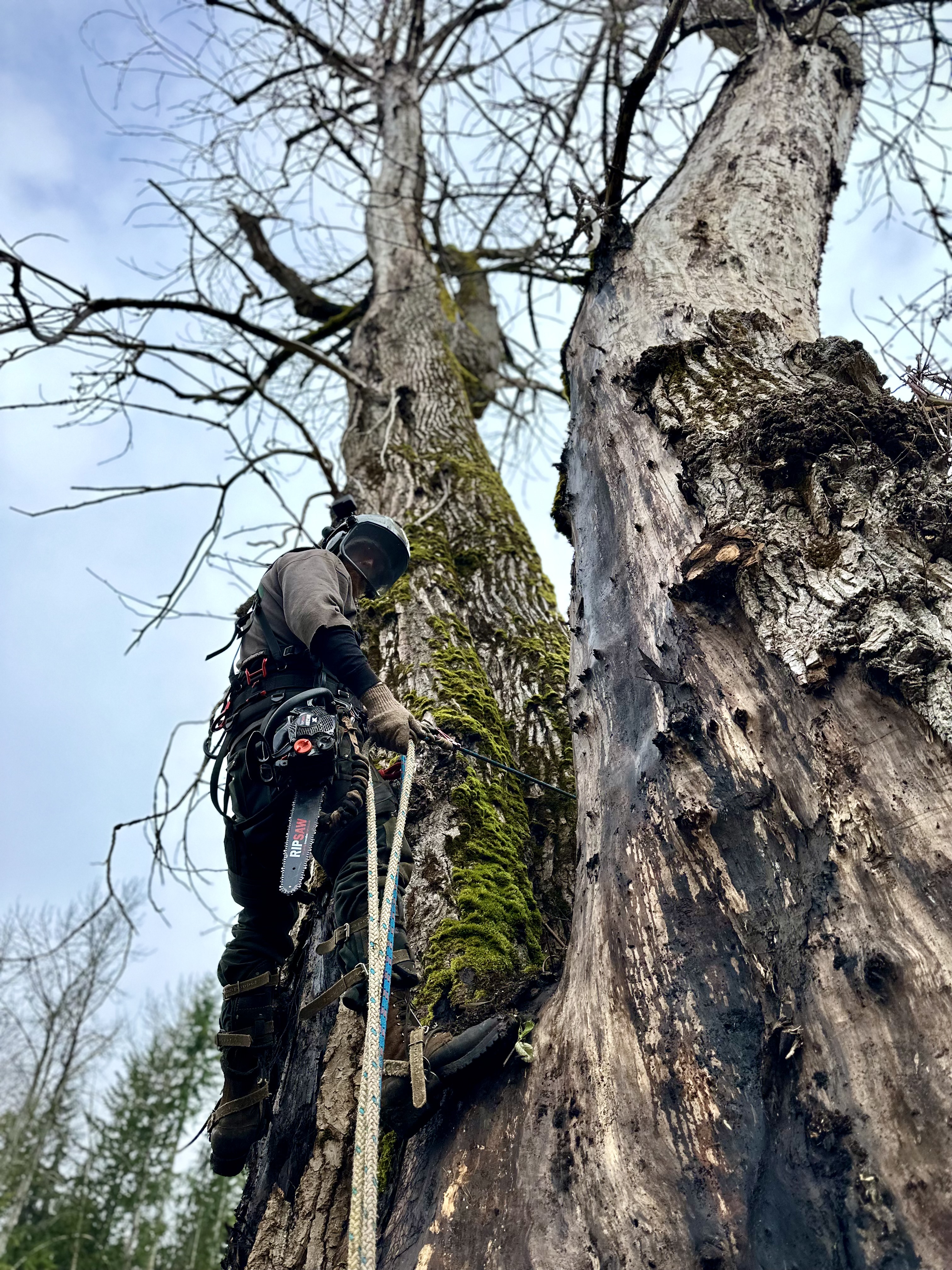
How to Choose a Tree Service Company in Washington State
Snohomish County, WA — April 7, 2026
A practical guide for Washington State homeowners on how to evaluate tree service companies — covering license verification, insurance requirements, quote red flags, equipment expectations, and the questions that separate reliable crews from risky ones.
Why Choosing the Right Tree Service Matters More Than You Think
Tree work is inherently dangerous — heavy wood, heights, chainsaws, and proximity to homes and power lines create real risk on every job. When a qualified crew handles the work, these risks are managed through training, proper equipment, and experience. When an unqualified crew shows up, the homeowner bears the consequences: property damage, injuries on your land with no workers' comp coverage, incomplete work, and cleanup problems that cost more to fix than the original job. In Washington State, the difference between a legitimate tree service and a fly-by-night operation comes down to a few verifiable credentials. This guide shows you exactly what to check, what questions to ask, and what red flags to watch for — so you can hire with confidence whether you are in Sultan, Shoreline, or anywhere in between.
- How to verify a Washington State contractor license in 60 seconds
- Insurance requirements that protect you from liability
- 5 red flags that signal an unreliable tree service
- Questions to ask during your free estimate
- Why the cheapest quote often costs more in the long run
How to Verify a Tree Service Company's Credentials in Washington
Washington State has clear requirements for tree service contractors. Every company that performs tree work for hire must meet these minimum standards — and you can verify each one online before scheduling any work:
- Active L&I Contractor License: Washington's Department of Labor & Industries (L&I) requires all contractors performing tree work to hold a valid, active contractor registration. You can look up any company at lni.wa.gov/verify using their license number or business name. The listing shows registration status, bond information, and any violations. For example, K&J Tree Works holds license KJTREJT792QS — you can verify that registration is active and in good standing in under a minute.
- General Liability Insurance: A legitimate tree service carries general liability insurance that covers damage to your property during the job — if a tree section hits your fence, a limb drops on your roof, or equipment damages your driveway. Ask for a certificate of insurance (COI) and verify the policy is current. A company that hesitates to provide proof of insurance is not worth the risk.
- Workers' Compensation Coverage: This is the one homeowners most often overlook — and it is the most important. If a tree worker is injured on your property and the company does not carry workers' comp, you can be held liable for medical expenses and lost wages. Washington State requires workers' comp coverage for all employees. Verify this through the L&I contractor lookup.
- Surety Bond: Washington requires contractors to carry a surety bond as part of their registration. The bond provides a financial guarantee that the contractor will fulfill their obligations. While the bond amount is modest, its presence confirms the company has gone through the proper registration process.
5 Red Flags That Signal an Unreliable Tree Service
After years of hearing from homeowners who had bad experiences with other companies, these are the warning signs that consistently indicate a tree service you should avoid:
- Door-to-Door Solicitation After a Storm: Legitimate tree companies are busy after storms — they are responding to existing customers and emergency calls, not knocking on doors. Storm chasers target neighborhoods with visible damage, offer low prices, do rushed or incomplete work, and move on before you realize what went wrong. They often lack local licenses and disappear when problems surface.
- No Written Estimate: A verbal quote with a handshake is not a contract. Any reputable tree service provides a written estimate that describes the specific work, the trees involved, what happens to the wood and debris, the total price, and the payment terms. If someone cannot put it in writing, they are not accountable to a defined scope of work.
- Requesting a Large Upfront Deposit: Standard practice in the tree industry is payment upon completion — or for larger jobs, a small deposit (10 to 20 percent) with the balance due when the work is done. A company asking for 50 percent or more upfront, especially if they are unfamiliar to you, is a significant risk. You lose your leverage to ensure the work is completed properly.
- Topping Trees as a Standard Practice: Tree topping — cutting the main trunk and leaders to stubs — is universally condemned by arborists and the International Society of Arboriculture (ISA). It weakens trees, creates hazardous regrowth, and shortens the tree's life. A company that recommends topping as routine practice lacks basic arboricultural knowledge. Proper crown reduction uses targeted cuts at branch junctions.
- No Proof of Insurance When Asked: If you ask for proof of insurance and get excuses, delays, or vague assurances, walk away. A properly insured company can produce a certificate of insurance within a day. The small inconvenience of asking protects you from potentially catastrophic liability.
Questions to Ask During Your Free Estimate
A free on-site estimate is your opportunity to evaluate the company face-to-face. The way they answer these questions tells you as much as their credentials:
- How will you access the tree?: A knowledgeable crew leader will explain whether they will climb the tree, use a bucket truck, or work from the ground — and why. They should point out specific challenges like proximity to power lines, overhead utility clearance, or slope conditions. If they cannot explain their approach for your specific tree, they have not thought it through.
- What equipment will you bring?: For Pacific Northwest tree work, you should expect professional-grade chainsaws, a wood chipper, rigging ropes and hardware, personal protective equipment (PPE) including hard hats and chaps, and potentially a crane for large removals in tight spaces. Ask about the equipment — a serious company invests in the right tools.
- What happens to the wood and debris?: A clear answer here shows the company has a complete plan. Will branches be chipped? Will trunk wood be bucked into firewood rounds or hauled away? Will they clean up the work area and blow off hard surfaces? The scope of cleanup should be spelled out in the written estimate.
- Who will be on the crew?: Owner-operated companies often provide more consistent quality because the person giving your estimate is the same person leading the crew. Ask whether the estimator will be present on job day. Larger companies may send a salesperson for the estimate and a separate crew for the work — which can lead to miscommunication about the scope.
- Can you provide references or show past work?: An established company should have a portfolio of completed work, customer reviews on Google or other platforms, and willingness to connect you with past customers. Check their Google Business profile, read the reviews, and look at photos of actual jobs — not stock images.
Why the Lowest Bid Is Often the Most Expensive Choice
Price matters — but the cheapest tree service quote frequently leads to higher total costs. Here is why the lowest bid deserves extra scrutiny:
- Corners Get Cut on Safety: Proper tree work requires time — setting up rigging, making controlled cuts, lowering sections carefully near structures. A lowball quote often means the crew will rush, skip rigging, and take chances that put your property at risk. A crushed fence, damaged roof, or rutted lawn costs far more than the price difference between quotes.
- Cleanup Gets Skipped or Shortchanged: One of the most common complaints about cheap tree services is incomplete cleanup — chips left scattered, ruts in the lawn, sawdust on the roof, small branches missed throughout the yard. A thorough cleanup takes time and labor that budget operators do not build into their pricing.
- No Insurance Means You Pay for Accidents: Companies that skip insurance can offer lower prices because they are not carrying the overhead of premiums. But when a worker gets hurt on your property or a tree section damages your neighbor's car, that savings evaporates instantly. The cheapest quote may not include the cost of doing business legally.
- The Price May Not Include Everything: A vague low quote often excludes items a complete quote includes: hauling away wood, chipping branches, final cleanup, or addressing secondary trees affected by the removal. Compare quotes line by line. If one quote is significantly cheaper, ask what it does not include.
Your Step-by-Step Hiring Checklist
Follow this process before signing with any tree service company to protect yourself and your property:
- Look Up Their L&I Contractor License: Go to lni.wa.gov/verify and search the company name or license number. Confirm the registration is active with no unresolved violations. This single step eliminates most unqualified operators.
- Request Proof of Insurance: Ask for a certificate of insurance showing current general liability and workers' compensation coverage. A reliable company produces this within a day. If they stall or make excuses, move on.
- Get a Written Estimate: Schedule an on-site visit. The estimate should describe each tree to be worked on, the specific work planned, what happens to wood and debris, the total price, and payment terms. Compare estimates side by side across 2 to 3 companies.
- Check Reviews and Past Work: Look at their Google Business profile, read recent reviews, and ask to see photos of completed jobs. Consistent positive feedback from local homeowners is the strongest signal of reliability.
- Ask Your Questions Face-to-Face: During the on-site estimate, ask how they will access the tree, what equipment they will bring, and who will be leading the crew. Their answers — and their willingness to answer — tell you everything about how the job will go.
- Confirm Scope and Schedule: Before signing, confirm the start date, expected duration, cleanup scope, and payment terms in writing. A clear scope prevents misunderstandings and gives you recourse if the work is not completed as agreed.
Questions About Choosing a Tree Service
- How do I check if a tree service is licensed in Washington State?
- Visit lni.wa.gov/verify and search by the company's contractor license number or business name. The database shows current registration status, bond information, insurance status, and any infractions or violations. This takes less than a minute and is the single most important step you can take before hiring.
- Should I get multiple estimates for tree work?
- Yes — getting 2 to 3 estimates is good practice. It gives you a range of pricing, lets you compare approaches, and helps you evaluate each company's professionalism during the estimate visit. Be wary of any estimate that is dramatically lower than the others, and focus on the scope of work described, not just the bottom-line number.
- What is the difference between an arborist and a tree service?
- An arborist is a tree care professional, often certified by the International Society of Arboriculture (ISA). A tree service is a business that performs tree work. Not all tree service companies employ certified arborists, and not all arborists run tree service businesses. For most residential tree work — removal, trimming, and cleanup — an experienced, licensed, and insured tree service crew with hands-on knowledge of Pacific Northwest species is what you need.
- Do I need a written contract for tree work?
- Yes. A written estimate or contract protects both you and the company. It should specify the trees to be worked on, the type of work (removal, trimming, etc.), what happens to the wood and debris, the total price, payment terms, and the expected timeline. Verbal agreements leave too much room for misunderstanding.
- Is it worth paying more for an owner-operated tree service?
- In many cases, yes. Owner-operated companies typically provide more consistent quality because the owner's reputation is directly tied to every job. The person who walks your property and gives the estimate is the same person leading the crew — which eliminates the miscommunication that can happen when a salesperson hands off to a separate work crew. K&J Tree Works is owner-operated for exactly this reason.
Ready to Get a Trustworthy Tree Service Estimate?
K&J Tree Works is a licensed (KJTREJT792QS), fully insured, owner-operated tree service serving Snohomish and King County. We provide free, no-obligation on-site estimates with a written scope of work. The person who walks your property is the same person leading the crew on job day. Call (425) 223-7904 or request an estimate online. Monday through Saturday, 8 AM to 5 PM.