Tree Service & Removal Granite Falls, WA
K&J Tree Works serves Granite Falls, the gateway to the Mountain Loop Highway and the Cascade foothills. Properties here are surrounded by towering evergreens—Western Red Cedars, Douglas Firs, and Hemlocks that require experienced care.
Whether you need hazard tree removal, wildfire defensible space creation, or routine maintenance, our team understands the unique needs of Granite Falls' mountain-adjacent properties.
We handle tree work along the Mountain Loop Highway corridor, the Robe Valley, Pioneer Street area, and the rural parcels off Menzel Lake Road and Jordan Road where dense timber and steep terrain are the norm.
Granite Falls Tree Service at a Glance
- County: Snohomish County
- Elevation: 300–400 ft (Cascade foothills)
- Common Trees: Douglas Fir, Western Hemlock, Western Red Cedar
- Terrain: Dense foothill stands with clay and gravelly soils
- Distance from Sultan: ~20 miles from Sultan
- Permit Authority: Check with City of Granite Falls
- Services: Tree removal, trimming & pruning, emergency tree service, land clearing, wood & debris removal, hazard tree assessment
- Contractor: WA L&I #KJTREJT792QS — bonded and insured
- Hours: Monday–Saturday, 8am–5pm
- Estimates: Free on-site estimates — call (425) 223-7904
What Tree Challenges Do Granite Falls Properties Face?
Granite Falls sits in the Cascade foothills at 300 to 400 feet elevation, where the Pilchuck River and South Fork Stillaguamish River converge near town. Soils shift from gravelly sandy deposits along the rivers to clay-rich material on the surrounding hillsides, creating uneven drainage that stresses root systems differently across a single property. Along the Mountain Loop Highway and toward Iron Mountain, dense stands of Douglas Fir and Western Hemlock grow rapidly in the wet climate, producing tall, closely spaced trees that become top-heavy. Clay hillside soils become slick during heavy rains, reducing root grip and increasing the risk of whole-tree blowdown during Pacific storm events.
When a storm brings down a tree or leaves one leaning against a home, fence, or power line, our emergency tree service responds quickly across Granite Falls and the surrounding area.
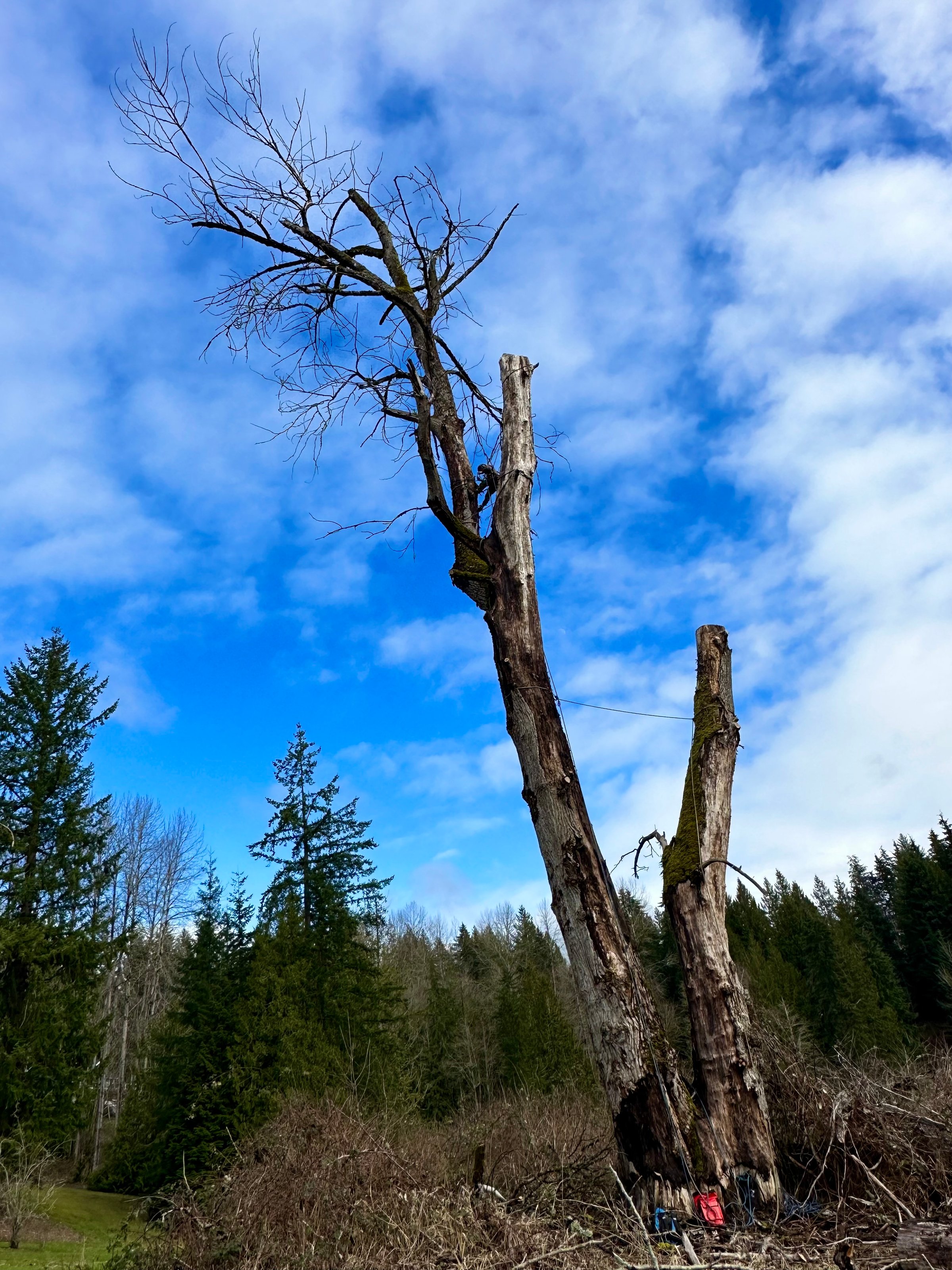
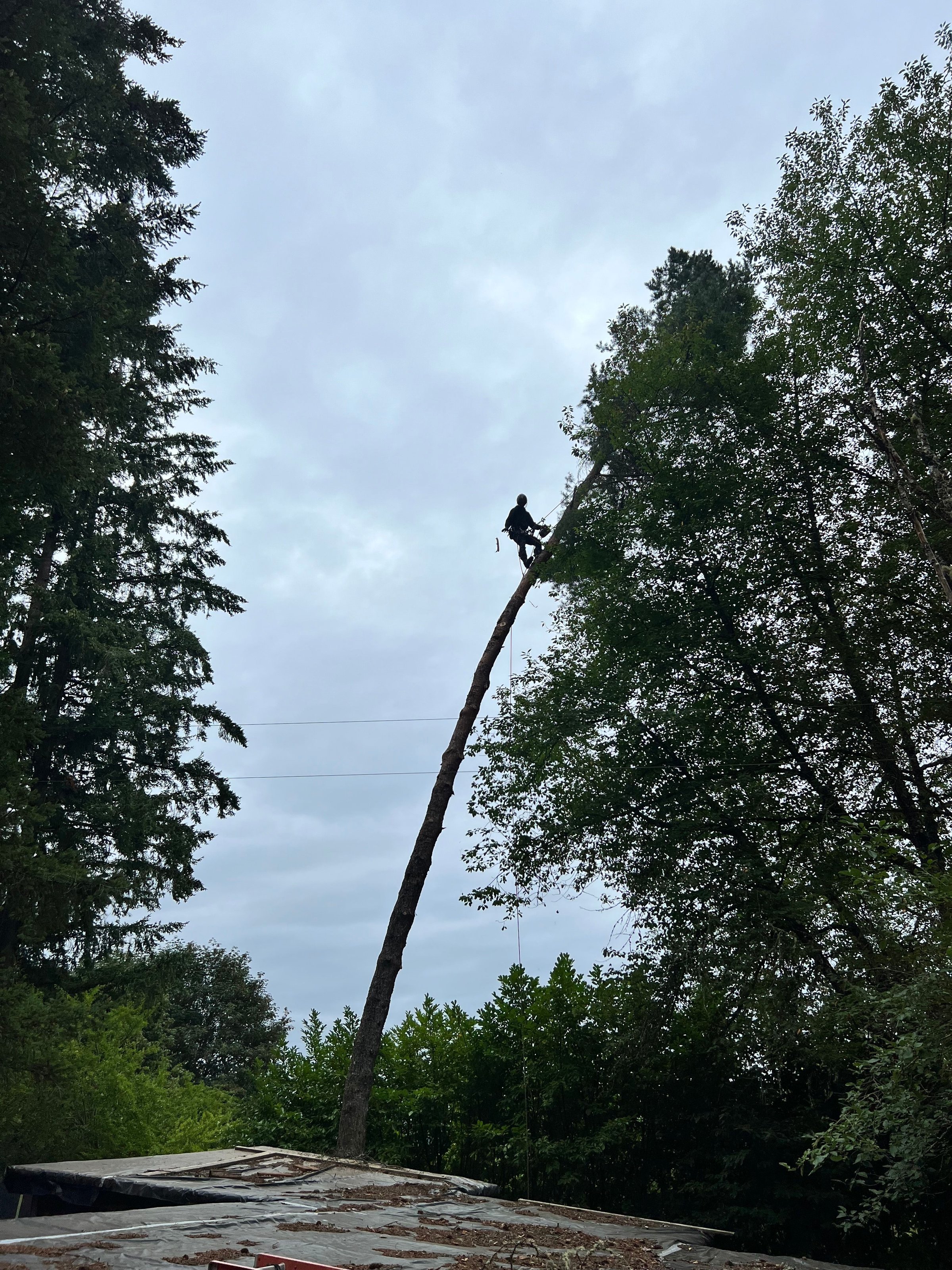
Browse our project photo gallery to see examples of tree work we've completed in Granite Falls and surrounding areas.
Tree Services for Granite Falls Properties
Tree Removal in Granite Falls
Professional removal of tall conifers and hardwoods common to the Granite Falls area. We handle the challenging terrain of foothill properties.
Forest Management
Many Granite Falls properties border forest land. We help manage the boundary between your yard and the wild woods.
Storm & Wind Damage
Granite Falls' mountain location means exposure to strong winds. We respond quickly to storm damage and windfall.
Why Choose K&J Tree Works for Tree Service in Granite Falls?
K&J Tree Works has assessed and removed hazard trees on properties throughout Granite Falls, from the neighborhoods along Mountain Loop Highway to the hillside lots near the Pilchuck River where shallow soils over bedrock create persistent wind-throw risk. We understand how this mountain-lowland transition zone concentrates both snow loading and valley-channeled winds.
- Experienced with Cascade foothill terrain at 300-to-400-foot elevation
- Clay and gravelly soil assessment along the Pilchuck River and South Fork Stillaguamish
- Sequenced removal expertise for dense, closely spaced stands near the Mountain Loop
- Wildfire defensible space creation for properties backed up to forest
- Fully licensed, bonded, and insured
- Free estimates for Granite Falls properties
How Does Tree Service Work in Granite Falls?
- Contact Us: Call (425) 223-7904 or request a free estimate online for your Granite Falls property
- Free On-Site Assessment: We travel to your Granite Falls property to assess trees in the Cascade foothills and plan equipment access
- Professional Tree Work: Our crew brings specialized rigging for Granite Falls' large conifers growing in gravelly river soils and clay-rich hillsides
- Complete Cleanup: We leave your property clean — all wood, brush, and debris removed or chipped on-site. In Granite Falls, our crews stage material carefully on properties near the Mountain Loop Highway where road shoulder space is limited and haul distances to disposal facilities are longer
Common Tree Species in Granite Falls
- Douglas Fir (Pseudotsuga menziesii)
- Rain-on-snow loading at Granite Falls' 350-foot elevation causes branch and stem failures that lowland communities do not experience
- Western Hemlock (Tsuga heterophylla)
- Extremely shallow root systems on thin soils over bedrock on the east side of town produce the highest windthrow rate in the area
- Western Red Cedar (Thuja plicata)
- Heart rot in older specimens creates hollow trunks that split during the valley-channeled winds funneled through the Pilchuck River corridor
- Red Alder (Alnus rubra)
- Aging alders on steep slopes above the South Fork Stillaguamish fail in groups as interconnected root systems decay simultaneously
Do You Need a Tree Removal Permit in Granite Falls?
Granite Falls regulates trees through its development code rather than a standalone yard-tree permit. GFMC Chapter 19.06 applies its tree standards to site-plan or architectural-design review, duplex or multifamily construction, new subdivisions or manufactured/mobile-home parks, and commercial or industrial construction or expansion. In those categories, "significant trees" are evergreen or deciduous trees ten inches or more in diameter at four and a half feet, excluding alders and cottonwoods; the city may require a certified arborist's evaluation. The city has also assumed jurisdiction over Class IV forest practices from the state.
You can read the development standards in the official Granite Falls Municipal Code, Chapter 19.06 (Development Standards). Chapter 19.06 does not by itself show that every ordinary yard-tree removal is covered. Whether a specific removal needs city review depends on the applicable development category, critical areas, native growth protection tracts, and plat conditions, so check with Granite Falls' planning department.
If a tree is touching or leaning into a power line anywhere in Granite Falls, call the electric utility before anyone else — Granite Falls is served by Snohomish County PUD. Never trim or cut within 10 feet of a power line yourself. Stay clear and contact PUD so it can determine whether the vegetation is within its maintenance scope; vegetation around service lines and standalone communication lines is excluded.
Frequently Asked Questions About Tree Service in Granite Falls
- What affects cost for tree removal in Granite Falls, WA?
- Tree removal costs in Granite Falls are driven by the Cascade foothill terrain at 300 to 400 feet elevation, where dense stands of closely spaced Douglas Fir and Western Hemlock grow in mixed gravelly and clay soils.. Clay hillside soils — clay-rich material on surrounding hillsides becomes slick during heavy rains, reducing root grip and requiring ground-stabilization measures during removal. Gravelly river soils — properties along the Pilchuck River and South Fork Stillaguamish sit on gravelly sandy deposits with uneven drainage that stresses root systems differently across a single lot. Dense, tall stands — rapid growth in the wet climate produces closely spaced, top-heavy trees along the Mountain Loop Highway and toward Iron Mountain that require sequenced removal. Pacific storm exposure — the foothill position channels storms through the valley, increasing blowdown risk for trees already weakened by clay-soil slippage. Free on-site estimates — we assess your Granite Falls property's soil type, slope conditions, and stand density before quoting
- What makes tree removal in Granite Falls unique?
- Dense forest surrounds most Granite Falls properties, meaning trees are often very tall and closely spaced from decades of growth in the wet foothill climate — removal of one tree requires planning around its neighbors to avoid domino effects. The Mountain Loop Highway corridor and surrounding terrain create access challenges that suburban tree services rarely encounter — properties at higher elevations toward Iron Mountain may require extended travel and specialized equipment staging. Granite Falls sits on a transition zone between lowland second-growth and Cascade foothill old-growth, producing some of the tallest trees in residential settings anywhere in Snohomish County. Clay-rich soils on surrounding hillsides become unstable during heavy rains, and tree removal on slopes requires ground-stabilization measures to prevent erosion and soil movement after the root system is no longer holding the hillside in place
- Do you offer fire mitigation services in Granite Falls?
- Yes, defensible space creation is increasingly important in Granite Falls as the foothill community sits at the interface between developed residential areas and dense Cascade forest. We thin overgrown vegetation, remove ladder fuels — the brush, small trees, and low branches that carry fire from the ground into the canopy — and create clearance zones around structures that meet Firewise USA defensible space guidelines. Strategic removal of closely spaced conifers reduces crown-fire risk by increasing the distance between tree canopies, slowing fire spread and giving firefighters a better chance of protecting structures. We follow current fire mitigation best practices including maintaining 30 feet of reduced-fuel space immediately around buildings and thinning stands to recommended spacing out to 100 feet where property boundaries allow
- Can you handle emergency tree removal after storms in Granite Falls?
- Yes, emergency tree service is available for Granite Falls and surrounding foothill areas — the Mountain Loop Highway corridor and Pilchuck River drainage channel storms that produce significant tree damage. We clear fallen trees from homes, driveways, access roads, and power lines, prioritizing life-safety situations and blocked roadways before moving to secondary cleanup of property damage. Storm damage assessment and insurance documentation are provided with every emergency response — including photos, species identification, trunk diameter measurements, and a written damage report for your insurance carrier. Remote foothill locations may have longer initial response times during major regional storms, but we prioritize Granite Falls calls and plan equipment routing to reach mountain properties efficiently
- What tree species are most problematic in Granite Falls?
- Western hemlock is the most frequently toppled species in Granite Falls because its shallow root system cannot anchor in thin soils over bedrock on the east side of town. Douglas fir handles Granite Falls' conditions better than hemlock but suffers branch and stem failures under rain-on-snow loading events unique to this mountain-lowland elevation. Red alder colonizes disturbed slopes aggressively but decays from within after 40 years, creating hazard trees on steep terrain above homes and roads
- How does Granite Falls' elevation affect tree risk compared to lowland cities?
- At 350 feet elevation, Granite Falls sits in a transition zone receiving both lowland rain and mountain-level snow, creating loading combinations that purely lowland communities do not experience. Rain-on-snow events are 3 to 5 times more common in Granite Falls than in sea-level communities like Edmonds or Mukilteo. Valley channeling through the Pilchuck River corridor amplifies wind speeds by 15 to 25 percent compared to open terrain, increasing force on trees already stressed by snow loading
Tree Services We Offer in Granite Falls, WA
Nearby Service Areas
What Granite Falls Customers Say
Robert and crew were awesome! From the initial assessment to the completion of the work, the skill and care shown was impressive. Absolutely professional and super reasonable pricing. K&J Tree Works will be our go-to for any problem trees in the future.
We had 3 enormous cottonwood trees taken down that posed a danger to our property. The crew was prompt and efficient. We highly recommend this tree service. Thank you!
Our Tree Service Work in Granite Falls
See recent tree service projects we've completed in Granite Falls and the surrounding area.
From Our Blog
Expert tree service advice for Granite Falls and Snohomish County.
- Tree Hazards at the Mountain-Lowland Transition in Granite Falls — Granite Falls occupies the transition zone where Cascade foothill terrain meets lowland Stillaguamish valley. This elevation boundary creates tree hazards that neither mountain nor lowland communities face alone.
- How to Choose a Tree Service Company in Washington State — A practical guide for Washington State homeowners on how to evaluate tree service companies — covering license verification, insurance requirements, quote red flags, equipment expectations, and the questions that separate reliable crews from risky ones.
- Complete Homeowner's Guide to Hiring a Tree Service in Snohomish County — Everything Snohomish County homeowners need to know about tree services — from removal and trimming to emergency response and land clearing, covering Sultan, Everett, Snohomish, Monroe, and all 16 communities we serve.
Get a Free Tree Service Estimate in Granite Falls
K&J Tree Works serves Granite Falls and surrounding communities in Snohomish County, WA. Contact us for a free on-site estimate.
Request Free Estimate | (425) 223-7904
PNW storm season runs October through March — schedule your free estimate before winter weather arrives.
Meet our team | Read customer reviews | Watch our team in action