Managing Rapid-Growth Trees in Marysville's Expanding Neighborhoods
Marysville, WA — April 12, 2026
Marysville is one of the fastest-growing cities in Snohomish County, and that growth creates specific tree challenges as new construction meets established trees and former agricultural land.
How Does Marysville's Rapid Growth Create Tree Problems?
Drive through neighborhoods like Whisper Ridge, Cedarcrest, Grove, or the developments along 67th Avenue NE and 84th Street NE and you will see a pattern: rows of new homes with a few tall Douglas fir or western red cedar left standing among them. These retained trees were part of the original forest or farm hedgerow that covered the land before development. Developers kept them to satisfy tree retention requirements, provide aesthetic appeal, and create the wooded-lot feeling that buyers want. The problem is that these trees were part of an ecosystem — a dense forest or a hedgerow with windbreak neighbors — and now they stand alone or in small clusters surrounded by cleared, graded, compacted soil and new construction. Within 3 to 7 years of development, many of these retained trees begin showing stress: crown thinning, branch dieback, bark beetle activity, and root plate instability from the radically altered soil and drainage conditions around them.
- Marysville's population has nearly tripled since 2000 with extensive new development
- Construction-retained trees often decline 3-7 years after surrounding development
- Former farmland species (cottonwood, alder) colonize vacant lots and field edges aggressively
- Dense subdivision layouts create lot-edge tree disputes between neighbors
Why Do Construction-Retained Trees Decline in Marysville Developments?
The retained trees you see in Marysville's newer subdivisions face a cascade of stresses that began during construction:
- Root Zone Compaction from Heavy Equipment: Excavators, concrete trucks, and lumber delivery vehicles compact soil within the drip line of retained trees. In Marysville's silt-loam soils, a single pass of a loaded concrete truck compacts the upper 12 to 18 inches enough to reduce oxygen penetration by 50 percent. Tree roots need oxygen to function. The compaction damage is invisible at first — the tree looks fine for 2 to 4 years while it slowly exhausts stored energy reserves, then crown thinning begins.
- Grade Changes and Root Burial: Grading for new homes and streets often adds or removes soil within the root zone of retained trees. Adding as little as 4 inches of fill soil over an existing root system can suffocate feeder roots by cutting off gas exchange. Cutting grade exposes and severs roots. Both are common on Marysville development sites, and both produce delayed decline that homeowners notice years after construction ended.
- Altered Drainage Patterns: New impervious surfaces — roofs, driveways, streets — redirect rainwater away from some tree root zones and concentrate it on others. A Douglas fir that received evenly distributed rainfall across its root system for 80 years may now have half its roots in bone-dry compacted soil under a driveway and the other half drowning in concentrated runoff from the neighbor's roof. This imbalanced moisture kills roots on both sides.
- Wind Exposure After Stand Removal: A tree that grew in a forest stand of 200 trees per acre and is now standing alone after clearing has dramatically more wind exposure than it evolved to handle. Its trunk diameter, root system, and crown shape were all optimized for sheltered conditions. When the surrounding trees are removed, it is structurally inadequate for the wind loads it now faces. This is the primary reason retained trees windthrow during storms in Marysville subdivisions.
What Happens When Former Farmland Trees Meet New Homes in Marysville?
Much of Marysville's new development occurs on former dairy farms, berry fields, and pastureland where fast-growing pioneer species have colonized field edges and drainage ditches:
- Hedgerow Cottonwoods Towering Over New Homes: Farm field boundaries in Marysville were often marked by cottonwood and alder hedgerows planted 40 to 60 years ago. When subdivisions are built around these hedgerows, homeowners inherit 80-foot cottonwoods along their property lines that were appropriate at the edge of a 40-acre hay field but are overwhelming next to a residential structure. These cottonwoods drop branches in every windstorm, release cotton that coats everything in June, and have aggressive root systems that infiltrate new sewer and water connections.
- Drainage Ditch Alder Along New Streets: Agricultural drainage ditches throughout Marysville's development areas are lined with red alder that grew unchecked for decades. When new streets and homes are built adjacent to these ditches, the alder overhangs roofs, drops leaves that clog gutters, and shades yards to the point where grass will not grow. Alder along drainage infrastructure also creates maintenance conflicts — the trees are often within drainage easements where the local drainage district has clearing authority.
- Volunteer Conifers on Vacant Lots: Vacant lots and undeveloped parcels in Marysville's growth areas have been colonized by Douglas fir seedlings that are now 30 to 50 years old and 60 to 80 feet tall. When adjacent lots are developed, these volunteer conifers suddenly become someone's backyard trees. They often grow in clusters with poor form — multiple stems, tight forks, and competing leaders — because they grew in unmanaged conditions. These structural defects make them higher risk than properly spaced and maintained trees.
How Do We Handle Tree Work in Marysville's New Developments?
Working in Marysville's newer subdivisions requires specific approaches for the development context:
- Retained Tree Health Assessment: We evaluate retained trees for the specific stress indicators associated with construction damage: scattered crown dieback (not concentrated on one side), bark beetle entry holes in the lower trunk, mushroom growth at the root flare, and soil compaction within the drip line. We use soil probing to assess compaction levels and root activity depth. A retained tree that appears healthy but has severely compacted soil may be 2 to 3 years from visible decline.
- Lot-Edge Tree Evaluation: For trees on or near property lines, we determine which property the tree belongs to (trunk center defines ownership in Washington), assess whether the tree affects neighboring structures, and discuss any shared responsibility. In dense Marysville subdivisions, lot-edge tree removal often benefits both neighbors, and we work with both parties when possible.
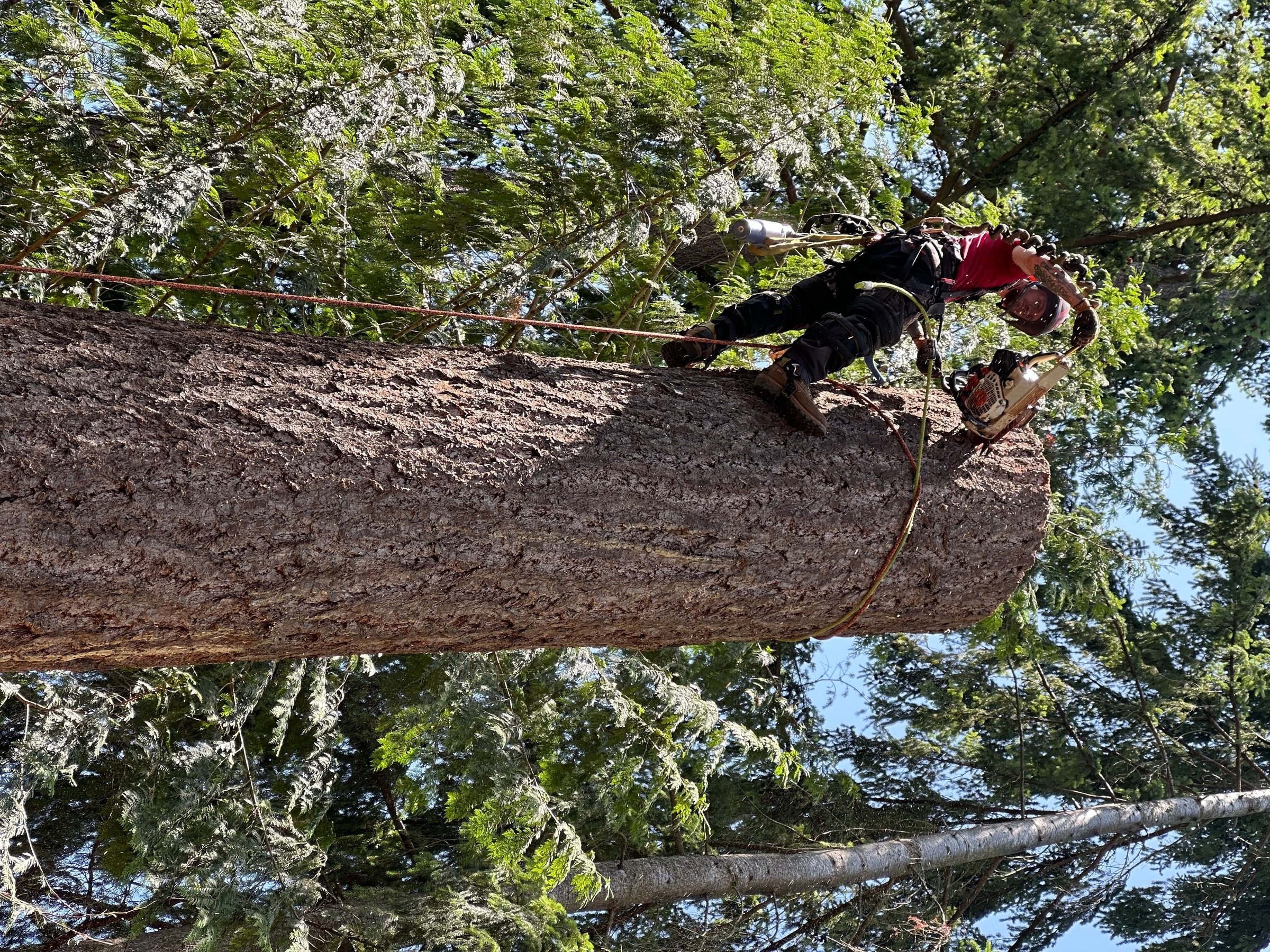
- Efficient Removal in Subdivision Settings: Marysville subdivisions typically have good street access but tight lot spacing. We park the chipper and log truck on the street and carry material from the backyard. For trees between homes, we use rigging to lower every piece rather than letting anything fall freely. The goal is zero impact on neighboring properties — no branch drops on fences, no trunk sections rolling toward foundations.
- Replacement Planting Guidance: When a retained tree fails and must be removed, we help Marysville homeowners choose replacement species that are appropriate for a residential lot rather than a forest. Trees like vine maple, Pacific dogwood, or appropriately sized ornamental conifers provide shade and character without the scale problems that come from 100-foot Douglas fir on a quarter-acre lot.
Marysville Tree Service Questions
- Why is the Douglas fir the builder left in my Marysville yard losing needles and looking thin?
- Construction-retained Douglas fir typically show decline 3 to 7 years after development. The cause is almost always root damage from soil compaction, grade changes, or altered drainage during construction. The tree lived on stored energy for several years but is now exhausting those reserves. Once crown loss exceeds 30 to 40 percent, recovery is unlikely. We can assess whether the tree has enough remaining vitality to justify preservation efforts or whether removal is the safer choice.
- My neighbor and I share a large cottonwood on the property line in our Marysville subdivision — who pays to remove it?
- Under Washington State law, a tree whose trunk straddles the property line is shared property. Both owners have rights and responsibilities. Neither owner can remove the tree unilaterally without the other's consent. In practice, we often see Marysville neighbors split the removal cost when a lot-edge tree is causing problems for both properties. We can provide a single quote and let the neighbors work out their arrangement.
- Do I need a permit to remove a tree in Marysville?
- The City of Marysville does not currently require permits for removing trees on developed residential lots outside of critical areas. However, if your property is within a mapped wetland buffer, stream corridor, or steep slope area, Snohomish County critical areas regulations may apply. Newer subdivisions often have recorded tree retention tracts or easements that restrict removal in specific areas — check your lot's plat conditions or CCRs before removing trees.
- How much does it cost to remove a retained tree from a Marysville subdivision lot?
- Most retained-tree removals in Marysville subdivisions cost $1,200 to $3,500. The trees are typically 60 to 100 feet tall Douglas fir or western red cedar in tight lot conditions requiring rigging and hand-carrying debris to the street. Larger trees over 100 feet or trees requiring crane access run $3,000 to $5,500. We provide free on-site estimates because lot conditions vary significantly even within the same subdivision.
- Should I be worried about the alder trees along the drainage ditch behind my Marysville home?
- Alder along drainage ditches is a common concern in Marysville developments. Evaluate the lean direction — if trees lean toward your home or fence, they should be assessed. Alder wood is soft and breaks unpredictably. Also check whether the trees are within a drainage easement, as the local drainage district may handle clearing within their easement boundaries. For trees outside the easement that lean toward your property, a professional assessment can determine which trees pose actual risk versus which are stable despite their proximity.
Need Tree Work in Your Marysville Neighborhood?
K&J Tree Works understands the unique tree challenges in Marysville's growing communities. We provide free on-site assessments throughout Marysville. Call (425) 223-7904 or request an estimate online. Monday through Saturday, 8 AM to 5 PM.