Urban Canopy Care in Everett's Established Neighborhoods
Everett, WA — April 14, 2026
Everett's established neighborhoods have some of the oldest and largest urban trees in Snohomish County. Managing this aging canopy requires understanding the city's tree ordinance, power line conflicts, and the unique challenges of century-old trees in dense residential settings.
What Makes Everett's Urban Tree Canopy Unique in Snohomish County?
Everett was founded in 1890 and grew rapidly as a mill town and railroad hub. By the 1920s, residential neighborhoods stretched from the waterfront bluffs to the hillsides east of Broadway. The trees in these neighborhoods — both deliberately planted street trees and retained native forest remnants — have had 80 to 130 years to mature. A drive through Rucker Avenue, Grand Avenue, or the residential streets of Pinehurst reveals the result: enormous bigleaf maples with 70-foot canopy spreads arching over streets, Douglas fir towering 120 feet above single-story bungalows, and western red cedars with trunk diameters exceeding 4 feet. This mature canopy provides significant benefits — shade, stormwater management, property values, and neighborhood character. But it also creates an ongoing management burden. Every year, Everett homeowners deal with roots cracking foundations and heaving sidewalks, branches interfering with power lines, falling limbs during storms, and the increasing likelihood that trees planted a century ago are developing the internal decay and structural weaknesses that come with age.
- Everett has the largest and oldest urban tree canopy in Snohomish County
- Neighborhoods like Pinehurst, Riverside, and Boulevard Bluffs have trees 80-130+ years old
- Aging trees create infrastructure conflicts with sidewalks, power lines, and foundations
- Everett's Municipal Code Chapter 19.28 regulates significant tree removal on developed lots
What Problems Do Aging Urban Trees Cause in Everett Neighborhoods?
The challenges of managing century-old trees in dense residential settings are different from managing younger trees in open areas:
- Sidewalk and Driveway Root Damage: Bigleaf maple and Douglas fir have aggressive surface root systems that heave concrete sidewalks, crack asphalt driveways, and invade sewer lines. In neighborhoods like Pinehurst and Riverside, entire blocks have buckled sidewalks from tree roots. The City of Everett's sidewalk program addresses some of these conflicts, but homeowners are often responsible for root damage on their own property. Root pruning can provide temporary relief, but the roots regrow — and aggressive pruning on one side of a mature tree can destabilize it.
- Power Line Conflicts and Clearance Issues: Everett's older neighborhoods have overhead power distribution on wooden poles along streets and alleys. Mature trees growing into or near these lines create fire risk, outage risk, and safety hazards. Snohomish County PUD maintains clearance along its transmission lines, but distribution lines often run through tree canopies that have been growing for decades. Homeowners are typically responsible for tree clearance on their side of the service line. Regular trimming on a 3 to 5 year cycle is necessary to maintain safe clearance, and the asymmetric cuts required for line clearance can compromise tree structure over time.
- Internal Decay in Mature Trunks: Trees over 80 years old frequently develop heart rot — internal decay of the central trunk wood. The tree can look healthy from the outside with a full green canopy while the interior trunk is hollow or spongy. Heart rot is especially common in bigleaf maple, where carpenter ants and moisture exploit pruning wounds and branch stubs to enter the heartwood. A maple with a 4-foot trunk diameter may have only 4 to 6 inches of sound wood remaining as a shell around a decayed core. These trees can fail catastrophically in storms without any prior visible warning signs.
- Bluff-Edge Tree Instability: Everett's Boulevard Bluffs, Grand Avenue, and North Everett waterfront neighborhoods sit atop unstable glacial bluffs overlooking Port Gardner Bay and the Snohomish River. Trees on these bluffs face soil erosion at the edge, progressive lean as the bluff retreats, and root exposure from wave action and rainfall erosion. Bluff-edge trees that were 30 feet from the edge when planted may now be 5 feet from a 60-foot drop. These situations require careful assessment because removing a bluff-edge tree can sometimes accelerate erosion by removing root stabilization.
How Does Everett's Tree Preservation Code Affect Homeowners?
The City of Everett regulates tree removal through its Municipal Code, and understanding these requirements is essential before planning any significant tree work:
- Significant Tree Thresholds: Everett's code defines significant trees as those with trunk diameters of 6 inches or greater measured at 4.5 feet above grade (diameter at breast height, or DBH). Removing significant trees on developed residential lots may require a tree removal permit depending on the number of trees and the zoning classification of the property. Single-tree removal for hazard mitigation is generally straightforward, but removing multiple significant trees for view enhancement or landscaping purposes may require replacement planting.
- Hazard Tree Exemptions: Trees that pose an imminent hazard to life or property can be removed under an emergency exemption without the standard permit process. A written assessment from a qualified tree professional documenting the hazard is required. We provide hazard documentation that meets the city's requirements for every emergency removal we perform in Everett.
- Replacement Planting Requirements: When tree removal permits are required, Everett may condition the permit on planting replacement trees. The replacement ratio and species requirements vary by zone and situation. We help Everett homeowners understand what replacement obligations may apply before they commit to removal, so there are no surprises after the work is done.
- Critical Areas Overlay: Properties near streams, wetlands, steep slopes, or the Everett waterfront bluffs may fall under additional critical areas regulations that restrict tree removal beyond the standard municipal code provisions. The Lowell neighborhood near the Snohomish River, areas near Pigeon Creek, and bluff-top properties are commonly affected. We verify critical areas status as part of our pre-work assessment for Everett properties.
How Do We Handle Urban Tree Work in Everett?
Working on mature trees in Everett's dense residential neighborhoods requires city-specific approaches:
- Permit and Code Review: Before quoting the work, we assess whether the tree removal requires an Everett tree removal permit based on size, species, and zoning. We explain the requirements and any potential replacement planting obligations so the homeowner can make an informed decision. We do not pull permits on the homeowner's behalf, but we provide the tree information the city needs.
- Utility Coordination: For trees near power lines, we coordinate with Snohomish County PUD for line clearance or de-energization. In Everett's older neighborhoods, this is a frequent requirement because the trees and the lines have been growing closer together for decades. PUD coordination can add 1 to 2 weeks to the project timeline.
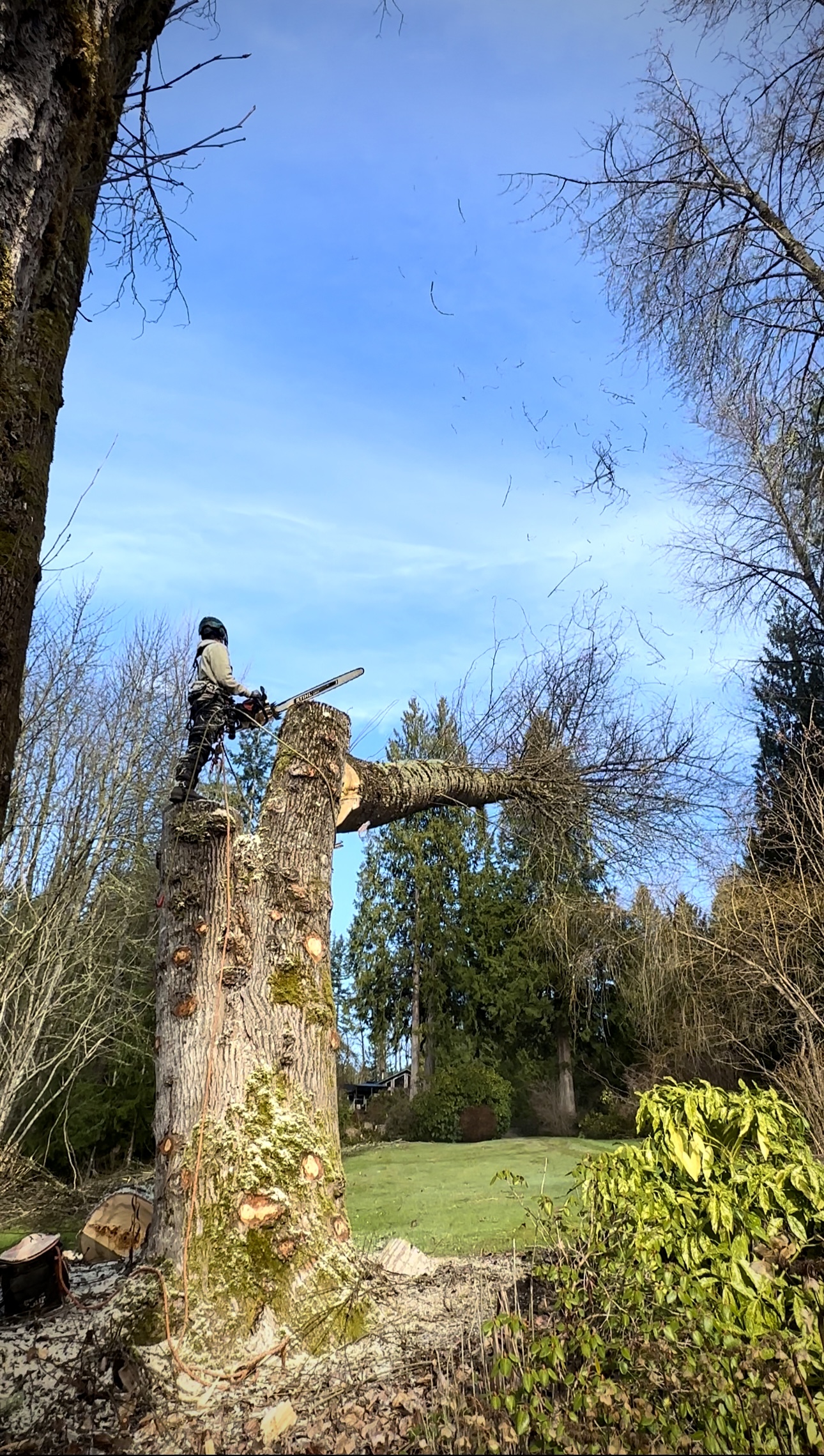
- Sectional Removal in Tight Quarters: Most large tree removals in Everett's established neighborhoods are sectional — we climb the tree and remove it in pieces from the top down, lowering each section on ropes to avoid impact on surrounding structures, fences, and landscaping. Full directional felling is rarely possible on lots where the canopy overhangs multiple neighboring properties.
- Root and Infrastructure Assessment: Before removing a tree with significant surface roots, we assess how the roots interact with nearby sidewalks, foundations, and utilities. Sometimes selective root removal after the tree is down can resolve sidewalk heaving. Other times, the root system is so integrated with the foundation that stump grinding should be limited to above-grade removal only.
Everett Tree Service Questions
- Do I need a permit to remove a tree from my Everett yard?
- It depends on the tree size and your property's zoning. Trees with trunk diameters of 6 inches or greater at breast height are classified as significant trees under Everett's code. Removing one or two significant trees on a developed residential lot for safety reasons is generally straightforward, but removing multiple trees or trees in critical areas may require a permit. We assess the permit situation as part of our free on-site estimate and explain what is required before any work begins.
- How do I know if the large maple in my Everett yard is safe?
- Bigleaf maples over 60 to 80 years old should be professionally assessed for internal decay, which is common in the species. External indicators include mushroom growth at the base, carpenter ant frass (sawdust-like debris) around trunk openings, hollow sounds when the trunk is tapped, and sections of bark that have fallen away revealing dead wood underneath. A professional assessment includes evaluating the trunk shell thickness, root stability, and overall crown vitality. We provide free on-site assessments for Everett properties.
- My tree is growing into the power lines along the alley behind my Everett house — who handles that?
- Snohomish County PUD maintains clearance along its primary distribution lines. For the service drop line from the pole to your house, you are typically responsible for maintaining clearance. Contact PUD first to determine if the conflicting branches are in their maintenance zone or yours. If you need to hire a tree service for clearance on your side, we have experience working near energized lines and coordinate with PUD when de-energization is needed for safety.
- What does tree removal cost in Everett's older neighborhoods?
- Mature tree removal in Everett's established neighborhoods typically costs $1,500 to $4,500 for trees 60 to 120 feet tall on tight residential lots. The main cost driver is access — sectional removal with rigging in tight quarters takes more time and skill than open-lot work. Trees on bluff edges, near power lines, or over structures tend toward the higher end. We provide free on-site estimates because every Everett lot has unique conditions.
- Can I remove a tree on the bluff edge in North Everett or Boulevard Bluffs?
- Bluff-edge trees are typically in critical areas and subject to Everett's critical areas regulations, which may restrict removal or require a geotechnical assessment of slope stability impacts. Even when removal is allowed, it needs careful planning because tree roots often provide the primary erosion resistance on bluff faces. We assess bluff-edge trees in consultation with the homeowner and recommend an approach that addresses the safety concern without worsening slope stability.
Need Tree Service in Everett?
K&J Tree Works handles the complex urban tree work that Everett's established neighborhoods require — from permit navigation to power line coordination to century-old tree removal in tight quarters. Free on-site estimates throughout Everett. Call (425) 223-7904 or request an estimate online. Monday through Saturday, 8 AM to 5 PM.