Tree Removal Cost in Snohomish & King County: 2026 Guide
Snohomish County, WA — March 10, 2026
A practical Snohomish and King County guide to tree removal cost factors, project scenarios, written estimates, permits, utilities, insurance questions, and deciding when removal is necessary.
How Is Tree Removal Priced in Snohomish and King County?
There is no honest flat price for tree removal across Snohomish and King County. An open-access tree with a clear drop zone is a different project from the same-size tree over a roof, behind a narrow gate, or beside energized lines. K&J Tree Works evaluates the tree, access, targets, removal method, and cleanup choices on site, then provides a written estimate. Use the scenarios and cost factors below to understand what the estimator will look for — not as a substitute for a property-specific quote.
- Four common project scenarios and why their costs differ
- Ten factors that shape a tree removal estimate
- What should be included in a written quote
- Permit, utility, and insurance questions to resolve before work
Four Tree Removal Scenarios That Price Differently
Tree height is only a starting point. These common scenarios show why two trees that look similar from the street can require very different crews, equipment, and time. Projects that remove several trees to change how a property will be used may be better scoped as whole-lot clearing and site preparation rather than pricing each tree in isolation. K&J does not assign a planning range until we have seen the property and confirmed what the quote includes.
- Open-Access Planned Removal: A clear drop zone and room for the chipper, truck, and crew can allow directional felling and efficient material handling. The estimate still depends on trunk diameter, condition, species, and whether wood and chips stay or leave.
- Sectional Removal Near a Structure: A tree over a home, garage, fence, landscaping, or neighboring property is usually dismantled in controlled sections. Rigging, target protection, and slower piece-by-piece handling add labor compared with an open drop zone.
- Difficult-Access or Slope Removal: Narrow gates, long hand-carry routes, soft ground, septic areas, and steep slopes can limit equipment access. The estimate accounts for how material will move safely from the tree to the chipper or truck and what ground protection is needed.
- Large, Damaged, or Emergency Removal: Heavy wood, decay, storm damage, broken tops, unsafe climbing conditions, or contact with a structure can change the removal method. Immediate hazards and trees near utility lines need a separate safety and coordination plan rather than a routine-price assumption.
What Actually Drives Tree Removal Cost
A useful estimate explains the work plan behind the number. These are the main factors K&J evaluates before quoting a removal:
- Height, Diameter, and Wood Volume: Height matters, but trunk diameter, canopy spread, multiple stems, and the amount of wood to process can affect labor and equipment just as much.
- Species and Tree Condition: Wood density, brittle limbs, decay, root instability, storm damage, and whether the tree can be climbed safely all influence the removal method.
- Lean and Weight Distribution: Lean, canopy imbalance, and the direction of available space determine whether the tree can be felled or must be dismantled in controlled sections.
- Targets Around the Tree: Homes, roofs, garages, fences, vehicles, landscaping, pools, septic systems, and neighboring property increase the protection and rigging required.
- Access and Ground Conditions: Gate width, slopes, long carry distances, soft soil, overhead obstructions, and room for trucks, chippers, lifts, or other equipment affect production time.
- Utilities: Overhead electrical lines and underground utilities can limit removal and stump-work options. Trees close to energized lines require coordination with the serving utility.
- Removal Method and Equipment: Open-area felling, sectional dismantling, technical rigging, lift access, and crane-assisted work involve different plans and costs.
- Wood, Chips, and Hauling: Keeping firewood rounds or chips can reduce hauling. Bucking, stacking, hauling, and disposal should be stated clearly in the estimate.
- Stump and Site Finish: K&J cuts the trunk as low as practical but does not provide stump grinding. Any specialist stump work or restoration should be treated as a separate scope.
- Permits, Documentation, and Timing: Jurisdictional review, property-specific documentation, active storm conditions, and urgent scheduling can add work that is not part of a routine planned removal.
7 Warning Signs Your Tree Is Beyond Saving
After years of assessing trees across communities from Sultan to Shoreline, these are the conditions that consistently mean removal is the right call:
- Fungal Conks at the Base: Shelf-like fungi growing from the trunk base or root flare indicate internal decay. In Douglas fir and western hemlock, this often means laminated root rot — a disease that destroys structural wood from the inside. A tree can look green and full while being hollow at the base. We see this regularly on properties in Monroe, Snohomish, and the Sultan foothills.
- Sudden Lean After a Storm: A tree that has always been straight but develops a lean after heavy rain or wind likely has root failure on one side. This is different from a tree that has grown at an angle its whole life. Sudden lean on saturated clay soils — common in Marysville, Lake Stevens, and Everett — is an emergency.
- Major Crown Dieback: When 30 percent or more of the upper canopy is dead, the tree is in serious decline. Dead branches become brittle and fall unpredictably. Large conifers with significant crown death in neighborhoods like Mill Creek, Woodinville, or Bothell pose falling-branch hazards that trimming cannot solve.
- Split or Cracked Trunk: Vertical cracks that extend deep into the trunk or a fork that is actively splitting apart compromise the tree's structural integrity. Wind loading during Pacific Northwest storms can open these cracks further without warning.
- Root Damage from Construction: Grading, trenching for utilities, or adding driveways and patios can sever major roots. Trees in newer Lake Stevens, Arlington, and Redmond developments sometimes develop decline symptoms 3 to 5 years after construction disturbed their root zones.
- Heaving Soil Around the Base: Cracked or lifted soil on the side opposite a tree's lean means roots are pulling out of the ground. This is an advanced failure signal — the tree may come down in the next significant storm. We see this most in areas with shallow soils over hardpan, including parts of Lynnwood, Mukilteo, and Edmonds.
- Proximity That Cannot Be Managed: Some trees were planted or retained too close to foundations, septic systems, or power lines. If root intrusion is cracking your foundation or the tree grows back into utility lines within a year of trimming, removal may be the only long-term solution.
What a Written Tree Removal Estimate Should Include
Compare the scope line by line, not just the total. A lower number is not a better value if it leaves out material handling, cleanup, property protection, or work you expected to be included.
- The Tree and Removal Method: The quote should identify the tree or trees, describe whether the plan is directional felling or sectional removal, and note unusual access or rigging requirements.
- Property and Utility Protection: Confirm how nearby structures, landscaping, driveways, septic areas, and overhead or underground utilities will be handled.
- Wood, Chips, and Cleanup: State whether logs are left, cut into rounds, stacked, or hauled; whether chips stay or leave; and what final raking or blowing is included.
- Stump Scope: Tree removal and stump grinding are separate scopes. K&J cuts the trunk low but does not provide stump grinding, so the estimate should not imply otherwise.
- Credentials and Price: Confirm the contractor identity, written scope, total or clearly described pricing method, and proof of insurance. Washington L&I provides an official contractor-verification tool.
Tree Removal Permits Depend on the Property's Jurisdiction
First confirm whether the property is inside an incorporated city or in unincorporated Snohomish or King County. The applicable city or county planning department — not a county-wide guide — determines whether approval is required. Critical areas, buffers, shorelines, development work, and larger clearing projects can change the process, so check before work begins. Start with Snohomish County critical area requirements for unincorporated Snohomish County property or King County permit guidance for unincorporated King County property.
- City Versus Unincorporated County: County guidance applies to unincorporated property. Everett, Lake Stevens, Bothell, Shoreline, and other incorporated cities maintain their own codes and permit contacts.
- Ordinary Removal Versus Land Clearing: A single-tree project may be treated differently from clearing, grading, development work, or vegetation removal across a larger area. Describe the project accurately when asking the jurisdiction.
- Critical Areas and Shorelines: Wetlands, buffers, streams, erosion or landslide hazards, shorelines, and protected tracts can trigger additional review even when an ordinary yard-tree project might otherwise be exempt.
- Hazard Trees Still Need a Process Check: Do not assume that calling a tree hazardous automatically removes every requirement. Some jurisdictions have expedited or documentation-based processes, and the applicable authority decides what is required.
- How K&J Helps: We can point out site conditions that may affect the work and direct you to the correct jurisdiction. K&J does not make the permit decision or pull permits on a property owner's behalf.
Utilities and Insurance: Questions to Resolve Before Work
Utility safety and insurance coverage are property- and event-specific. They should be confirmed with the organization responsible rather than assumed from a general cost guide. Washington call before you dig explains utility-marking requirements, Washington homeowner insurance claims guidance covers the claim process, our storm tree and insurance guide explains what policies usually cover when a tree falls on a house, and Washington contractor verification helps homeowners check a contractor's registration status.
- Overhead Electrical Lines: Keep people and equipment away from trees touching or close to energized lines and contact the serving utility. A tree crew should not treat an energized-line conflict as routine removal access.
- Underground Utilities: Before stump or root work that disturbs the ground, confirm utility-marking requirements through Washington's call-before-you-dig resources.
- Homeowners Insurance: Coverage depends on the policy, cause of loss, what the tree damaged, and the insurer's decision. Document damage and contact the carrier. K&J provides a written scope, estimate, contract, invoice and receipt but cannot determine coverage.
- Contractor Verification: Washington L&I's Verify tool can show contractor registration and related status information. Registration and insurance verification are separate from any arborist credential.
What Removal Day Looks Like
Here is exactly what happens when K&J Tree Works removes a tree from your property:
- On-Site Assessment and Written Quote: We visit your property, assess the tree's size, condition, lean, and surroundings, then provide a clear written estimate. We point out anything that affects the approach — overhead lines, nearby structures, or slope. No pressure, no obligation.
- Work Zone Setup: On removal day, our crew sets up a work zone, positioning the chipper and establishing drop areas. For trees near structures, we set up rigging lines before any cutting begins. We protect landscaping, driveways, and fences with plywood or mats when needed.
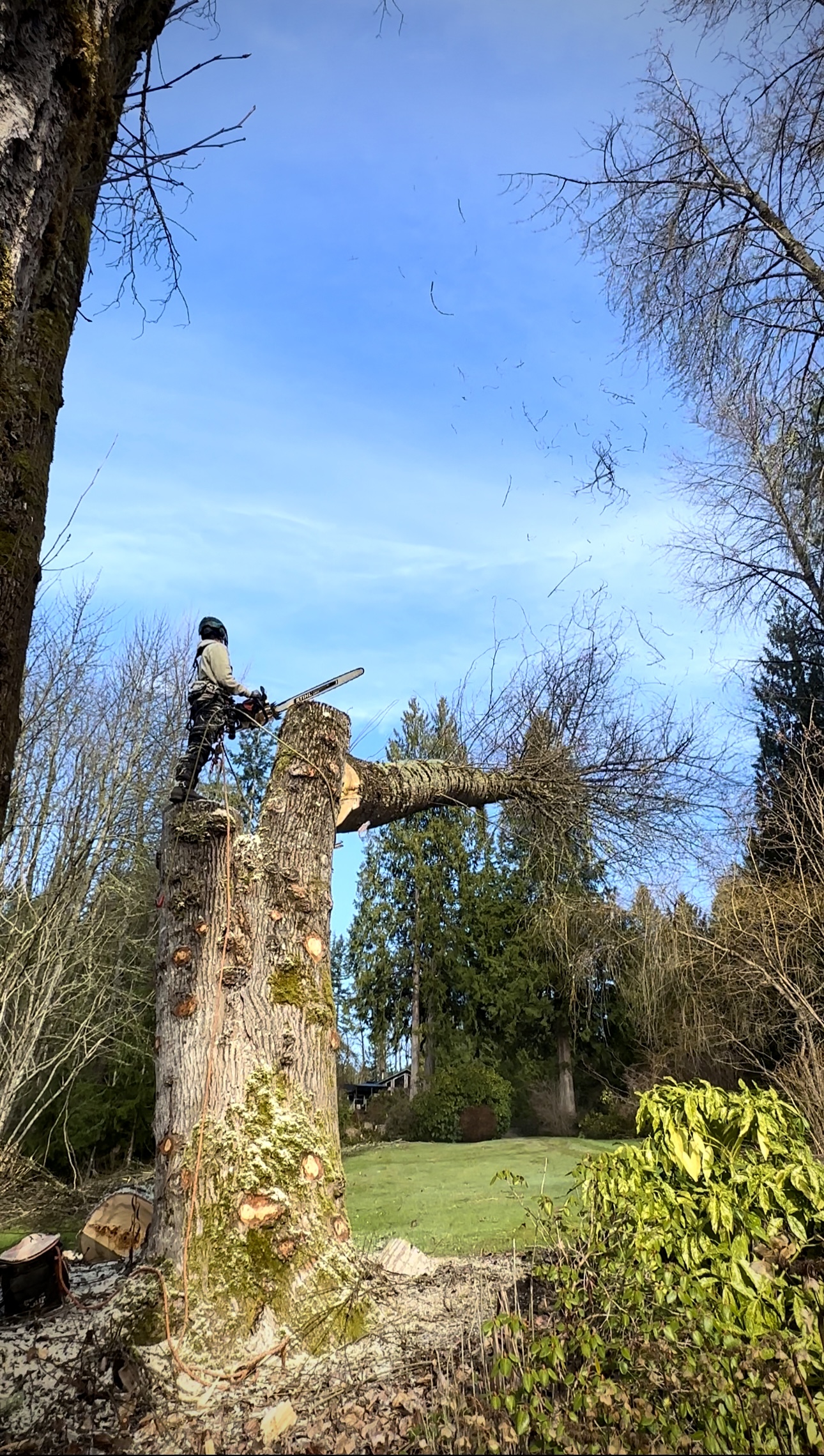
- Sectional Dismantling or Directional Felling: Depending on the situation, we either climb the tree and remove it in sections from the top down, lowering each piece on ropes, or we fell the tree directionally into an open area. The method depends on available space and what is around the tree.
- Processing and Cleanup: All branches are fed through the chipper. Trunk wood is bucked into rounds — you can keep it for firewood or we haul it away. We rake the area, blow debris from hard surfaces, and leave your property cleaner than we found it.
What Happens to the Wood After Removal
One of the most common questions homeowners ask is what happens to all that wood. Here are the options we offer on every job:
- Firewood Rounds: We buck the trunk and major limbs into 16- to 18-inch rounds and stack them on your property. Douglas fir, big leaf maple, and red alder all make good firewood. Cedar is excellent for kindling. Many homeowners in Sultan, Monroe, and Granite Falls heat with wood and appreciate keeping it.
- Chips for Landscaping: Our chipper reduces branches and smaller wood into landscape chips. We can leave a pile on-site for garden paths, flower beds, or weed suppression — or haul it away. Most Snohomish County properties can use a load or two of fresh chips.
- Complete Removal: If you want everything gone, we haul all wood, chips, and debris off your property. The site is left clear and clean.
- What About the Stump?: K&J Tree Works does not provide stump grinding. We cut the trunk as low to the ground as possible — typically 4 to 6 inches above grade. If you want the stump ground down, we can recommend a stump grinding specialist in your area.
Tree Removal Cost and Planning Questions
- How much does tree removal cost in Snohomish County?
- The cost depends on the tree's diameter, height, condition, targets, access, removal method, utilities, and cleanup scope. K&J provides a written price after an on-site assessment rather than applying one county-wide average to unlike projects.
- Why can't a tree company quote accurately from height alone?
- Height does not show the amount of wood, decay, lean, access, nearby structures, or whether the tree can be felled or must be dismantled and rigged in sections. Those factors can change the work plan more than height.
- Does stump grinding come with tree removal?
- No. K&J cuts the trunk as low as practical but does not provide stump grinding. If you want grinding, we can recommend a specialist, and that work should be quoted separately.
- Does it cost more to remove a tree near a house?
- It often requires more labor because the crew may need sectional dismantling, rigging, and additional property protection instead of an open-area fall. The on-site assessment determines the safest plan.
- What changes the cost in Lake Stevens or Everett?
- The city name alone does not set the price. Lot access, mature conifers, structures, utilities, slopes or wet ground, cleanup choices, and city-specific permit questions are the factors that shape the estimate.
- Do I need a permit to remove a tree?
- It depends on whether the property is in a city or unincorporated county, the project scope, and whether critical areas, buffers, shorelines, or local tree-retention rules apply. Confirm requirements with the applicable planning or permitting department before work begins.
- Will homeowners insurance pay for tree removal?
- Coverage depends on the policy, cause of loss, what was damaged, and the insurer's claim decision. Contact your carrier. K&J can document the tree work but cannot determine or promise coverage.
- What should a written tree removal estimate include?
- It should identify the trees and removal method, access or rigging assumptions, property protection, wood and chip handling, cleanup, stump scope, price, and contractor information so you can compare quotes on the same scope.
Get an Accurate Tree Removal Estimate
K&J Tree Works provides free, no-obligation on-site estimates across Snohomish and King County. We assess the tree, access, nearby targets, removal method, and cleanup choices, then give you a written scope and price. If trimming or monitoring is a better option than removal, we will explain that too. Call (425) 223-7904 or request an estimate online. Monday through Saturday, 8 AM to 5 PM.