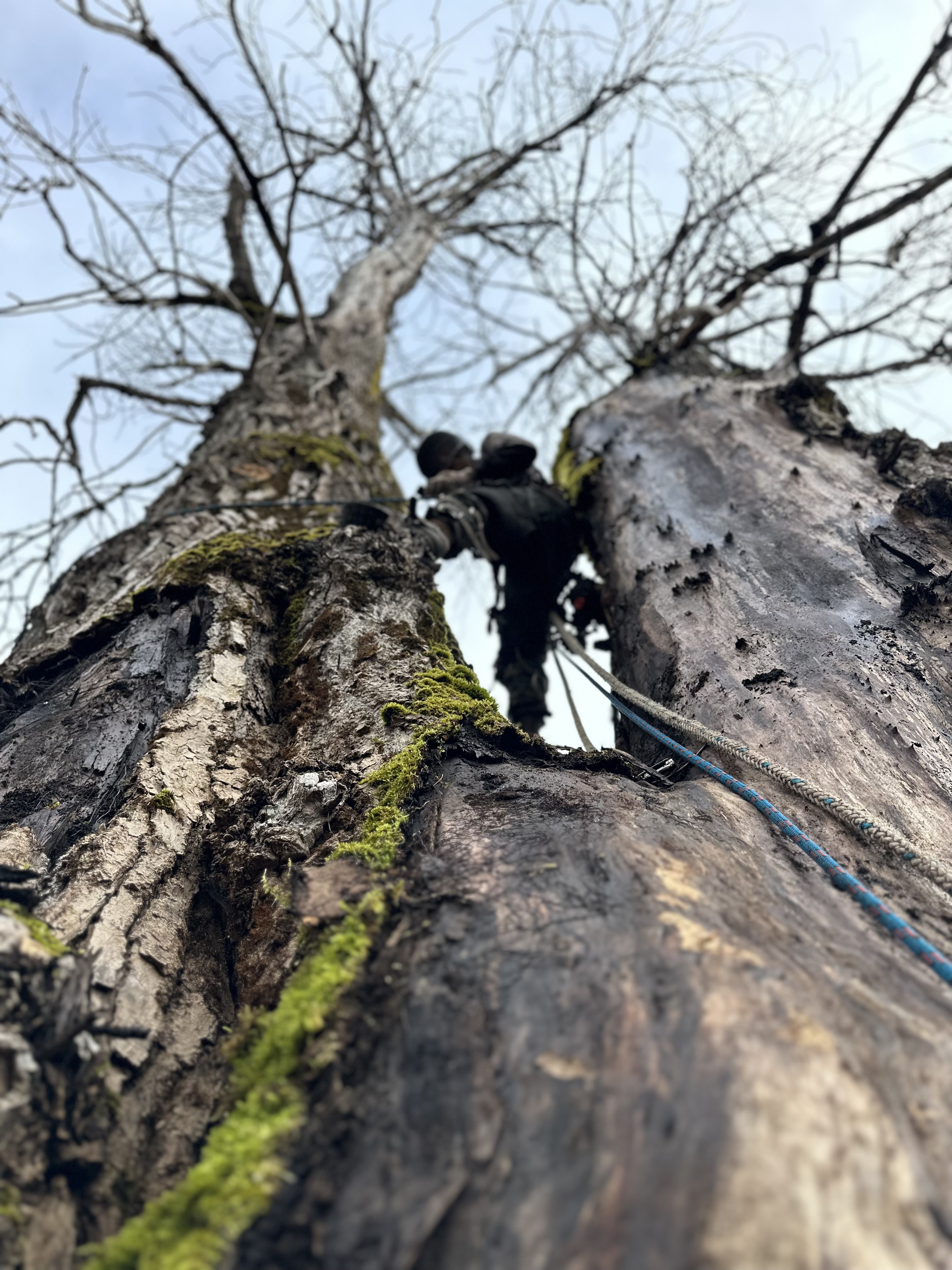
Why River Valley Properties in Gold Bar Need Special Tree Rigging
Gold Bar, WA — March 25, 2026
Tree removal in Gold Bar's Skykomish River valley demands specialized rigging techniques due to saturated alluvial soils, shallow root plates, and narrow lot access along May Creek and River Drive.
What Makes Tree Removal Different in Gold Bar?
Gold Bar sits at roughly 200 feet elevation where the Skykomish River valley begins to narrow as it approaches Index and the Cascade Range. The town occupies a river terrace built from centuries of alluvial deposits — fine sand, gravel, and silt carried downstream from the mountains. These deposits create a soil profile that holds water well into June most years, keeping root zones saturated long after the last spring rain. Douglas fir, Western red cedar, and big leaf maple dominate the canopy here, and they respond to these perpetually moist soils by spreading roots wide rather than deep. A 90-foot Douglas fir in Gold Bar might have a root plate only 18 to 24 inches deep, compared to 36 inches or more on the well-drained glacial till soils in Marysville or Lake Stevens. That shallow anchoring means Gold Bar trees are disproportionately vulnerable to windthrow — particularly during the atmospheric river events that funnel up the Skykomish valley from the southwest every November through March.
- Alluvial soils along the Skykomish hold moisture that creates shallow root systems
- River valley funneling amplifies wind speeds during atmospheric river storms
- Tight lot spacing on River Drive requires sectional rigging for most removals
- Equipment staging on May Creek Road and side streets presents unique logistics
How Skykomish River Valley Soils Affect Tree Stability
Understanding Gold Bar's geology explains why certain trees fail here while identical species in nearby Sultan or Monroe stay standing:
- River Terrace Deposits: Gold Bar's buildable land sits on a river terrace — a flat bench of sediment deposited when the Skykomish River ran at a higher elevation thousands of years ago. This material is loose, unconsolidated sand and gravel with lenses of finer silt. Roots penetrate it easily but cannot grip the way they would in compacted glacial till or clay. When saturated, these soils lose shear strength, and the root plate can rotate out of the ground under wind load.
- Seasonal Water Table Rise: The Skykomish River and its tributaries including May Creek cause the water table under Gold Bar to rise significantly between October and May. Properties within 500 feet of the river can see groundwater within 12 to 18 inches of the surface during peak winter flows. Trees growing in this zone develop virtually all their structural roots in that thin upper layer, making them exceptionally vulnerable to uprooting.
- Wind Funneling Through the Valley: The Skykomish valley narrows from about two miles wide near Sultan to less than half a mile at Gold Bar. This geographic constriction accelerates wind speeds — the same atmospheric river storm that produces 35 mph sustained winds in Monroe can generate 50 to 60 mph gusts as it funnels through Gold Bar. Trees here experience more wind stress than trees just 8 miles downstream.
- Root Competition in Dense Stands: Many Gold Bar lots still have the original forest canopy or second-growth stands from the 1930s and 1940s. Trees growing in these dense clusters compete for the limited well-drained root zone, producing even shallower and more one-sided root systems than isolated trees. When one tree in a cluster falls, the remaining trees lose their wind buffering and often follow within a few storms.
Rigging Techniques for Gold Bar's Constrained Properties
Most tree removal in Gold Bar requires some form of technical rigging because of how the town is laid out — small lots, mature trees, and limited equipment access:
- Spar Pole Rigging on River Drive: Properties along River Drive sit between the road and the river, often with only 40 to 60 feet of yard depth. Trees here cannot be felled in any direction without hitting a structure, the road, or risking logs rolling toward the river. We convert the tree itself into a spar pole — removing the canopy first, then using the remaining trunk as an anchor point to lower large sections on rope. This technique lets us control exactly where every piece goes on lots where there is no open drop zone.
- Negative-Lean Rigging on Hillside Lots: The south side of Gold Bar rises steeply above the valley floor along Lewis Street and the properties backing up to Wallace Falls State Park. Trees on these slopes often lean downhill toward homes below. Standard directional felling would send the tree straight into the house. We rig these trees with a redirect — a block mounted high in the canopy with a tagline running uphill to an anchor tree, allowing us to guide each section away from structures despite the natural lean.
- Crane-Assisted Removal on May Creek Road: For the largest trees on May Creek Road — some Douglas fir here exceed 120 feet with 48-inch trunk diameters — we bring in a crane when road width and ground conditions permit. A crane can lift 5,000 to 8,000 pound sections straight up and set them in the road for processing, eliminating the risk of swinging loads in tight quarters. May Creek Road is just wide enough for crane setup with a flagging operation to manage traffic.
- Low-Impact Removal Near the River: Properties on the north bank of the Skykomish face additional constraints from the Shoreline Management Act. Trees within 200 feet of the ordinary high water mark fall under Snohomish County's shoreline regulations, which may require a shoreline exemption for removal of hazardous trees. We stage equipment on the upland side and lower sections away from the water to avoid any disturbance to the riparian zone.
How We Approach a Tree Removal Job in Gold Bar
Every Gold Bar removal starts with a site assessment that accounts for the valley's specific conditions:
- Site Assessment and Soil Evaluation: We walk the property and evaluate not just the tree but the soil conditions around it. In Gold Bar, this means probing for water table depth, checking for root plate heaving, and assessing how saturated the ground is — which directly affects whether we can position equipment close to the tree or need to work at a distance.
- Access and Staging Plan: Many Gold Bar properties are accessed via narrow driveways off River Drive or May Creek Road. We determine where the chipper and crew trucks can safely park, whether we need traffic control for road-adjacent work, and how we will route material from the tree to the processing area. Properties near Wallace Falls State Park trailhead get heavier weekend traffic that affects staging.
- Rigging System Installation: Before any cutting begins, we install the rigging — friction devices, blocks, slings, and lowering lines — specific to this tree and site. For spar pole work on river-adjacent lots, we set up the lowering system to direct material toward the road side, away from the river. Every rigging point is inspected for the load it will carry.
- Sectional Dismantling: We remove the tree from the top down, cutting sections sized to what the rigging can handle on this particular tree. In Gold Bar's saturated soils, we keep sections lighter than we might in Sultan or Monroe because the anchor points — whether the trunk itself or adjacent trees — have less holding capacity in wet alluvial ground.
- Wood Processing and Cleanup: All brush goes through the chipper. Trunk wood is bucked into rounds on-site — many Gold Bar homeowners heat with wood and want to keep the Douglas fir and maple. We rake and blow the work area, and on soft ground we repair any turf damage from equipment positioning.
Gold Bar Tree Removal Questions
- Can I remove a tree near the Skykomish River on my Gold Bar property?
- Trees within 200 feet of the Skykomish River's ordinary high water mark are subject to Snohomish County's Shoreline Management regulations. Hazard trees that threaten structures can usually be removed under a shoreline exemption, but you need to document the hazard — typically with a written assessment from a qualified tree professional. We help Gold Bar homeowners understand which regulations apply to their specific parcel and provide the documentation needed.
- Why do trees in Gold Bar blow over more than in nearby towns?
- Two factors specific to Gold Bar's geography: First, the alluvial soils deposited by the Skykomish River hold moisture that keeps root systems shallow — sometimes only 18 inches deep for large conifers. Second, the valley narrows significantly at Gold Bar, which accelerates wind speeds during storms. A tree with shallow roots in amplified wind is far more likely to uproot than an identical tree on the well-drained glacial soils in Sultan or Lake Stevens.
- Is the ground in Gold Bar too soft for heavy equipment?
- It depends on the season and the specific property. During summer and early fall when the water table drops, most Gold Bar properties can support a chipper and crew trucks. From November through May, saturated alluvial soils near the river can be too soft for heavy equipment. In those conditions, we rely on climbing and rigging techniques that keep equipment on the road or driveway rather than on soft ground. For crane work, we verify soil bearing capacity before setup.
- My property backs up to Wallace Falls State Park — are there extra rules for tree removal?
- Your property is private land with standard Snohomish County regulations, even if it borders state park land. However, you cannot access park land for equipment staging, rigging anchors, or tree felling without a permit from Washington State Parks. All work must stay within your property boundaries. We plan these jobs so every piece falls or is lowered within the private lot, which usually means spar pole rigging rather than directional felling toward the park.
- How do the atmospheric river storms in Gold Bar's valley affect tree failure timing?
- Atmospheric river events funnel moisture-laden air up the Skykomish valley from the southwest, and Gold Bar's position in the narrowing valley concentrates both rainfall and wind. These storms typically arrive between November and March, producing 2 to 4 inches of rain in 24 hours while sustained winds exceed 40 mph in the valley constriction. Trees with compromised root systems — those in saturated alluvial soil with shallow root plates — are most likely to fail during these events, particularly during the first major storm after a dry summer when soils transition rapidly from dry to saturated and root plate cohesion drops.
- Do you coordinate with Snohomish County PUD for power line clearance work in Gold Bar?
- Yes. Several properties along River Drive and May Creek Road have Snohomish County PUD overhead distribution lines running through or adjacent to mature tree canopies. When our work involves trees within striking distance of power lines, we contact PUD's vegetation management department to coordinate. For trees that could fall onto energized lines during removal, PUD can de-energize the line during our work window. We schedule this coordination in advance so there is no delay on removal day.
Need a Tree Removed on Your Gold Bar Property?
K&J Tree Works has the rigging expertise that Gold Bar's river valley terrain demands. We provide free on-site assessments for homeowners along River Drive, May Creek Road, and throughout the Gold Bar area. Call (425) 223-7904 or request an estimate online. Monday through Saturday, 8 AM to 5 PM.