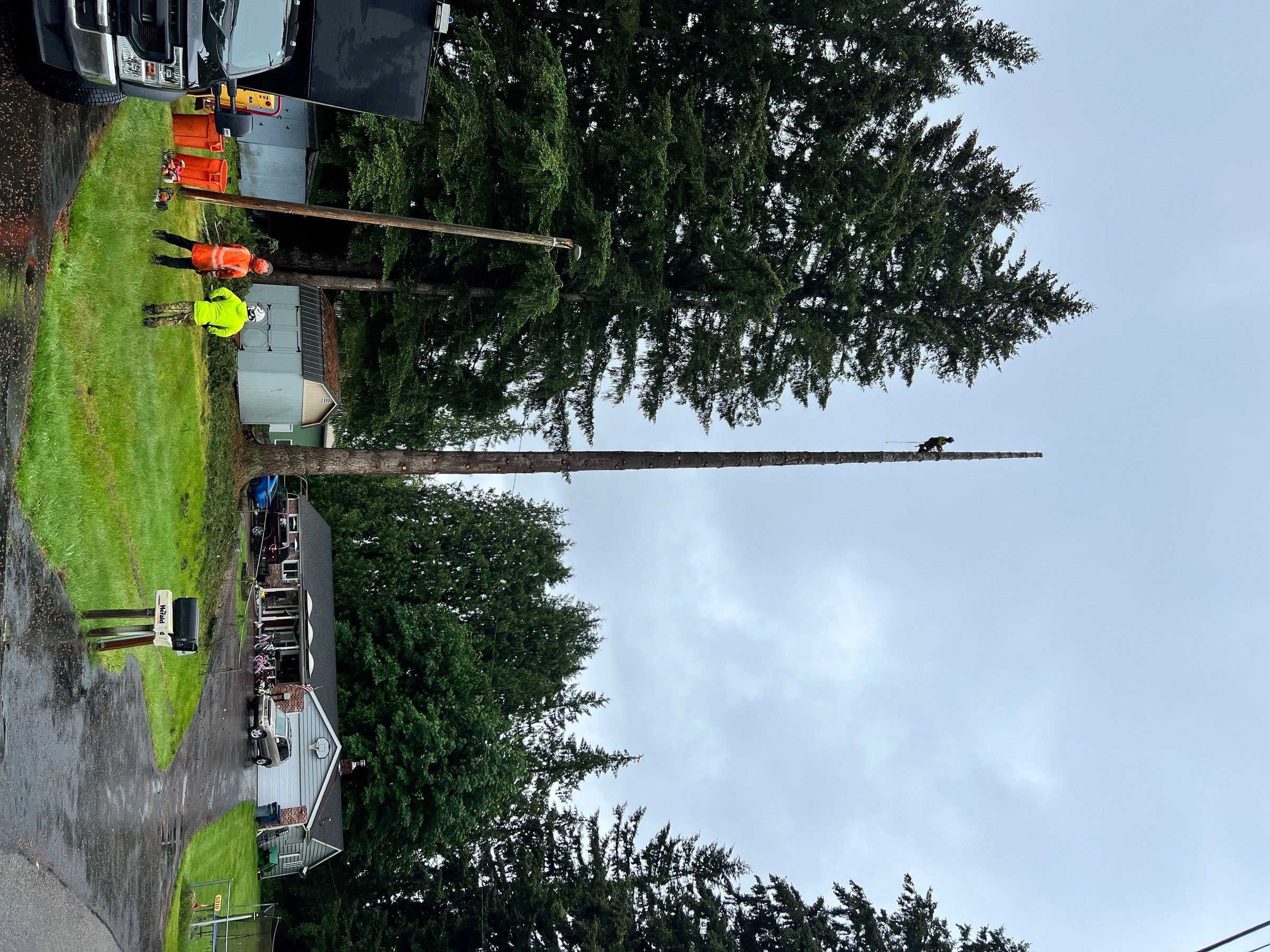
Tree Service in Index, WA: Mountain Valley Property Guide
Index, WA — April 2, 2026
Index occupies a narrow valley where the North Fork Skykomish meets the main river, surrounded by granite peaks. Tree work here demands mountain-specific approaches for thin soils, extreme slopes, and single-road access.
What Makes Tree Work in Index Different From Lowland Communities?
Index sits at 530 feet elevation in one of the narrowest inhabited valleys in Snohomish County. The town occupies a small bench of relatively flat ground at the confluence of the North Fork Skykomish River and the main Skykomish, hemmed in by Mount Index (5,979 feet) to the south and the Town Wall — a 700-foot vertical granite cliff — to the northeast. This is not a place where you can drop a tree into an open yard and chip it with a truck parked on a wide suburban street. Properties in Index perch on thin soils over fractured granite bedrock, connected by roads barely wide enough for a single truck. Many lots are accessible only by foot trail from Index-Galena Road or Avenue A. The trees here — Douglas fir, Western hemlock, Western red cedar, and big leaf maple — grow in conditions that profoundly affect their root architecture, their stability, and how they must be removed. A 100-foot Douglas fir in Index may have roots that penetrate only 6 to 12 inches of soil before hitting granite, anchoring the tree through wedging into rock fractures rather than the deep root plates found in lowland glacial soils. Understanding these mountain-specific conditions is essential for safe tree work in this extraordinary valley.
- Thin granitic soils (6-12 inches) over bedrock create unique root anchoring patterns
- Slopes exceeding 60 percent grade on many residential parcels require slope rigging
- Single-road access via Index-Galena Road limits equipment size and staging options
- Proximity to the Skykomish River triggers shoreline regulations for riparian trees
Terrain Challenges Specific to Index Properties
Each of Index's geographic features creates specific challenges for tree work that do not exist in lowland settings:
- Bedrock Root Systems: Most of Index sits on granite and granodiorite bedrock with a thin veneer of glacially derived soil — rarely more than 12 inches thick. Trees anchor themselves by threading roots into fractures and cracks in the rock rather than spreading through deep soil. This creates strong anchoring in some directions but virtually no root mass in others. A tree that seems well-rooted can fail if wind loads it from a direction where its rock-fracture anchoring provides no resistance. We assess these root conditions by probing soil depth and looking for exposed rock near the base of target trees.
- Steep Slope Access: Many Index properties — particularly those above Avenue A on the hillside toward Mount Index — sit on slopes of 40 to 70 percent grade. Equipment cannot traverse these slopes safely, and felled trees do not stay where they land — they roll, slide, or tumble downhill. All tree work on Index's steep lots is climbing work, with every piece rigged and controlled by ropes. We sometimes set up a highline system between anchor trees to cable sections across the slope to a processing area on flatter ground.
- Narrow Road and Trail Access: Index-Galena Road is the only vehicle access to most properties in Index. It is a two-lane road with no shoulders in many stretches. Some properties are accessed only by foot trails or staircases from the road. Our full-size chipper and crew trucks need turnaround space and safe parking — in Index, this often means staging on Highway 2 near the Index General Store and hand-carrying equipment to the work site along foot trails. This access limitation adds time to every job.
- River Proximity and Flood Zone: Properties along the lower bench in Index, near the North Fork Skykomish, are in the FEMA-designated 100-year floodplain. Trees in this zone experience periodic inundation during major flood events, which saturates already-thin soils and can undermine root anchoring that depends on friction in dry rock fractures. After high water events in fall and winter, trees along Index's river bench should be assessed for flood-induced instability.
Tree Species and Growth Patterns in the Index Valley
The valley's microclimate and geology produce distinctive growth patterns in the trees that populate Index properties:
- Douglas Fir on Bedrock: Douglas fir in Index grows slower than in the rich lowland soils around Sultan or Monroe — the thin, nutrient-poor granitic soils limit growth rate. A 100-foot fir in Index may be 120 to 150 years old, compared to 60 to 80 years for the same height in Sultan. The wood is denser, the growth rings tighter, and the trees are heavier per foot of height. This affects rigging calculations — Index Douglas fir sections weigh more than equivalent-sized pieces from faster-growing lowland trees.
- Western Hemlock in the Understory: Western hemlock thrives in the shaded, moist conditions of Index's narrow valley. Hemlock has the shallowest root system of any native conifer and is the most windthrow-prone species in the region. On Index's thin soils over bedrock, hemlock root systems are essentially a mat of roots sitting on top of rock — anchored by weight and friction rather than structural roots in soil. These trees fail frequently during windstorms and are a common emergency call.
- Big Leaf Maple on Steep Slopes: Big leaf maple colonizes Index's steep slopes above the valley floor, growing in a sprawling, multi-trunk form that takes advantage of any soil pocket in the fractured rock. These slope maples often develop significant lean away from the hillside, with heavy canopies extending over properties and roads below. Managing them requires working on ropes on the slope above the tree, which is physically demanding and technically complex.
How We Execute Tree Work in Index's Mountain Setting
Every Index job requires adapting our standard process to the valley's specific constraints:
- Access Route Planning: Before scheduling work in Index, we drive the access route and determine where equipment can safely park and turn around. For properties accessible only by foot trail, we plan which tools we carry in and identify the closest point where a chipper can be staged. Some Index jobs require using a landing zone on flatter ground near the river and carrying material down to it from the work site above.
- Slope and Soil Assessment: We probe soil depth around the target tree and assess the slope grade. On bedrock-anchored trees, we check for root exposure, rock fracture patterns, and any signs of progressive root failure. The root assessment in Index is more critical than in lowland settings because there is so little soil that the margin between stable and unstable is measured in inches rather than feet.
- Rigging for Slope Control: On steep lots, we rig every piece to prevent uncontrolled downhill movement. This typically means a redirect block high in an anchor tree with the lowering line running uphill to a friction device operated by ground crew on stable terrain above the work zone. The climber cuts small sections — 3 to 4 feet rather than the 6- to 8-foot sections possible on flat ground — because each piece must be controlled precisely on the slope.
- Piece-by-Piece Processing: In Index, we often cannot bring material to the chipper — we bring hand tools to the material. Brush is cut to manageable lengths and hand-carried or slid down slope to the nearest vehicle-accessible point. Trunk rounds are rolled or skidded on slope to processing areas. This labor-intensive approach is necessary because the terrain will not support equipment at the tree location.
- Site Restoration on Thin Soils: After tree removal on Index's thin soils, the disturbed area is vulnerable to erosion. We scatter brush chips over exposed soil, leave root systems in place on slopes, and position log sections as erosion barriers where the slope funnels water. In a setting where soil formation takes centuries, preserving the existing soil layer is an important part of finishing the job.
Index Tree Work Questions
- Why does tree work cost more in Index than in nearby Sultan?
- Three factors drive higher costs in Index: access limitations mean longer setup and material handling time, steep slopes require rope rigging for every piece rather than simple felling, and the 30-minute drive from our Sultan base adds mobilization time. A tree that takes 3 hours to remove on a flat Sultan lot might take 6 to 8 hours in Index because of slope rigging and hand-carrying material. We provide honest quotes that reflect the actual labor and logistics involved.
- Can heavy equipment operate on Index properties?
- On the flat bench properties along Avenue A and near the river — yes, for equipment that can reach via Index-Galena Road. On the steep hillside lots above town — generally no. Excavators and loaders cannot safely traverse 40 to 70 percent slopes, and the thin soil over bedrock provides insufficient support for heavy machinery. These properties are climbing-and-rigging jobs exclusively.
- Are there restrictions on removing trees near the Skykomish River in Index?
- Yes. Trees within 200 feet of the Skykomish River's ordinary high water mark fall under Snohomish County's Shoreline Management regulations. Hazard trees threatening structures can typically be removed under a shoreline exemption with proper documentation. We assess whether specific trees are within the shoreline jurisdiction using county mapping and help property owners understand the applicable requirements before work begins.
- What happens during a tree emergency in Index when the road is blocked?
- Index has single-road access via Highway 2 and Index-Galena Road. If a fallen tree blocks the road, WSDOT or Snohomish County maintenance crews handle the road clearing. For trees on private property during emergencies, we respond as soon as road access is restored. Index residents should have a plan for power outages and road closures during winter storms — downed trees blocking Highway 2 near the Index tunnel can isolate the community for hours or occasionally a day.
- What tree species are most problematic on Index hillside lots?
- Western hemlock is the species we remove most frequently on Index hillside properties. Hemlock develops a shallow root system even in deep soil, and on bedrock slopes with thin soil, the roots spread across the rock surface with minimal anchorage. Red alder is the second most problematic — it grows fast but has a 40 to 60 year lifespan, and aging alders on steep slopes frequently fail when the root system decays. Douglas fir and Western red cedar are generally more stable on slopes because they send deeper tap roots into rock crevices, but even these species become unstable when growing on less than 18 inches of soil over bedrock.
- Do I need to worry about the North Fork of the Skykomish River eroding toward my Index property?
- River migration and bank erosion are active geological processes along the North Fork Skykomish near Index. Properties on the alluvial bench — the flat land closest to the river — can experience bank retreat during major flood events. Trees along the riverbank actually help stabilize the bank through root reinforcement. If you are considering removing riverside trees, understand that the root system is providing bank protection. We can selectively remove hazardous trees while retaining those whose root systems are actively preventing bank erosion — this requires on-site assessment of which trees are structurally compromised versus which are serving a protective function.
Need Tree Work on Your Index Property?
K&J Tree Works has the mountain-terrain experience that Index's unique valley setting demands. We provide free on-site assessments for properties throughout Index and along the Highway 2 corridor. Call (425) 223-7904 or request an estimate online. Monday through Saturday, 8 AM to 5 PM.