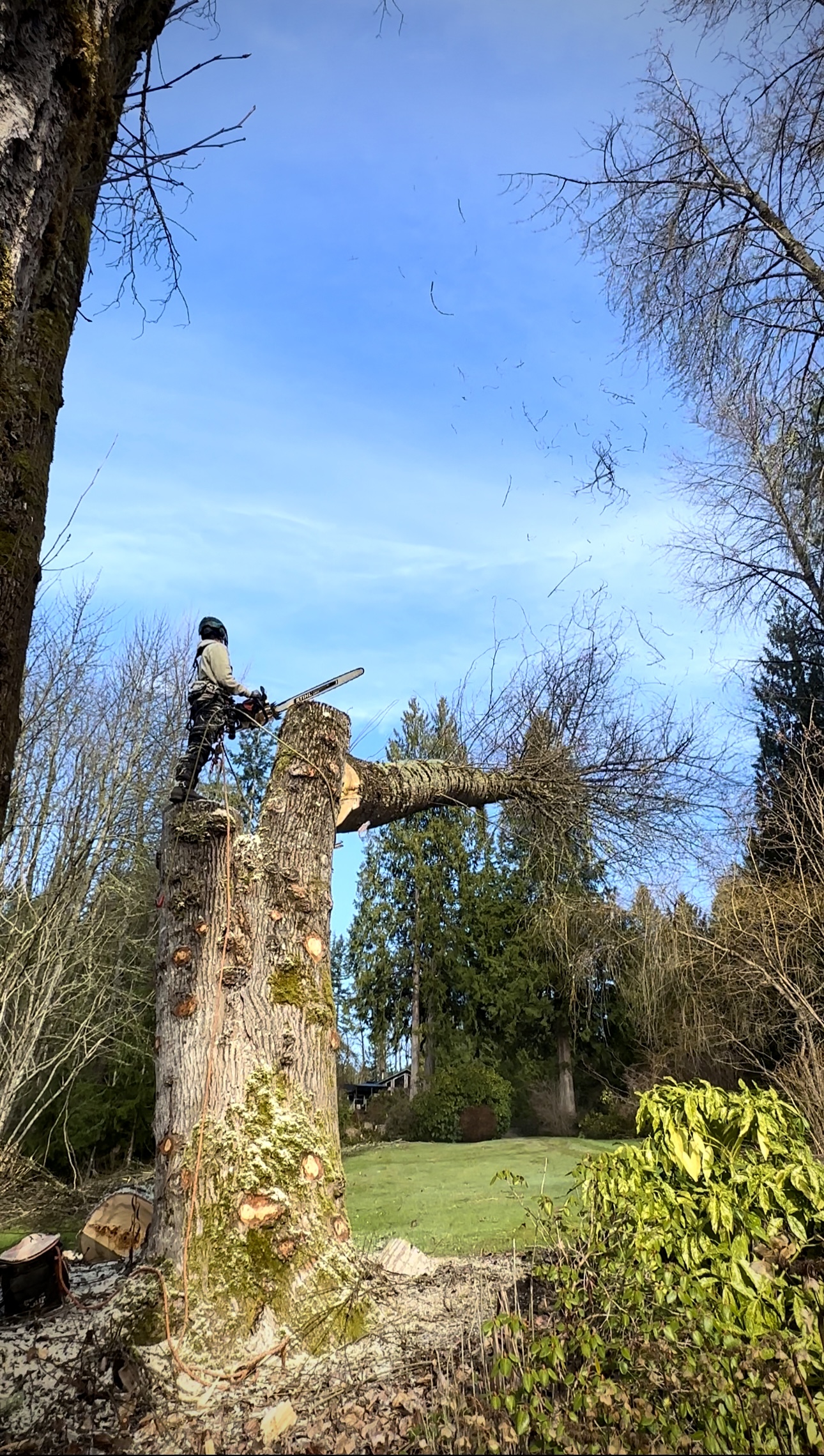
How to Tell If a Tree Is Dying: Western Washington Guide
Sultan, WA — March 28, 2026
A look inside the biology of tree decline in western Washington — the fungi, insects, and structural failures that destroy trees from the inside out, and how our crew identifies hidden dangers before they become emergencies.
The Tree That Looks Fine Until It Doesn't
There is a Douglas fir on a property outside Sultan that stands 110 feet tall. Its crown is green. Its bark looks solid. To most people walking past, it is a healthy Pacific Northwest conifer doing what conifers do. But inside the lower 20 feet of that trunk, there is almost nothing left. Armillaria root rot has been consuming the heartwood for over a decade, hollowing the tree from the roots upward while the outer sapwood continues carrying water and nutrients to the canopy above. The tree is, in the most literal sense, a shell. One strong November windstorm could bring it down across the driveway, the fence, or the neighbor's roof. This is the hidden life of a dying tree — and it is far more common than most homeowners realize. Across Snohomish and King County, thousands of residential trees are in some stage of internal decline. The mild, wet climate that makes the Pacific Northwest one of the best tree-growing regions on earth also creates ideal conditions for the fungi, insects, and structural failures that destroy trees from the inside out. Understanding what is happening inside a struggling tree helps you make better decisions about whether to monitor, trim, or remove it before nature makes the decision for you. When you spot warning signs on your property, a free on-site hazard tree assessment is the fastest way to know whether a tree is safe to keep or needs to come down.
- The 5 hidden biological killers of Pacific Northwest trees
- External warning signs that reveal internal decay
- How professional arborists assess suspect trees
- Species-specific risk factors for Douglas fir, cedar, maple, and alder
The 5 Hidden Killers of Pacific Northwest Trees
Western Washington's climate — mild winters, heavy rainfall, and months of soil saturation — creates a perfect environment for the organisms and conditions that destroy trees from within. The Puget Sound lowlands receive 35 to 50 inches of rain annually, with some foothill communities like Sultan and Gold Bar seeing over 60 inches. That moisture keeps trees growing fast, but it also sustains an underground ecosystem of fungi and soil organisms that are constantly breaking down organic material — including the living wood of standing trees. Add in the region's glacial till soils, which trap water near the surface and limit deep root development, and you have conditions where even large, apparently vigorous trees can be structurally compromised beneath the surface. Our crew has assessed thousands of trees across communities from Darrington to Shoreline, and the five causes of hidden failure below account for the vast majority of dangerous trees we encounter. Each one works differently, attacks different parts of the tree, and leaves different clues on the exterior — but they all share one trait: by the time the problem is obvious to the untrained eye, the tree is often already past the point of saving. Understanding these processes helps homeowners recognize early warning signs and make informed decisions about tree removal before a failure event forces an emergency response.
- Armillaria Root Rot (Honey Fungus): Armillaria ostoyae is the most destructive root disease in Pacific Northwest forests. It spreads underground through dark, shoestring-like rhizomorphs that travel through soil from infected stumps and roots to healthy trees. Once it contacts a living root system, it colonizes the cambium layer and works inward, digesting the structural wood that anchors the tree. Above ground, the only visible signs may be clusters of honey-colored mushrooms at the trunk base in fall, or a gradual thinning of the crown over several years. Douglas fir, western hemlock, and grand fir are highly susceptible. We see Armillaria frequently on properties in Sultan, Gold Bar, and Monroe where second-growth forest was selectively logged decades ago — the old stumps left behind serve as infection reservoirs that continue spreading the fungus to nearby trees.
- Heart Rot Fungi (Bracket and Shelf Fungi): Heart rot is caused by a group of wood-decay fungi that enter through wounds — broken branches, pruning cuts, lightning strikes, or mechanical damage from equipment. Species like Fomitopsis pinicola (red-belted conk) and Laetiporus sulphureus (chicken of the woods) colonize the heartwood and digest it over years, creating a hollow cylinder inside what appears to be a solid trunk. By the time a shelf-shaped conk or bracket fungus appears on the outside of the trunk, the interior decay is extensive. A 24-inch diameter Douglas fir with a visible conk may have only 3 to 4 inches of sound wood remaining around the perimeter. Heart rot does not kill the tree outright — the sapwood continues functioning — but the loss of structural heartwood makes the tree vulnerable to wind snap. Properties in Granite Falls, Darrington, and the Stillaguamish Valley commonly have large second-growth conifers with heart rot from old logging-era damage.
- Bark Beetle Galleries: Several species of bark beetle attack Pacific Northwest conifers, with the Douglas fir beetle (Dendroctonus pseudotsugae) being the most significant for residential properties. Bark beetles bore through the outer bark and excavate galleries in the cambium layer where they lay eggs. The larvae feed on the inner bark, severing the tissue that transports nutrients between roots and crown. A healthy, well-watered tree can often pitch out individual beetles with resin, but trees stressed by drought, root damage, or competition lose this defense. The first visible signs are boring dust (fine reddish-brown powder) in bark crevices and at the trunk base, followed by patches of fading needles that turn from green to yellow to red. By the time the crown shows widespread color change, the beetle infestation is typically beyond saving. Hot, dry summers — increasingly common even in western Washington — trigger beetle outbreaks in stands of Douglas fir throughout the Skykomish Valley and surrounding foothills.
- Canker Diseases: Cankers are localized areas of dead bark and cambium caused by fungal or bacterial pathogens. On Pacific Northwest trees, the most common are Nectria canker on big leaf maple and red alder, and Cytospora canker on ornamental cherry and plum trees. Cankers girdle branches or trunks by killing the bark in an expanding ring. A cankered branch beyond the infection point is structurally dead even if it still carries some foliage from stored energy. On main trunks, cankers create weak points where the tree is likely to break under wind or snow loading. Cankers are particularly common on red alder — a fast-growing, relatively short-lived species that dominates disturbed sites throughout Snohomish County. Alder cankers combined with the species' naturally brittle wood make mature alders near homes one of the most common hazard tree scenarios we encounter in Everett, Marysville, and Lake Stevens.
- Wind-Induced Root Plate Failure in Saturated Soils: This is not a disease but a structural failure mode unique to the Pacific Northwest's geology and weather patterns. Much of Snohomish and King County sits on glacial till — compacted clay and gravel deposited by retreating glaciers. Tree roots in glacial till soils tend to spread laterally rather than growing deep, creating a shallow root plate. During the wet season from October through March, heavy rainfall saturates these clay soils, reducing their shear strength. When a strong windstorm hits a saturated landscape, trees can rock in the softened soil, progressively loosening their root plates with each gust. The failure is often sudden and complete — the entire root ball lifts out of the ground, toppling the tree at full length. We see this pattern repeatedly after major storms in areas with heavy clay soils, including parts of Lynnwood, Mukilteo, Edmonds, Mill Creek, and the Lake Stevens plateau.
What a Dying Tree Looks Like From the Outside
Most homeowners cannot see inside their trees, and unless you happen to own a resistograph or a sonic tomography unit, you are relying on what the tree shows you from the outside. The good news is that trees under stress communicate — not with words, but with physical changes that develop over weeks, months, and sometimes years before catastrophic failure. The challenge is that these changes are subtle, gradual, and easy to dismiss as normal aging or seasonal variation. A tree that drops a few more needles than usual, or a patch of bark that looks slightly different, may not register as alarming until you understand what those signals mean. Our crew has learned to read these exterior indicators across thousands of tree assessments on properties from the Skykomish Valley foothills to the Puget Sound waterfront, and the five signs below are the ones that most reliably predict serious internal problems. If you notice any of these on a tree near your home, driveway, or play area, it warrants a closer look from someone who can assess the full picture — because what you see on the outside is always less than what is happening within.
- Crown Thinning and Dieback: A healthy Pacific Northwest conifer has a dense, full canopy. When the crown begins thinning — you can see more sky through it than through neighboring trees of the same species — the tree is not getting enough water and nutrients to maintain its full canopy. This can indicate root rot, bark beetle damage, or root plate deterioration. Crown thinning in Douglas fir often starts at the top and works downward. In big leaf maple, it may appear as smaller-than-normal leaves or early fall color change. Any tree that has lost more than 25 to 30 percent of its expected canopy density warrants professional assessment.
- Epicormic Sprouting: Epicormic sprouts are clusters of small, vigorous shoots that emerge directly from the trunk or major limbs — often called water sprouts or suckers. Trees produce epicormic growth as a stress response when the main canopy is failing. It is the tree's attempt to replace lost photosynthetic capacity by activating dormant buds along the trunk. Heavy epicormic sprouting on a tree that previously had a clean trunk is a strong signal of crown decline or root system compromise. We see this frequently on stressed Douglas fir and big leaf maple throughout Monroe, Snohomish, and the central county area.
- Bark Sloughing and Separation: Bark that is peeling, cracking, or falling off in sheets — separate from normal bark shedding in species like madrone — indicates that the cambium layer beneath has died. On conifers, look for areas where bark has fallen away to reveal bare wood, often with visible beetle galleries or fungal staining underneath. On big leaf maple and red alder, canker infections cause bark to crack and separate in defined patches. Any trunk area where bark no longer adheres to the wood beneath is dead tissue and a potential entry point for further decay.
- Soil Heaving and Root Exposure: Cracked, lifted, or mounded soil around the base of a tree — especially on the side opposite the direction the tree leans — means roots are pulling out of the ground. This is the most urgent warning sign on this list. Soil heaving indicates active root plate failure, and the tree may come down in the next significant wind event. After heavy rains, check the base of any large tree near your home for fresh cracks in the ground radiating outward from the trunk. Properties on clay soils in Lynnwood, Edmonds, Mukilteo, and Shoreline are particularly vulnerable to this failure pattern.
- Woodpecker Activity: Woodpeckers are attracted to trees that harbor insects — particularly bark beetles and wood-boring larvae. Pileated woodpeckers, the large red-crested species common throughout western Washington, can excavate rectangular holes several inches deep into trunk wood while feeding on carpenter ants that colonize decayed heartwood. Sustained woodpecker activity on a single tree — multiple fresh holes, visible sawdust at the base, repeated visits — is a reliable indicator that the tree has an insect population feeding on compromised wood. The woodpecker is not causing the problem; it is revealing one that already exists.
How Our Crew Assesses a Suspect Tree
When a homeowner calls about a tree they are worried about, our assessment follows a systematic process developed from years of evaluating Pacific Northwest species on local terrain. There is no single test that tells you everything about a tree's condition — it takes a combination of observation, physical testing, and species-specific knowledge to build an accurate picture of what is happening inside. A tree that looks dangerous to a homeowner may actually be stable with decades of life left, while a tree that looks fine to the untrained eye may be days away from failure. The difference between those two assessments is experience — knowing what to look for, where to look, and how to interpret what you find in the context of Pacific Northwest growing conditions, soil types, and weather patterns. Our process starts broad and narrows down, beginning with the overall picture and drilling into specific areas of concern. We assess every tree in the context of its surroundings, because a tree's risk level depends not just on its condition but on what it could hit if it fails. A tree with moderate internal decay standing in an open field is a very different risk profile from the same tree leaning over your bedroom. Here is how our assessment works, step by step:
- 360-Degree Visual Inspection: We walk the full perimeter of the tree, examining the crown density, branch attachment points, trunk condition, root flare, and surrounding soil. We look for every exterior indicator — conks, cankers, beetle dust, bark separation, epicormic sprouting, lean, and soil disturbance. We also assess what is in the fall zone — your home, driveway, fence, power lines, or neighbor's property.
- Sounding and Tap Test: We strike the lower trunk with a mallet or the back of an axe at multiple points around the circumference. Solid wood produces a firm, resonant tone. Decayed or hollow wood produces a distinctly different sound — duller, flatter, and sometimes with a hollow echo. This simple technique can detect internal cavities and advanced heart rot without any cutting or drilling. An experienced arborist can map the approximate extent of internal decay by sounding around the trunk.
- Root Collar Excavation: The root collar — where the trunk transitions to the root system at ground level — is often buried under years of accumulated soil, mulch, or grade changes from landscaping. Many root rot infections and basal cankers are hidden below grade. We carefully excavate the root collar area to expose the actual trunk base and inspect for Armillaria rhizomorphs (the dark shoestring-like fungal strands), basal conks, soft or spongy wood, and insect damage that would otherwise be invisible.
- Lean Measurement and Load Assessment: We measure the degree and direction of trunk lean and assess whether it is natural growth lean or recent structural lean caused by root failure. We evaluate the crown's weight distribution relative to the lean — a tree leaning north with most of its canopy weight also on the north side is significantly more hazardous than one whose canopy is balanced. We factor in the prevailing storm wind direction for your specific property location.
- Species-Specific Risk Factor Review: Each tree species has characteristic failure modes. Douglas fir is prone to Armillaria root rot and butt rot. Western red cedar develops heart rot but can persist for decades as a hollow shell because its sapwood is remarkably durable. Red alder is brittle, short-lived, and prone to canker. Big leaf maple develops heavy lateral branches prone to failure under their own weight. We evaluate each tree's condition through the lens of its species' known vulnerabilities and the specific soil and exposure conditions on your property.
Common Questions About Dying and Hazardous Trees
Homeowners across Snohomish and King County ask us these questions regularly when they notice something concerning about a tree on their property. The answers draw on our experience assessing and removing trees in communities from the remote Skykomish Valley towns of Sultan, Gold Bar, and Index to the suburban neighborhoods of Bothell, Kenmore, and Shoreline. Every tree situation is different, but these responses address the patterns and concerns we encounter most often. If your specific situation does not fit neatly into one of these answers, or if you are unsure whether your tree is safe, the best next step is always a professional on-site assessment — which we provide at no cost and no obligation across our entire 24-community service area. A 20-minute walk around your tree with an experienced arborist can answer questions that no article or photo can fully address, because tree risk assessment depends on factors like soil conditions, wind exposure, species characteristics, and proximity to structures that can only be evaluated in person.
- Can a hollow tree still be safe?
- It depends on how much solid wood remains and the tree's size and exposure. A general guideline is that a tree with less than one-third of its trunk diameter as sound wood is structurally compromised. However, species matters — western red cedar can remain standing with extensive hollowing because its wood resists decay well, while Douglas fir with the same amount of hollowing is far more likely to fail. Location matters too: a hollow tree in a forest is supported by surrounding trees, but a hollow tree standing alone in your yard catches full wind force. We assess each hollow tree individually based on remaining wall thickness, species, height, exposure, and what is in the fall zone.
- My tree has mushrooms growing at the base — does it need to come down?
- Mushrooms at the base of a tree are fruiting bodies of fungi that are actively decomposing root or trunk wood. The most concerning are honey mushrooms (Armillaria) which indicate root rot, and conks or shelf fungi which indicate heart rot. Not every mushroom means the tree is doomed — some fungi decompose only dead tissue and do not affect living wood. But any fungal fruiting body at or near the trunk base warrants professional assessment, because by the time fungi produce visible mushrooms, the underground or internal colonization is typically extensive.
- How fast does root rot spread from tree to tree?
- Armillaria root rot spreads through the soil at roughly 1 to 3 feet per year via rhizomorphs — dark, root-like fungal strands. It also spreads through direct root contact between adjacent trees. An infected stump left in the ground can serve as a food base for the fungus for 20 or more years, continuously sending rhizomorphs outward to contact new root systems. If one tree on your property has confirmed Armillaria, adjacent trees of susceptible species within 10 to 20 feet should be monitored for early signs of crown thinning or stress.
- Should I remove a dead tree or can I leave it standing?
- A standing dead tree (called a snag) is valuable wildlife habitat — woodpeckers nest in them, owls roost in cavities, and insects in the dead wood support the food chain. However, a dead tree near your home, driveway, power lines, or areas where people spend time is a liability. Dead wood becomes increasingly brittle and unpredictable as it dries and decays. Branches and eventually the trunk itself can fail without warning in calm conditions, not just during storms. If a dead tree can fall and hit something you care about, it should come down. If it stands in a back corner of a large rural lot away from targets, leaving it as a snag is a reasonable ecological choice.
- Why did my tree die suddenly when it looked fine last month?
- Trees rarely die suddenly — they decline over months or years, but the visible symptoms can appear abruptly. A tree with advanced root rot may maintain a green canopy until the root system can no longer supply water during a hot week in July, at which point the entire crown browns within days. Bark beetle infestations can reach a tipping point where the crown transitions from green to red over a few weeks. What appears sudden to the homeowner is usually the final stage of a long internal process. This is why proactive assessment is valuable — catching the early subtle signs gives you time to plan rather than react to an emergency.
- Is it better to remove a declining tree now or wait until it gets worse?
- Earlier removal is almost always safer, easier, and less expensive. A tree in early decline still has solid wood that holds rigging hardware and supports a climber's weight. A tree with advanced decay is unpredictable — branches may break under a climber, rigging anchors may pull through rotten wood, and sections may fall in unplanned directions. A tree that fails on its own terms — during a storm, onto your roof, across your driveway — creates an emergency that costs more to resolve and may cause property damage. If our assessment indicates a tree is in irreversible decline and is within striking distance of a target, we recommend removal while conditions are still controlled.
Worried About a Tree on Your Property?
If you have noticed any of the warning signs described in this guide — a thinning canopy, mushrooms or conks growing at the trunk base, bark falling off in patches, soil cracking or heaving around the roots, sustained woodpecker activity, or epicormic sprouting along the trunk — contact K&J Tree Works for a free hazard tree assessment. We will walk your property, examine the tree in question, perform sounding tests and root collar inspection as needed, and give you an honest evaluation of what is happening inside and whether the tree needs to come down, needs trimming, or can be safely monitored. There is no cost and no obligation for the assessment. We serve Sultan, Gold Bar, Monroe, Index, Arlington, Darrington, Stanwood, Snohomish, Lake Stevens, Marysville, Granite Falls, Mill Creek, Everett, Mukilteo, Edmonds, Lynnwood, and eight King County communities including Bothell, Woodinville, Duvall, Redmond, Kenmore, Shoreline, Carnation, and Baring. Call (425) 223-7904 or request an estimate online. We are available Monday through Saturday, 8 AM to 5 PM.