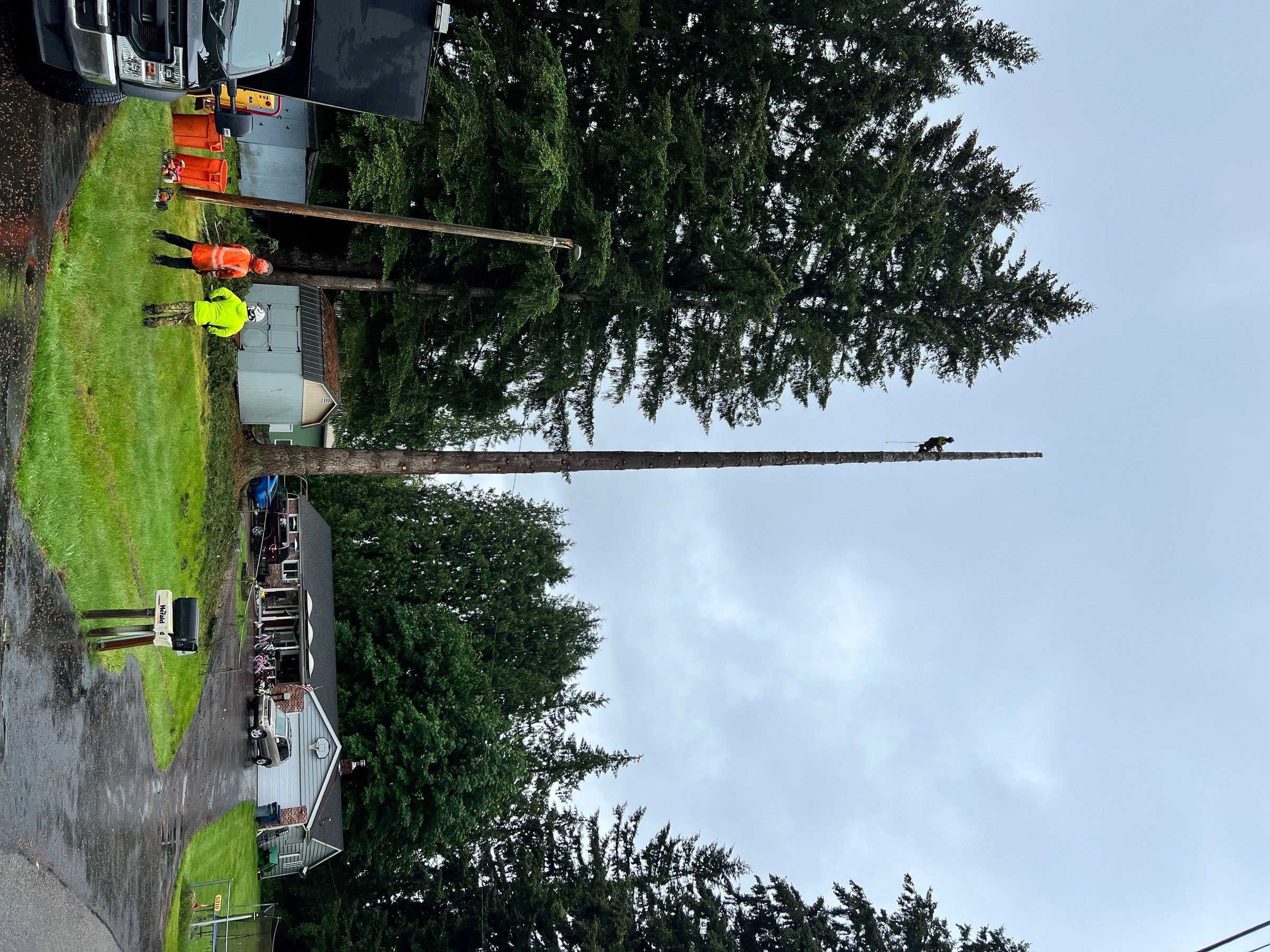
Tree Care in Arlington, WA: Floodplain and Second-Growth Guide
Arlington, WA — March 30, 2026
Tree work in Arlington has to account for two distinct terrains at once: the active Stillaguamish River floodplain that runs through downtown and out toward Trafton, and the dense second-growth timber covering the higher ground beyond the valley floor.
Why Does the Stillaguamish Floodplain Change How You Manage Trees in Arlington?
Arlington straddles the North Fork Stillaguamish River at one of the lowest elevations in northern Snohomish County — 89 feet above sea level at the river bridge, with the historic downtown grid and Haller Park sitting only a handful of feet higher. That elevation places much of the area south of SR 530 inside or near the active floodplain, depending on parcel-by-parcel mapping, where channel migration, sediment deposition, and bank scour reshape the landscape in measurable ways every winter. Trees that grew up in those conditions developed root architecture suited for moving soils and high water tables, but today's storm intensities and the cleared agricultural margins around the river are testing that architecture in ways those trees were never selected for. On the higher ground above the floodplain — the Smokey Point corridor north of the city, the rural acreage running east toward Trafton, and the ridge that climbs further east into the SR 530 corridor toward Oso — the situation is different but no easier. The uplands carry second-growth timber that regrew after early-twentieth-century logging, and it grew up dense. Trees in those stands have slender trunks and small root flares because they competed for light from the start and never had to stand alone. When a neighbor clears a few acres, the trees on the new edge get exposed to wind loads they were never built to handle, and we see them fail in the next sustained windstorm.
- Downtown Arlington and the agricultural flats sit inside the active Stillaguamish floodplain at 89 feet elevation
- Saturated floodplain soils can compromise root anchorage during a single sustained rainy week
- Dense second-growth stands on Smokey Point and Trafton uplands hide weak edge trees after adjacent clearing
- Tree work along the SR 530 corridor toward Oso requires extra care reading slope and root conditions
How Saturated Floodplain Soils Weaken Tree Anchorage
Trees on the Stillaguamish floodplain face a recurring set of problems that we walk through on every site visit south of SR 530:
- Prolonged Soil Saturation: When the river runs high for weeks at a time, the soils around tree roots stay saturated long enough that anaerobic conditions develop. Fine roots die back, fungal pathogens like Armillaria gain ground, and the tree's anchoring system thins out before the homeowner sees any change above ground. Western red cedar and Douglas fir on flood-prone parcels along the Stillaguamish flats commonly show declining vigor 18 to 24 months after a serious flood year.
- Sediment Loading at the Base: Each flood event deposits silt and fine sand against tree trunks. A few inches of new sediment seems harmless, but trees do not respond well to having their root flare buried — bark stays wet against the new grade, decay organisms get a foothold, and stability drops over a period of years. We routinely find buried root flares on properties along the river out toward Trafton where the original grade is six to twelve inches below current ground level.
- Channel Migration and Bank Scour: The North Fork Stillaguamish does not stay in one channel. Bends migrate, oxbows form and cut off, and bank scour can remove ten or twenty feet of soil from a single property in one high-water season. Trees that were thirty feet from the bank in October can be undermined by April. We assess the bank position from the previous winter before quoting any removal within sixty feet of the active channel.
- Wind on Saturated Ground: The combination is what produces uprooted trees — not flooding alone, not wind alone, but a westerly windstorm hitting trees rooted in soil that has been saturated for two weeks. The Convergence Zone storms that come through the Stillaguamish Valley between November and March hit hardest when the ground will not hold the load. This is the failure mode we respond to most often in Arlington emergency calls.
Why Arlington's Second-Growth Stands Behave Differently from Old Growth
The uplands around Arlington — Smokey Point, Trafton, the east-side acreage along Burn Road and the SR 530 corridor — are covered in trees that all grew in together after logging cleared this country a century ago. That shared history shapes how those trees behave today:
- Slender Trunks and Small Root Flares: When trees compete for light from seedling stage, they invest growth in height rather than diameter or root spread. The 100-foot Douglas fir on a typical Trafton acreage often has a 24- to 30-inch trunk where an open-grown tree of the same height would carry a 36- to 48-inch trunk and a much wider root plate. Less wood and less root means less margin against wind and less reserve when something starts to go wrong.
- Edge Tree Failures After Adjacent Clearing: The most predictable Arlington upland failure happens after a neighbor clears land for a new home or pasture. Trees that grew up sheltered inside the stand suddenly face full wind exposure on one side. They have not built reaction wood for that load, and within one or two storm seasons, the new edge can lose multiple trees. We see this every spring on properties where late-fall windstorms hit a recently exposed edge.
- Snags Hidden in the Canopy: Dense second-growth stands carry significant numbers of dead standing trees — snags that lost the light competition years ago and quietly died in place. From the ground, they are screened by neighboring crowns. From inside the stand, they are obvious. Snag inventory and removal is part of every multi-tree assessment we do on Arlington acreage, because a rotting snag becomes a falling-debris hazard for crews working anywhere near it.
- Laminated Root Rot Pockets: Phellinus weirii — laminated root rot — moves through second-growth Douglas fir and western hemlock stands across the Stillaguamish drainage. Infected trees can look fine from outside while their root systems are decomposing. When one tree fails, neighboring infected trees often follow within a few seasons. Where we see conks at the base of one tree, we recommend assessment of every conifer within sixty feet.
Species Most Affected by Arlington's Conditions
Different trees fail in different ways across Arlington's two terrains. These are the species and patterns we see most:
- Douglas Fir on Floodplain Margins: Doug fir is not a wetland species, and trees growing on the flood-prone margins of the Stillaguamish gradually decline as repeated saturation kills fine roots. We see crown thinning, top dieback, and eventual failure within a decade of properties starting to flood more frequently.
- Western Red Cedar on Saturated Ground: Cedar tolerates moisture better than fir but still suffers when soils stay saturated month after month. The classic Arlington cedar failure is a tree that looks healthy in summer, develops yellow foliage by late winter, and uproots in the next spring storm.
- Red Alder Along Banks and Ditches: Alder colonizes any disturbed wet ground, and Arlington has plenty of it — irrigation ditches, drainage channels, riverbanks. These trees serve a real function holding banks together, but they are short-lived (40 to 60 years) and become structurally weak well before they look it. Aging alders along Arlington pasture margins are a frequent removal candidate.
- Black Cottonwood on Riverbank Properties: Cottonwood drops large limbs without warning, especially after ice storms or after extended dry periods that stress the tree. The big cottonwoods along the Stillaguamish riverbank are picturesque but high-maintenance, and we recommend regular crown assessment on any cottonwood within striking distance of a structure.
How We Approach Tree Removal on Arlington Floodplain Properties
Floodplain and rural-acreage work in Arlington follows a sequence designed to read the ground before it reads us:
- Site Visit and Bank Assessment: For any property within sixty feet of the active Stillaguamish channel, we walk the bank before quoting. We look at how far the channel moved last winter, where active scour is happening, and which trees may already be partly undermined by the time the work happens.
- Root Flare Inspection: We check whether sediment deposition has buried the root flare on the trees we are working on or staging equipment near. A buried flare changes how a tree behaves under cutting loads and changes where we set our anchors.
- Equipment Staging on Stable Ground: Chipper trucks and bucket trucks need stable ground to operate safely. On saturated floodplain parcels, we stage equipment on the highest ground available and run extra hose, lines, or hauls to the work area rather than driving heavy machines onto soft soils.
- Cleanup That Respects Pasture and Fencing: Most rural Arlington properties have cattle, horse, or hay operations that cannot afford gates left open or chips dropped into hayfields. We coordinate with the property owner on which gates open when, where wood gets stacked, and where chips can be staged without disrupting field work.
Arlington Tree Care Questions We Hear Most
- Does my Arlington property need a permit for tree removal in the Stillaguamish floodplain?
- Snohomish County's Critical Areas Ordinance applies to properties inside designated frequently flooded areas, wetland buffers, and stream corridors. Standard removal of hazard trees on developed residential lots is often allowed without a permit, but if your parcel is mapped as a critical area, the work may require notification or a streamlined critical area review. We check the county GIS mapping for every Arlington property before quoting and let you know what applies.
- How soon after a flood event should I have trees inspected?
- Wait until the soils have drained enough to walk on without leaving deep prints — typically two to four weeks after the river drops below flood stage. That is when we can see whether sediment has buried any root flares, whether bank position has changed near your trees, and whether any conifers are showing the early lean that signals root failure.
- We just cleared land next to our second-growth stand — what should we expect?
- Plan on a tree assessment in the first growing season after the clearing. Trees on the new edge are at elevated risk for the next two to four winters as they either build reaction wood and stabilize, or fail. Removing the highest-risk edge trees and crown-thinning the remaining stand to reduce wind load is the most cost-effective intervention before the first major windstorm hits the new edge.
- How do you reach trees on rural Arlington acreage with long driveways and unpaved roads?
- Our equipment is set up for rural access. We bring four-wheel-drive chip trucks, mid-size chippers that fit on standard pickup-rated farm tracks, and rigging gear that works on the larger conifers found on Trafton-area acreage. We plan travel time and route into the estimate so rural Arlington jobs do not surprise you on the bill.
- What does removal of a typical floodplain Douglas fir cost in Arlington?
- A 70- to 90-foot Douglas fir on accessible ground in or near the Arlington floodplain typically runs $1,200 to $2,400 depending on lean direction, structures nearby, and access. Trees over the river itself, trees that require directional felling away from a building, or trees on saturated ground requiring matting under equipment can run $2,500 to $4,000. Free on-site estimates are the only honest way to price this work.
Tree Concerns on Your Arlington Property?
K&J Tree Works has cleared timber and managed hazard trees on properties throughout the Arlington area, from the Smokey Point corridor and downtown to the agricultural flats along the Stillaguamish River and the rural acreage out toward Trafton. We provide free on-site assessments for every Arlington property. Call (425) 223-7904 or request an estimate online. Monday through Saturday, 8 AM to 5 PM.