Cottonwood Tree Problems in Western Washington: Roots, Limb Drop & When Removal Makes Sense
Marysville, WA — July 26, 2026
Black cottonwood is the fastest-growing — and most complained-about — native tree in western Washington. This guide covers how to identify it, why it drops limbs without warning, what its roots do to foundations and sewer lines, and how to decide between removal and management.
How to Recognize a Black Cottonwood
Black cottonwood (Populus trichocarpa) is the tallest broadleaf tree in the Pacific Northwest — mature trees commonly reach 100 to 150 feet, taller than most of the conifers around them. Look for deeply furrowed gray bark on older trunks, triangular-to-oval leaves that are shiny green on top and pale silvery underneath, sticky sweet-smelling buds in spring, and the species' namesake: cotton. In late May and June, female trees release drifts of white cottony seed fluff that coats lawns, clogs gutters and AC units, and blankets whole neighborhoods. Cottonwoods dominate river floodplains and wet ground across Snohomish and King County — the Snohomish, Skykomish, and Stillaguamish river valleys, the Ebey Slough lowlands around Marysville, and any low parcel where water sits in winter. If you have a huge, fast-growing tree on wet ground that rains down twigs after every windstorm, it is very likely a cottonwood.
- Fastest-growing native tree in western Washington — 6+ feet per year when young
- Brittle wood that sheds limbs in summer heat, not just in storms
- Water-seeking roots that lift driveways and invade sewer lines
- A decision guide: when to remove, when to manage, and what it costs
Is My Cottonwood Tree Dangerous?
A mature cottonwood within striking distance of a house, garage, driveway, or play area is one of the higher-risk trees a western Washington homeowner can own. That is the direct answer. Cottonwood wood is weak and brittle for the tree's enormous size, the species sheds large live limbs with little warning — including on calm summer days — and the trunk and major unions decay quickly once damaged. A cottonwood standing well away from anything it could hit is a fine wildlife tree; the same tree 40 feet from your roof is a different conversation. Here are the specific failure patterns we see:
- Sudden Summer Limb Drop: Cottonwoods are the classic case of what arborists call sudden branch drop — large, healthy-looking limbs releasing on hot, still summer afternoons with no storm in sight. The mechanism is debated, but the pattern is well documented in poplars. A limb that is 12 inches thick and 40 feet long hits the ground with enormous force. This is why we treat cottonwoods over patios, driveways, and kids' play areas as a standing hazard, not just a storm risk.
- Brittle, Fast-Grown Wood: The growth rate that makes cottonwoods impressive also makes them weak. Fast-grown poplar wood has low density and poor branch attachment, and the species favors upright, tightly-angled unions that split under wind loading. October-through-March windstorms off Puget Sound routinely tear out cottonwood tops and co-dominant stems.
- Rapid Internal Decay: Every torn limb and topping cut becomes a decay column. Cottonwoods compartmentalize damage poorly, so a tree that lost its top in a storm five years ago is often hollow at that point today. Woodpecker activity, conks, and carpenter ants around old wounds are all signs the interior is going soft.
- Whole-Tree Failure on Saturated Ground: Cottonwoods grow where water is — which means their root plates sit in soil that saturates every winter. A 130-foot tree with a rain-soaked root plate and a full sail of canopy is exactly the profile of the whole-tree failures we respond to after wind events in the river valleys and floodplain neighborhoods.
What Cottonwood Roots Do to Foundations, Driveways, and Sewer Lines
Cottonwood roots cause more property damage over time than cottonwood limbs. The species is engineered by evolution to find water fast, and on a residential lot the reliable water sources are your sewer lateral, your septic drain field, your downspout lines, and the moist soil under slabs and foundations:
- Sewer and Septic Intrusion: Cottonwood roots follow condensation on pipes and enter through any joint or hairline crack, then expand into root masses that plug the line. Older neighborhoods with concrete or clay sewer laterals — common in Marysville, Everett, and Snohomish — are the classic setting. If your plumber keeps pulling roots from the same lateral every couple of years and there is a big cottonwood in range, the tree is usually the source.
- Lifted Slabs and Driveways: Shallow structural roots thicken with age and lift whatever sits above them. We regularly see driveways, walkways, and patio slabs cracked and tilted 20 to 40 feet from the trunk — cottonwood roots run far past the canopy edge.
- Foundation and Crawl-Space Trouble: Roots do not crush foundations, but they exploit them: they wedge into existing cracks, clog perimeter drains, and dry out or heave the soils that footings bear on. On the wet lowland lots where cottonwoods thrive, a compromised perimeter drain shows up as a wet crawl space every winter.
- Sucker Regrowth: Cut a cottonwood down and its root system answers with suckers — sometimes dozens of shoots from roots across the yard. Managing regrowth is part of a real removal plan, and it is one reason cottonwood removal is a decision to make once, properly, rather than piecemeal.
Remove It or Manage It? A Decision Guide
Not every cottonwood needs to come down. Here is how we walk homeowners through the decision on a free hazard tree assessment:
- Remove: Within Striking Distance of a Structure: If the tree can reach a house, garage, shop, or a neighbor's structure when it fails — and cottonwoods fail more often than almost any other local species — removal is usually the honest recommendation. Waiting rarely improves the situation; the tree only gets taller and heavier.
- Remove: Active Root Damage: Recurring sewer-line root blockages, a lifting driveway, or a chronically wet crawl space traced to root activity are progressive problems. Trimming the canopy does nothing for roots — removal is the fix that lasts.
- Manage: Big Tree, Open Ground: A cottonwood in a back pasture, along a rural property edge, or in a greenbelt with nothing in its fall zone can stay. Cottonwoods are genuinely valuable wildlife trees — eagles and herons nest in them, and cavity-nesters use the soft wood. Periodic deadwood removal keeps the risk acceptable.
- Manage Carefully: Crown Reduction Buys Time, Not Safety: Reducing a cottonwood's height and end-weight can lower risk temporarily, but the regrowth comes back fast, weakly attached, and more failure-prone than what was removed. Never let anyone top a cottonwood — topping creates the decayed, multi-topped hazard trees we end up removing under emergency conditions a decade later.
- Check Your City's Rules First: Cottonwoods are so widely disliked that several local codes treat them differently — Bothell's tree code, for example, explicitly excludes cottonwood from its protected significant-tree definition. Rules vary by city, so check your city's tree rules or ask us what applies to your parcel before scheduling removal.
What Cottonwood Removal Involves and Costs
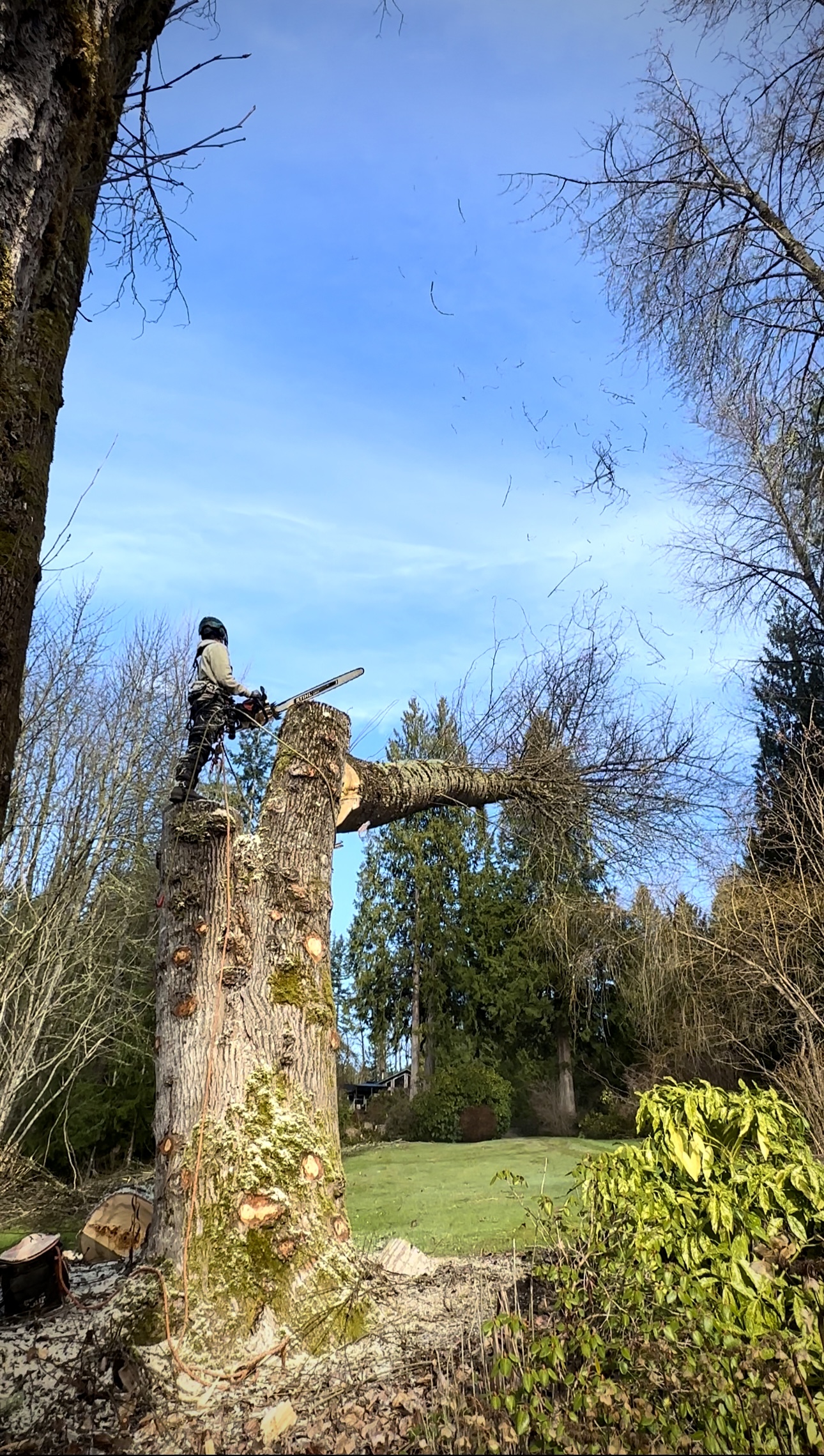
Cottonwood removals are big jobs. The trees are tall, the wood is heavy with water, and the brittleness that makes them hazardous also makes them tricky to climb and rig — every piece has to be assessed before it is trusted with a climber's weight or a rigging load. Expect $1,500 to $5,000+ for a mature cottonwood in western Washington, driven by height, trunk diameter, decay, and how close the tree stands to structures. Trees with significant decay may require a crane or lift because the stem cannot be safely climbed. The wood itself has little value — it is poor firewood that rots quickly — so most homeowners have us chip and haul everything. On floodplain and riverside parcels, we also flag whether the tree falls under critical-area rules before any work is scheduled. For the technical background on how tree failures are assessed, the Washington DNR forest health program page is a good authority resource, and the US Forest Service black cottonwood species profile covers the species' biology in depth.
Cottonwood Questions We Hear Most
- Are cottonwood trees dangerous?
- Near structures, yes — more than most local species. Cottonwoods combine brittle wood, sudden summer limb drop, fast internal decay, and enormous size, which is a high-risk profile when homes, driveways, or play areas sit within falling distance. Away from targets, they are valuable wildlife trees that can safely stay.
- Why do cottonwoods drop branches in summer?
- The pattern is called sudden branch drop, and poplars are among the most prone species. Large limbs can release on hot, windless afternoons with no visible defect. The exact mechanism is still debated, which is why arborists treat overhanging cottonwood limbs as a hazard regardless of storm forecasts.
- How far do cottonwood roots spread?
- Well beyond the canopy — root damage 20 to 40 feet from the trunk is routine, and roots chasing a water source like a leaking sewer lateral can travel much farther. If a cottonwood stands within about 50 feet of your sewer line, septic field, or foundation drains, it is close enough to matter.
- Do I need a permit to remove a cottonwood in Washington?
- It depends on your city and whether the tree is in a critical area such as a stream buffer or steep slope. Some codes, like Bothell's, specifically exclude cottonwood from protected-tree status; others regulate all trees over a size threshold. We tell you which rules apply to your specific parcel during the free estimate.
- Can you just top my cottonwood instead of removing it?
- We do not top trees, and cottonwoods are the clearest example of why. Topping triggers fast, weakly-attached regrowth and opens the stem to decay, producing a tree that is more dangerous within a few years — and more expensive to remove once it is hollow. Proper crown reduction or full removal are the professional options.
Have a Cottonwood You're Worried About?
K&J Tree Works removes and manages cottonwoods across Snohomish and King County — from Marysville floodplain lots to riverside parcels up the Highway 2 corridor. We will give you an honest read on whether your tree can stay or needs to go, and a written quote either way. Call (425) 223-7904 or request a free assessment online. Monday through Saturday, 8 AM to 5 PM.