Hazard Tree Assessment in Edmonds, WA: Bluff Erosion Guide
Edmonds, WA — April 6, 2026
Edmonds' five miles of Puget Sound shoreline and the steep bluffs above it set the rules for tree care on most waterfront and view-side properties. Aging Douglas fir, shallow Edmonds-series soils, and view pressure from below the canopy combine into a tree management challenge that does not exist three miles inland.
Why Are Bluff Trees the Defining Tree Care Challenge in Edmonds?
Most cities in Snohomish County have one or two terrains. Edmonds has at least four within a couple of miles: the hilltop neighborhoods of Perrinville, Seaview, and Westgate at roughly 300 feet elevation; the steep Bowl valley with its dense canopy of mature Douglas fir, western red cedar, and big leaf maple; the bluff edge along Sunset Avenue and Brackett's Landing where the land drops sharply to Puget Sound; and the narrow waterfront strip itself. The bluff edge is the geography that defines tree management here. Edmonds-series soils — the shallow, well-drained glacial soils mapped across the city — limit how deep roots can grow on most lots. Below the soil sits marine clay and glacial till that does not hold water well and slumps periodically when saturation builds up. The Douglas fir and western red cedar on these slopes were never adapted for the situation they are now in: 60 to 100 years old, growing on shallow soil over unstable subsoil, exposed to the sustained westerly winds and salt-bearing air that come off Puget Sound. Add view pressure from neighbors and homeowners trying to keep their water and Olympic Mountain views, and you have a tree management environment that looks nothing like inland Lynnwood three miles east.
- Edmonds spans roughly 300 feet of elevation from hilltop neighborhoods to the Puget Sound waterfront
- Edmonds-series soils are shallow over marine clay, limiting root depth and slope stability
- Aging conifers from the post-logging regeneration era are reaching the end of their stable lifespan
- Bowl, bluff, and hilltop terrains each require different tree-care approaches
How Edmonds-Series Soils and Bluff Geology Affect Tree Stability
Knowing what is under your trees explains a lot of what those trees are doing. On a typical Edmonds bluff or hilltop lot, the soil profile looks like this:
- Shallow Topsoil and Subsoil Layer: Edmonds-series soils run roughly 12 to 30 inches deep before hitting the underlying glacial till. That is enough for shrubs, lawn, and small ornamentals to thrive but not enough for a 100-foot Douglas fir to develop the deep anchoring root it would have on a deeper inland soil. Roots flatten out instead of going down.
- Glacial Till and Marine Clay Below: Below the soil sits dense glacial till and, near the bluffs, marine clay deposits. Neither layer accepts root penetration, and neither holds excess water well. When winter rains saturate the topsoil, water perches on the till and creates a slip plane between the rooted layer and the unrooted material below. That is the geology behind most Edmonds bluff slumps.
- Bluff-Edge Soil Loss: Edmonds bluffs erode steadily through a combination of toe scour from Puget Sound, surface runoff cutting gullies, and groundwater seepage destabilizing the face. Bluff retreat rates vary block by block, but on the more active stretches above the Edmonds Underwater Park and along the southern waterfront, we see measurable retreat over a decade. Trees that were thirty feet from the edge twenty years ago are now ten feet from it, and removal logistics change accordingly.
- Wind on Shallow Roots: The combination of shallow soil and exposed-bluff position means Edmonds conifers have less root system than open-grown trees of the same size and face wind loads inland trees do not. Crown thinning and weight reduction on tall conifers is far more important here than in Lynnwood or Mountlake Terrace.
Why Mature Douglas Fir Become a Liability on Edmonds Slopes
The dominant Douglas fir age class on Edmonds bluffs and hillsides regrew between roughly 1925 and 1955 after the original stand was logged. Those trees are now 70 to 100 years old, and several factors push them toward the high-risk end of their lifespan on Edmonds-specific terrain:
- Root Architecture Mismatch: Douglas fir on deep inland soils develops a wide root plate with strong anchor roots driving down where it can. On Edmonds-series soils over till, that anchor root has nowhere to go and the lateral plate stays shallow. The taller the tree gets, the worse the leverage ratio gets.
- Salt Air and Westerly Wind Stress: Trees within roughly 1,500 feet of the bluff edge get measurable salt deposition from wave action during winter storms, and they get sustained wind loading whenever a westerly comes off the Sound. Both stresses accumulate over decades, and they show up as reduced live crown ratio and reaction-wood loading on the windward side of the trunk.
- View-Pressure Pruning History: Many older Edmonds firs have been topped or heavily reduced over the years to preserve neighbor views. Topping cuts produce weakly attached regrowth that increases failure risk a decade or two later. We frequently inspect Edmonds firs whose previous topping wounds are now decay columns running down the trunk.
- Slope Failure During Storm Sequences: When a windstorm hits during a saturated period, the failure mode is rarely a single broken branch — it is a whole tree leaning out, dragging soil with it, and pulling neighboring trees off balance. The bluff edges above Sunset Avenue and the steep Bowl hillsides are where we see this most often. Proactive removal of the highest-risk firs before that situation develops is far cheaper than emergency response after.
Bowl Neighborhood vs. Waterfront Bluff: Different Trees, Different Decisions
Tree decisions in Edmonds depend heavily on which microsite the property sits on. Three patterns shape almost every job:
- The Bowl: Sheltered, Dense, Slope-Stabilizing: The Bowl sits in a natural depression with steep wooded sides protecting it from direct Sound exposure. Trees here are sheltered from wind and salt but grow in dense canopy where root systems contribute to slope stability. Removing a single tree is rarely the right answer in the Bowl — selective thinning and structural pruning preserve the slope-stabilizing canopy while reducing risk on individual trees.
- The Waterfront Bluffs: Exposed, Eroding, View-Pressured: Properties along Sunset Avenue, the Pine Ridge area, and the southern waterfront bluffs face a different reality. Trees here are wind-shaped and salt-stressed, the bluff itself is retreating, and almost every conversation with a homeowner involves view considerations. Removal decisions weigh long-term bluff stability against immediate view goals, and we are often the ones recommending against a removal the homeowner asked for because the tree is doing slope work the homeowner cannot easily replace.
- The Hilltop Neighborhoods: Exposure Without Bluff Risk: Perrinville, Westgate, and Seaview sit at the city's high points and face the same wind and salt as the bluffs without the slope concerns. Tree work here looks more like standard upland Snohomish County work, with the added wrinkle of preserving the Olympic Mountain views that drove most homeowners to buy in these neighborhoods.
How We Plan a Bluff-Adjacent Removal in Edmonds
Bluff-edge work demands more planning than a standard residential removal. Our sequence on Edmonds waterfront jobs runs:
- Bluff-Edge Walk and Slope Read: We walk the bluff face from the toe up if access allows, looking for active scour, seepage points, recent cracking, and where the tree's root mass actually sits relative to the bluff edge. This often shifts the removal plan because the tree's anchor zone is rarely where the homeowner thought it was.
- Crown-Reduction Alternatives Discussion: Before quoting a removal on the bluff edge, we walk the homeowner through whether crown reduction or structural pruning could achieve the safety or view goal without losing the slope-stabilization function. About a third of bluff-edge inspections end in pruning rather than removal.
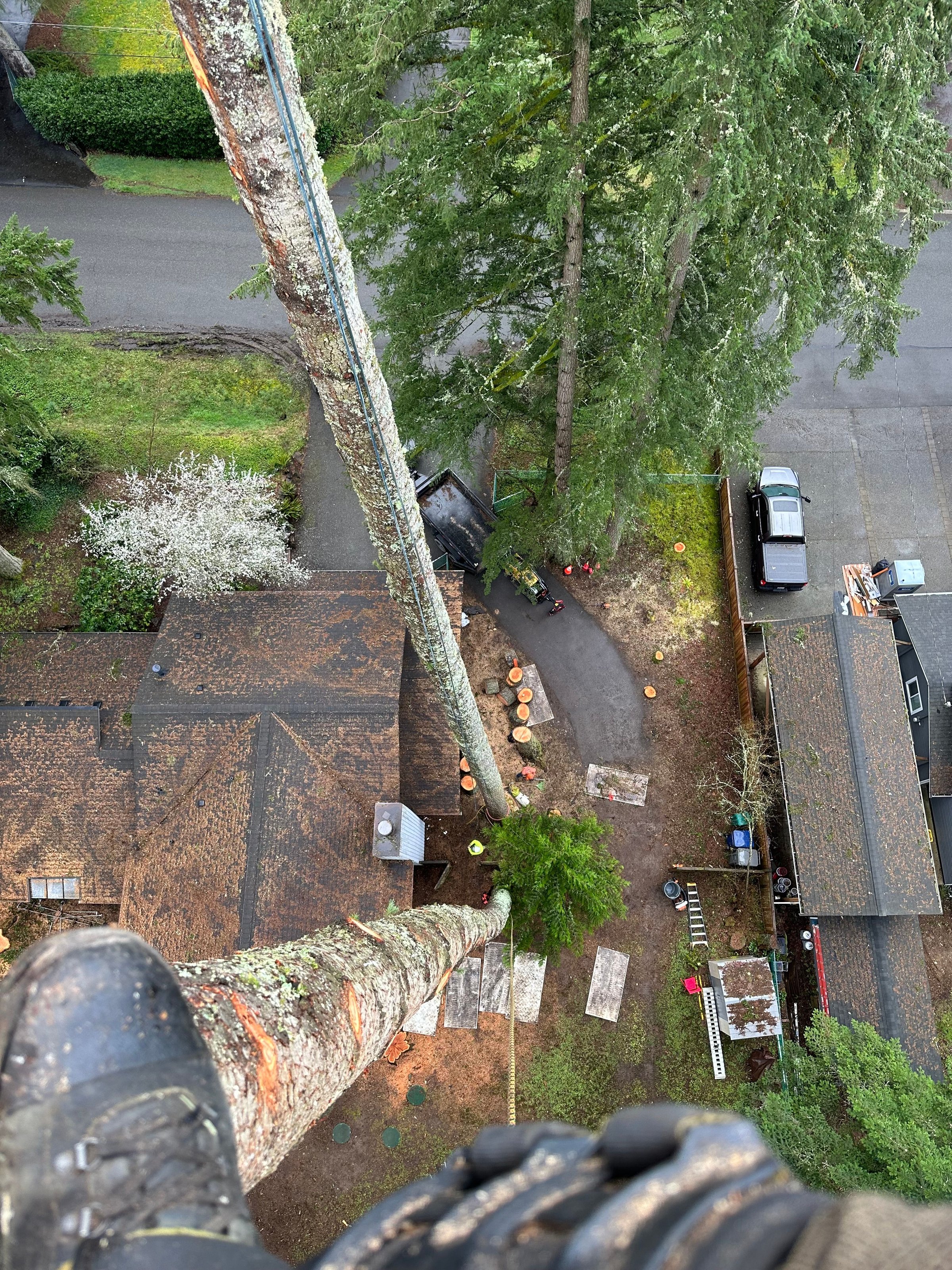
- Sectional Dismantle from the Top Down: Bluff-edge trees almost always come down in sections from the top, with each piece lowered or rigged out away from the bluff face. Dropping the trunk is almost never an option because there is nowhere safe for it to fall and because dropping would shock the soil mass on the slope.
- Erosion Control After Removal: We leave erosion control matting or seed-mix recommendations on every bluff job. The newly exposed soil where the tree's root flare sat needs cover before the next storm season or it becomes the starting point for the next gully.
Edmonds Tree Care Questions We Hear Most
- Does Edmonds require a permit to remove a tree on my bluff lot?
- Edmonds has tree preservation regulations that vary by zoning and by whether the property sits in a critical area. Bluff-edge lots, steep slopes over 40 percent, and parcels within shoreline jurisdiction typically face additional review. Permitting decisions are made by the City of Edmonds Planning and Development Department, and we recommend contacting them before any significant tree removal in those zones. We can help describe the work in the format the city tends to ask for.
- Can I remove the Douglas fir blocking my Olympic Mountain view?
- Probably, but the right answer is often pruning rather than removal. Vista pruning — selectively thinning interior branches and lifting the lower canopy — can open a view corridor without removing the tree. On bluff lots, the slope-stabilization role of the tree may also weigh against removal. We assess the specific tree and view geometry before recommending an approach.
- My neighbor's fir on the bluff above me is leaning toward my house — what can I do?
- Start with a conversation, then a written request if needed. You have the right under Washington law to trim branches that overhang your property, but you cannot enter your neighbor's land or remove the tree. If the lean represents a real hazard, an arborist assessment from a third party documenting the risk often moves the conversation forward. We provide neutral assessments that both parties can use.
- How much does a typical bluff-edge removal cost in Edmonds?
- Bluff-edge removals run noticeably higher than standard residential work because the rigging is more complex, the dismantle is sectional from the top, and erosion control follow-up is required. A 70- to 90-foot fir on a bluff-edge lot in Sunset Avenue or Pine Ridge typically runs $2,500 to $4,500. Easier-access trees on hilltop lots in Perrinville run more like $1,500 to $2,800 for a comparable size. Free on-site estimates are the right way to price your specific situation.
- Is it safe to remove the trees holding the bluff together?
- Sometimes the right answer is not to. Trees that are visibly stabilizing a bluff face may need to stay even if they pose other concerns. When removal is necessary for safety, we coordinate with the homeowner on replacement plantings — typically with deeper-rooted native species like Pacific madrone or salal — that can take over the stabilization role over a few seasons. Bluff stability and tree management are the same problem in Edmonds, not two separate ones.
Bluff or Bowl Tree Concerns in Edmonds?
K&J Tree Works has worked on Edmonds properties from the bluff lots above Sunset Avenue to the hillside ornamentals in the Bowl and the hilltop firs in Perrinville and Seaview. We provide free, no-pressure on-site assessments and will recommend pruning over removal whenever it is the right answer for the tree and the slope. Call (425) 223-7904 or request an estimate online. Monday through Saturday, 8 AM to 5 PM.