Tree Care in Mukilteo, WA: Salt Air and Coastal Wind Guide
Mukilteo, WA — March 31, 2026
Mukilteo's waterfront bluffs face prevailing Puget Sound westerlies that carry salt spray inland. This coastal exposure shapes how trees grow, fail, and need to be managed differently than inland communities.
What Does Puget Sound Exposure Do to Mukilteo's Trees?
Mukilteo occupies a series of coastal bluffs and benches rising 100 to 250 feet above the Puget Sound waterfront, from the ferry terminal at Mukilteo Beach northward past the Lighthouse Park and along the Harbour Pointe community. This west-facing geography means every tree in Mukilteo is exposed to the prevailing winds that cross Puget Sound from Whidbey Island — sustained 15 to 25 mph westerlies during fall and winter storms, with gusts reaching 50 mph or more during major events. These winds carry salt aerosol from wave action that deposits on foliage, particularly on the windward side of tree canopies. Salt spray causes desiccation and burn on leaf tissue, which is why the western crowns of trees along 5th Street, Mukilteo Speedway, and the Harbour Pointe bluffs often show brown, sparse foliage while the lee side stays green. Over decades, this asymmetric salt damage combined with wind loading causes trees to develop a pronounced eastward lean — trunks grow away from the wind, canopies develop more mass on the protected side, and root systems reinforce disproportionately on the windward (west) side. This lean is not inherently hazardous, but it does concentrate weight over properties and structures downhill to the east, and it influences how every pruning cut and removal plan must be designed.
- Prevailing westerlies carry salt spray that burns windward foliage and causes eastward lean
- Bluff-edge trees face slope stability concerns that complicate removal decisions
- Japanese Gulch and Lighthouse Park heritage trees require specialized management
- Harbour Pointe HOA tree rules layer on top of Mukilteo's municipal code
How Salt Air and Wind Affect Specific Tree Species in Mukilteo
Not all tree species respond to Mukilteo's coastal conditions the same way. Here is what we see on properties throughout the city:
- Douglas Fir — Salt-Stressed Crowns: Douglas fir is moderately tolerant of salt spray, but prolonged exposure on Mukilteo's bluff-top lots causes needle burn and dieback on the windward crown. Over time, the tree develops an asymmetric canopy — full and green on the east side, thin and brown on the west. This does not necessarily mean the tree is unhealthy, but the dead branches on the windward side become falling hazards, and the unbalanced crown increases the eastward lean. We prune these trees to remove dead windward branches and selectively thin the heavy lee-side crown to reduce the lever arm.
- Shore Pine — Naturally Wind-Adapted: Shore pine (Pinus contorta var. contorta) is the one conifer that thrives in Mukilteo's salt and wind exposure. Found naturally along the bluffs near Lighthouse Park, shore pines develop the sculpted, wind-pruned forms that characterize Pacific Northwest coastlines. These trees rarely need management except for deadwood removal. Homeowners who plant shore pine as replacements in coastal Mukilteo get a species that is adapted to the conditions rather than fighting them.
- Big Leaf Maple — Epiphyte Loading Plus Wind: Mukilteo's big leaf maples carry heavy moss, licorice fern, and polypody fern colonies on their branches — typical for Puget Sound lowlands. But in Mukilteo, the sustained wind adds dynamic loading on top of the static epiphyte weight. Branches that a maple in sheltered Bothell can support become overloaded in Mukilteo when wind gusts add lateral force to the downward weight. Crown thinning and selective limb removal are more critical here than in inland communities.
- Western Red Cedar — Lean and Bluff Edge Risk: Western red cedar's shallow, wide root system makes it the species most prone to windthrow on Mukilteo's bluffs. Cedars growing within 30 feet of bluff edges along Harbour Pointe and the Mukilteo Speedway corridor lean significantly eastward, and bluff erosion gradually undermines the windward root system. These are the highest-priority trees for assessment in Mukilteo — a cedar falling off a bluff can slide downslope and damage properties or infrastructure below.
Bluff-Edge Trees: Balancing Stability and Safety in Mukilteo
Mukilteo's bluff-top properties face a paradox — trees both protect and threaten slope stability:
- Trees as Bluff Stabilizers: Tree roots bind soil on coastal bluffs and reduce surface erosion from rainfall. Removing all trees from a bluff edge can accelerate erosion and slope instability. Snohomish County's critical area regulations recognize this by restricting tree removal in geologically hazardous areas — which includes many of Mukilteo's bluff properties. Complete clearing of bluff-edge vegetation typically requires a geotechnical assessment.
- Trees as Bluff Hazards: Conversely, a large tree that fails on a bluff edge can pull out a section of the slope, triggering a larger slide. The weight of a 90-foot Douglas fir — trunk, canopy, and root ball — can exceed 20,000 pounds. If the root plate rotates out during a windstorm, it creates a void in the bluff face that collects water and undermines adjacent ground. On Mukilteo's bluffs, a single tree failure can destabilize a 20- to 30-foot section of slope.
- The Management Middle Ground: The solution for bluff-edge trees in Mukilteo is selective management rather than wholesale removal or neglect. We reduce canopy weight and wind resistance through thinning and crown reduction, keeping the root system intact and functioning as a soil binder while reducing the wind load that could cause the tree to fail. For trees in advanced decline on bluff edges, we sometimes remove the trunk in sections while leaving the root system in place to continue stabilizing the soil.
How We Manage Trees on Mukilteo's Coastal Properties
Tree work in Mukilteo requires accounting for the wind, salt, and slope conditions unique to this waterfront city:
- Wind Exposure and Lean Assessment: We evaluate each tree's lean direction and magnitude, noting the prevailing wind direction relative to the property. On Mukilteo's west-facing bluffs, every tree leans east — but the degree of lean and the root system's response to it varies. We check for root plate movement on the windward side, trunk sweep indicating progressive lean over years, and crown asymmetry that concentrates weight over structures.
- Salt Damage Evaluation: We distinguish between salt spray damage — brown, desiccated foliage on the windward crown — and actual disease or decline. Salt damage is cosmetic on otherwise healthy trees. But when salt stress is combined with other factors like root damage or trunk decay, the tree's ability to recover from pruning wounds or resist pathogens is reduced. This changes how aggressively we can prune.
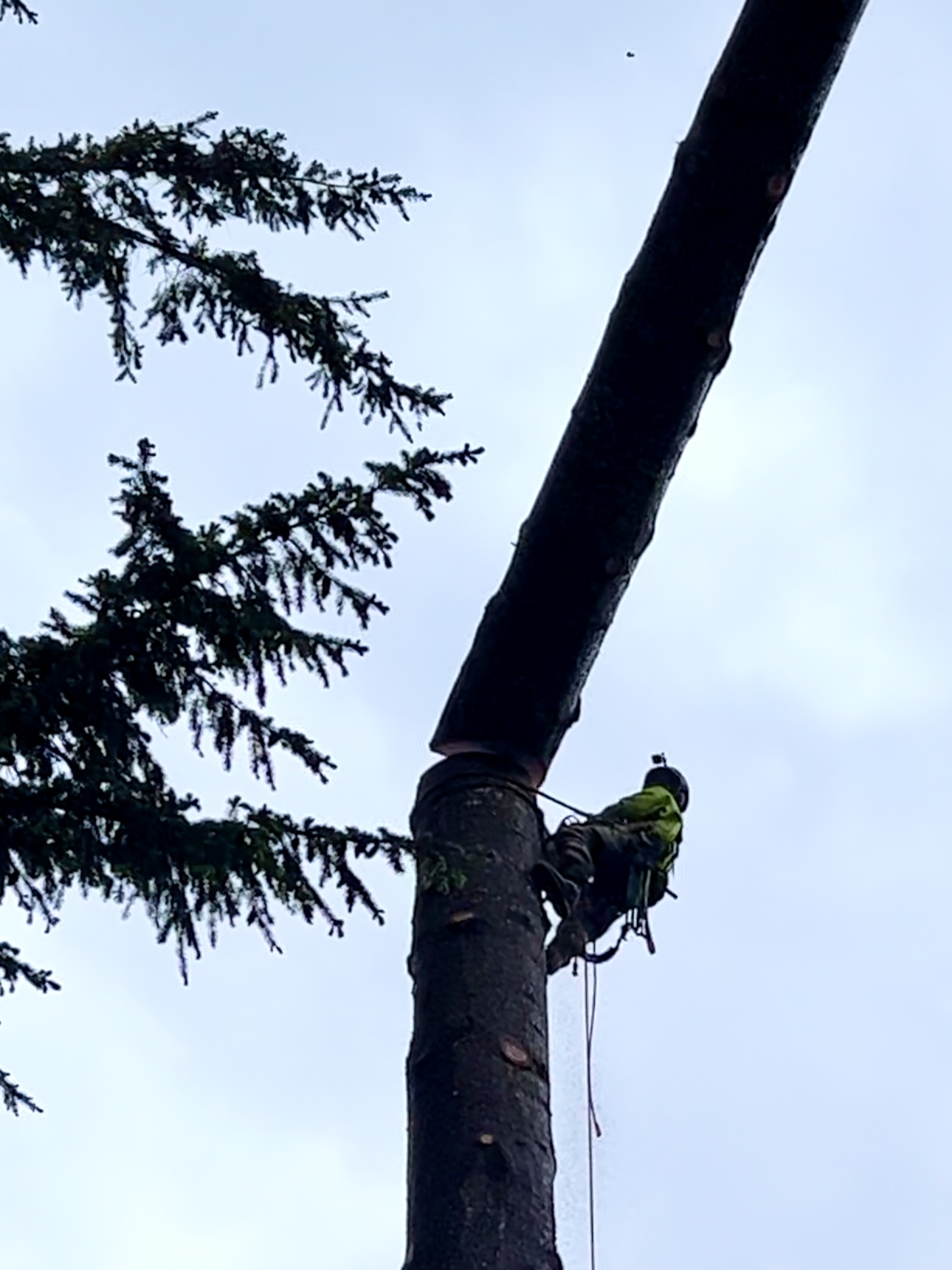
- Pruning to Reduce Wind Sail: The primary goal of pruning coastal Mukilteo trees is reducing the canopy's wind resistance — its sail area. We thin the crown to let wind pass through rather than pushing against a solid wall of foliage. We also reduce the length of extended limbs to shorten the lever arm that wind acts on. For bluff-edge trees, this wind reduction pruning can significantly extend the tree's safe service life.
- Bluff-Edge Coordination: For trees on or near Mukilteo's coastal bluffs, we coordinate with the property owner regarding Snohomish County's critical area regulations. Work in geologically hazardous areas may require a geotechnical letter confirming that tree work will not destabilize the slope. We position equipment away from bluff edges and lower cut material uphill away from the slope face.
Mukilteo Tree Care Questions
- Why do all the trees on my Mukilteo property lean the same direction?
- Prevailing westerly winds off Puget Sound push consistently against Mukilteo's trees throughout their lives. Trees respond by growing away from the wind — the trunk develops curvature toward the east, roots reinforce on the windward (west) side to resist overturning, and the canopy develops more branch mass on the sheltered east side. This is called wind-adapted growth and is normal for coastal trees. The lean becomes a concern only when it is progressive — increasing year over year due to root plate failure rather than gradual trunk curvature.
- Is the brown foliage on the west side of my trees a disease?
- In most cases, no. Brown, sparse foliage on the windward (west) side of trees in Mukilteo is salt spray damage — salt aerosol carried by Puget Sound winds desiccates needle and leaf tissue. This is common on Douglas fir, Western hemlock, and deciduous trees facing the water. The lee (east) side of the same tree is usually green and healthy. We prune out the dead windward branches to reduce falling hazard and improve the tree's appearance without treating it as a health issue.
- Can I remove trees blocking my Puget Sound view in Mukilteo?
- Possibly, but Mukilteo's regulations and the county's critical area rules apply. Trees on bluff-top lots may be in geologically hazardous areas where removal is restricted. Vista pruning — selectively thinning and shortening branches to frame views without removing the entire tree — is often the most permissible and practical approach. We design vista pruning plans for Mukilteo waterfront and bluff-top properties that balance the homeowner's view goals with regulatory requirements and slope stability needs.
- Do Harbour Pointe HOA rules affect what tree work I can do?
- Yes. Harbour Pointe's CC&Rs include tree maintenance and removal provisions that apply in addition to Mukilteo's municipal regulations. The Harbour Pointe Community Association typically requires architectural committee approval for tree removal and may specify replacement planting requirements. We have worked on many Harbour Pointe properties and can provide the documentation the committee requests, including scope of work descriptions, arborist assessments, and before-and-after plans.
- How far inland does salt spray damage extend in Mukilteo?
- Salt spray effects in Mukilteo are most pronounced within 500 feet of the bluff edge — this is where we see the classic windward brown, leeward green foliage pattern. Measurable salt deposition extends roughly 1,000 to 1,500 feet inland during major storms when sustained westerly winds carry aerosol from wave action on Puget Sound. Properties along the Mukilteo Speedway and in the upper Harbour Pointe neighborhoods above 200 feet elevation experience less direct salt spray but still get sustained wind exposure that affects tree form and health. The Japanese Gulch area, set in a natural ravine, provides surprising shelter from both salt and wind despite being close to the waterfront.
- Why do Western red cedars fall off the bluffs in Mukilteo more than other species?
- Western red cedar develops an extremely shallow, wide-spreading root system — the roots grow outward rather than downward, sometimes extending 30 to 40 feet from the trunk but only 12 to 18 inches deep. On Mukilteo's bluffs, this root architecture sits on top of the bluff soil with no deep anchoring into the underlying marine clay or glacial till below. When bluff erosion removes soil from the edge, it takes the cedar's shallow roots with it. Douglas fir, by contrast, sends roots deeper into the soil profile and is more resistant to edge erosion. This is why proactive management of bluff-edge cedars — crown reduction to decrease wind load before the roots are undermined — is particularly important in Mukilteo's waterfront neighborhoods.
Managing Coastal Trees on Your Mukilteo Property?
K&J Tree Works understands the specific wind, salt, and bluff conditions that affect Mukilteo's trees. We provide free on-site assessments for homeowners in Harbour Pointe, along the Mukilteo Speedway corridor, and throughout the city. Call (425) 223-7904 or request an estimate online. Monday through Saturday, 8 AM to 5 PM.