Historic Neighborhoods and Heritage Trees in Snohomish: What Property Owners Should Know
Snohomish, WA — April 8, 2026
Snohomish's historic downtown and surrounding neighborhoods contain some of the oldest residential trees in the county. Here's what property owners need to know about managing mature trees on historic lots.
Why Are Snohomish's Historic Trees Different from Suburban Trees?
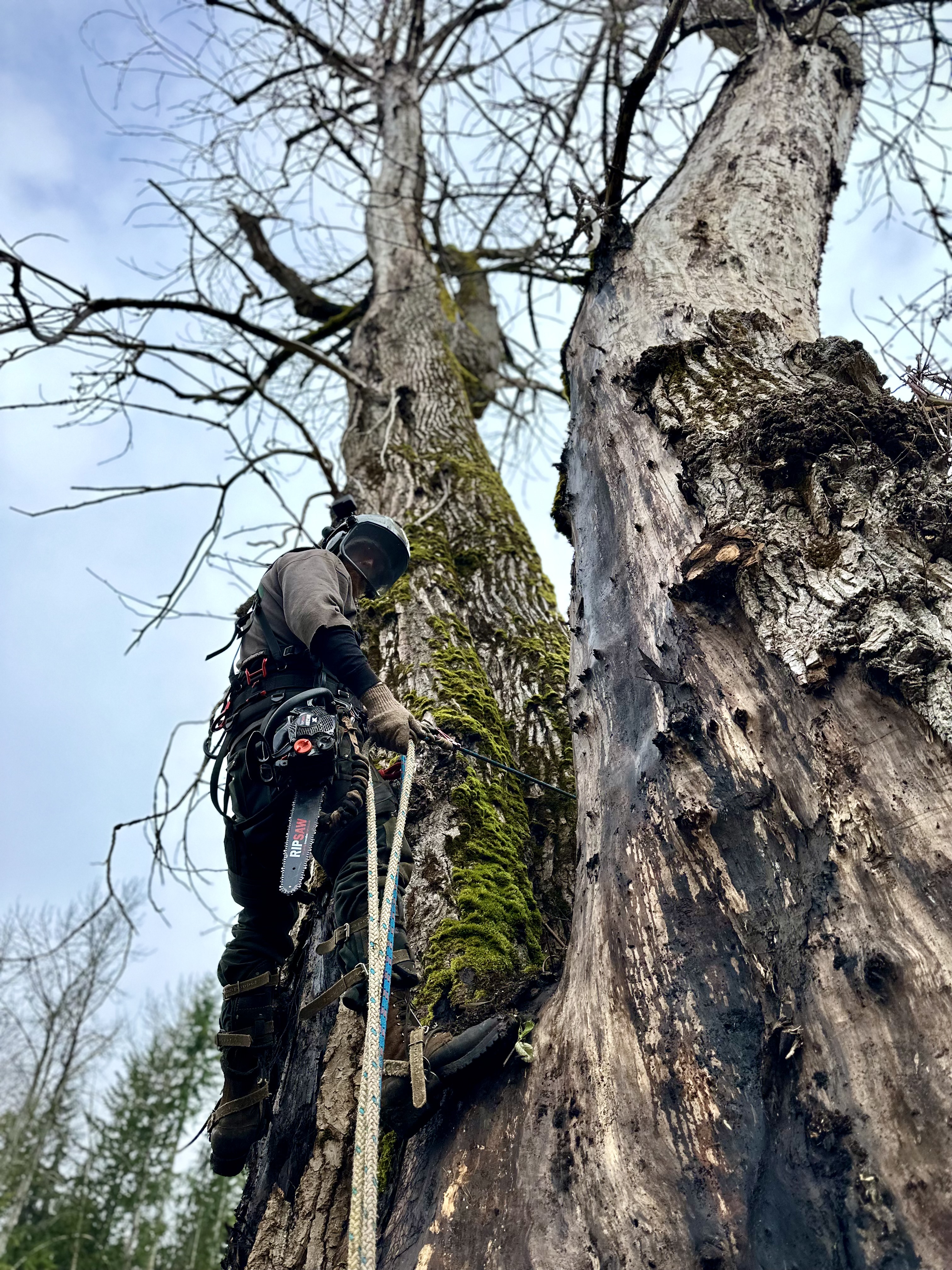
The city of Snohomish was incorporated in 1890 and served as the original Snohomish County seat until 1897. The downtown historic district along First Street and Avenue D, plus the residential neighborhoods along Avenue A through Avenue G between Sixth and Eleventh Streets, contain homes built between 1890 and 1940. Many of these properties have trees planted by their original owners or trees that were already mature when the homes were constructed. A 130-year-old bigleaf maple with a 60-foot canopy on a 6,000-square-foot lot presents fundamentally different management challenges than a 40-year-old Douglas fir on a half-acre lot in Lake Stevens or Mill Creek. The root systems occupy the entire lot. The branches extend over neighboring properties, streets, and power lines. Access for equipment is limited by narrow driveways, fences, and adjacent structures. And the trees themselves often have community attachment that makes removal a neighborhood discussion rather than a simple property decision.
- Snohomish's historic core has trees 80-130 years old on compact residential lots
- Root systems on older lots extend under foundations, sidewalks, and neighboring properties
- Narrow driveways and tight lot spacing limit equipment access for tree work
- Heritage trees often carry community significance beyond their property boundaries
What Mature Tree Species Are Common in Snohomish's Older Neighborhoods?
The tree mix in Snohomish's established neighborhoods reflects both intentional planting by early residents and natural colonization over the past century:
- Bigleaf Maple (Acer macrophyllum): The most common large tree in historic Snohomish neighborhoods. Bigleaf maples planted in the early 1900s now have trunk diameters of 3 to 5 feet and canopy spreads exceeding 60 feet. These trees are beautiful but heavy: a mature bigleaf maple can weigh 15 to 20 tons. Their shallow, spreading root systems heave sidewalks and driveways and their dense canopies shade entire lots. Heavy moss and fern growth on branches adds significant weight during wet winter months.
- English Walnut and Black Walnut: Early Snohomish residents planted walnut trees for nut production. Mature walnuts along Avenue B and Avenue C now tower over homes at 70 to 80 feet. Walnut trees present a unique challenge: juglone, a chemical compound in their roots and leaves, inhibits growth of many other plants. When these trees decline and need removal, the root zone soil remains hostile to replanting for several years.
- Douglas Fir Retained from Original Forest: Some Snohomish lots retain Douglas fir that were part of the original forest canopy before the town was platted. These trees are 150 to 200+ years old, 100 to 140 feet tall, and their root systems predate every structure around them. They were there first, and they are among the most complex trees to manage or remove in a dense residential setting.
- Ornamental Fruit Trees: Apple, pear, cherry, and plum trees planted by early residents are common on historic lots. Many of these fruit trees are now 60 to 80 years old, well past their productive lifespan, and developing structural decay. Old fruit trees with hollow trunks and heavy scaffold limbs are fall hazards that homeowners often underestimate because the trees seem small compared to the conifers and maples around them.
How Do Tight Lot Conditions Affect Tree Work in Historic Snohomish?
The physical layout of Snohomish's older neighborhoods creates access constraints that directly affect how tree work is performed and what it costs:
- Narrow Driveways and Side Yards: Many historic Snohomish homes have single-car driveways 8 to 10 feet wide, with side yards as narrow as 4 feet between structures. Our chipper and log truck need at least 8 feet of width. When driveway access is not available, we carry all material out by hand or use crane-assisted removal from the street — both of which add time and cost compared to standard access jobs.
- Overhead Utility Lines on Alleys: Snohomish's historic neighborhoods have power lines running along rear alleys behind properties. Trees in backyards often grow into or near these lines. All work within 10 feet of energized power lines requires coordination with Snohomish County PUD. We schedule PUD line clearance for complex removals, which can add 1 to 2 weeks to the project timeline.
- Shared Root Systems Across Property Lines: On lots as small as 5,000 to 7,000 square feet, a single large tree's root system extends well into neighboring properties. Removing a large maple or Douglas fir can affect soil stability, drainage patterns, and even foundation support on adjacent lots. We assess these cross-property impacts before recommending removal and discuss the situation with the homeowner.
- Historic Structures and Fragile Surfaces: Period homes with original cedar shake roofs, single-pane windows, and older foundations cannot withstand the same branch-drop impacts as modern construction. Brick walkways, stone walls, and vintage garden features are irreplaceable. We use additional rigging and lowering lines when working above historic structures, and we protect fragile surfaces with plywood shielding.
How Do We Assess Heritage Trees on Snohomish Properties?
Evaluating mature trees on historic lots requires looking beyond the tree itself to understand the whole property context:
- Tree Condition and Structural Integrity: We examine the trunk for cavities, seams, and fungal fruiting bodies. We assess crown vitality, looking for deadwood concentration, crown dieback percentage, and signs of decline. For trees over 100 years old, some internal decay is normal — the question is whether the remaining sound wood provides adequate structural support for the tree's weight and wind exposure.
- Root Zone Assessment: On tight historic lots, we map how the root system relates to foundations, utilities, sidewalks, and drainage. Soil probing around the root flare reveals root depth and soil type. Trees on Snohomish's silty clay soils often have shallower root systems than the same species on well-drained sites, making them more vulnerable to windthrow.
- Access and Equipment Planning: We measure gate widths, driveway clearances, and overhead obstructions before quoting the job. A tree that would be straightforward to remove on an open lot may require crane assistance on a tight Snohomish lot — and that changes the cost and timeline significantly. We always identify the access approach before providing a price.
- Preservation Versus Removal Recommendation: When a heritage tree has significant structural issues but the homeowner values it, we discuss management options: crown reduction to lower wind load, deadwood removal to reduce fall hazards, cabling of weak forks, or monitoring over time. Removal is our recommendation only when the risk cannot be managed to a reasonable level through other approaches.
Snohomish Heritage Tree Questions
- Does Snohomish have a heritage tree ordinance that restricts removal?
- The City of Snohomish does not have a formal heritage tree registry or the type of strict tree preservation ordinance that cities like Shoreline or Redmond maintain. However, trees in designated historic districts or on properties with historic landmark status may have additional considerations under the city's historic preservation guidelines. We recommend checking with the Snohomish Planning Department before removing any large tree on a historic property.
- How much does it cost to remove a large tree from a tight historic lot in Snohomish?
- Removing a large tree (80+ feet) from a constrained historic lot in Snohomish typically costs $2,500 to $5,000, compared to $1,200 to $2,500 for the same tree on an open lot. The difference comes from hand-carrying debris through narrow access, additional rigging to protect adjacent structures, and sometimes crane costs. We provide exact quotes after an on-site assessment because access conditions vary significantly between properties.
- Can you prune a 100-year-old bigleaf maple without damaging it?
- Yes, mature bigleaf maples respond well to careful pruning. We focus on deadwood removal, crown cleaning, and selective thinning of crossing or rubbing branches. We follow the one-third rule — never removing more than one-third of the live canopy in a single season. For very large maples on Snohomish's historic lots, we often recommend spreading the work over two seasons to minimize stress on the tree.
- My neighbor's heritage tree hangs over my property in Snohomish — who is responsible?
- Under Washington State law, you have the right to trim branches that extend over your property line, but you may not enter the neighbor's property to do so, and you cannot damage the health of the tree. For large heritage trees where major limbs overhang the neighboring property, we recommend that both property owners discuss the situation together. We frequently work on heritage trees in Snohomish where both neighbors share the cost because both benefit from the work.
- Should I remove a heritage tree that is pushing up my sidewalk in Snohomish?
- Not necessarily. Root pruning on one side of the tree can sometimes relieve sidewalk heaving without removing the tree. We assess whether the root damage is from surface roots (manageable) or structural roots (more serious). If the tree is otherwise healthy and stable, targeted root management combined with sidewalk repair is often more cost-effective than full tree removal and replanting, and it preserves the neighborhood character that heritage trees provide.
Need Heritage Tree Care in Snohomish?
K&J Tree Works has the experience to handle the access challenges and preservation considerations that Snohomish's historic neighborhoods require. We provide free on-site assessments for properties throughout Snohomish. Call (425) 223-7904 or request an estimate online. Monday through Saturday, 8 AM to 5 PM.