Lake Washington Shoreline Trees: Riparian Tree Care for Kenmore Properties
Kenmore, WA — April 13, 2026
The most regulated trees on a Kenmore property are usually the ones the homeowner cares about most: the ones along the lakefront, in the shoreline buffer, or near Swamp Creek. Here is how the rules read on the ground and how tree work actually gets done within them.
Why Are Shoreline Trees the Most Regulated Trees on Your Kenmore Property?
Lake Washington Shoreline in Kenmore runs from the Kenmore Air Harbor area east through the older lakefront neighborhoods, with the Burke-Gilman Trail corridor paralleling the shore through much of the city. Properties with frontage on the lake, on the mouth of the Sammamish River, or on Swamp Creek typically sit inside Washington's Shoreline Management Act jurisdiction. Trees within roughly 200 feet of the ordinary high water mark — the boundary set by typical seasonal high lake levels — are commonly subject to additional review before removal, with specifics depending on the city's shoreline master program and the individual parcel. The reasoning is straightforward: shoreline trees stabilize the bank, shade the water for fish habitat, intercept stormwater, and trap sediment that would otherwise enter the lake. From a homeowner's perspective, that often means the trees blocking the view, dropping leaves on the dock, or threatening the boathouse are exactly the trees the city has the most interest in preserving. Working through that tension productively is the daily reality of lakefront tree care in Kenmore.
- Lake Washington shoreline at roughly 20 feet elevation defines tree care across waterfront Kenmore
- Trees within 200 feet of the lake's ordinary high water mark fall under shoreline jurisdiction
- Swamp Creek wetlands and the Burke-Gilman Trail corridor add critical-area considerations
- The Inglewood and Moorlands neighborhoods carry mature conifers alongside aging mid-century homes
What the 200-Foot Shoreline Buffer Means for Your Trees
Kenmore is an incorporated King County city with its own Shoreline master program implementing state requirements. For tree work, the practical rules look like this:
- What Typically Counts as Shoreline Jurisdiction: The 200-foot buffer is generally measured from the ordinary high water mark of Lake Washington and from the centerline of associated wetlands and Swamp Creek, though the exact boundaries are determined by Kenmore's shoreline master program and applied parcel-by-parcel. Most Kenmore lakefront lots fall entirely or mostly inside that zone, as do properties on the lower reaches of Swamp Creek. Even setback distances on small wetland-adjacent lots can put significant tree work inside the regulated area.
- What Triggers a City Review: Removing a single hazard tree typically goes through a streamlined process; clearing multiple trees, cutting trees over a certain size, or removing trees that contribute to bank stabilization triggers a more detailed review. Replanting is sometimes required as a condition of removal. We help homeowners understand which path their specific job falls into before we quote.
- Why the Buffer Exists: Shoreline trees do real work: their roots hold the bank in place against wave action, their canopies shade the water in shallow nearshore zones where juvenile salmon rear, their leaf litter feeds aquatic invertebrates, and their fine roots filter stormwater before it enters the lake. Removing a shoreline tree without replacement subtracts all of those functions, which is why the regulatory burden exists.
- What Hazard-Tree Documentation Looks Like: When a shoreline tree poses a real risk, removal can usually proceed with documentation showing the hazard. A written assessment describing the defect, the target it threatens, and the lack of reasonable alternative is what the city looks for. Photos of the defect, ideally showing what is at risk if the tree fails, support the case.
Trees That Actually Belong on a Lake Washington Shoreline
The trees that grow naturally along Kenmore's lakefront are different from upland species and have different management needs. Knowing which species you have informs every decision:
- Pacific Willow and Sitka Willow: The most effective bank-stabilizing trees in our area. Willow root mats hold soil against wave action and seasonal water-level changes. They tolerate periodic submersion, regrow vigorously after storm damage, and are often the species the city most wants preserved on a Kenmore shoreline. Pruning rather than removal is almost always the right answer for healthy willows on the bank.
- Red Alder Along Swamp Creek and the Lakefront: Alder colonizes wet ground fast and dominates many older Kenmore shoreline plantings. It serves real bank-stabilization functions while alive, but it is a short-lived species (40 to 60 years) that becomes structurally weak well before it looks unsafe. We see frequent failures of mature alders on Kenmore lakefront properties, particularly along the Swamp Creek confluence and the Burke-Gilman corridor edges.
- Black Cottonwood and Pacific Cottonwood: The largest deciduous trees in the lakefront mix. They develop substantial root systems that contribute heavily to bank stability but drop heavy limbs unpredictably. Cottonwoods overhanging docks and boat moorages need regular crown-cleaning passes to keep dead and weakly attached branches out of the water below.
- Western Red Cedar Set Back from the Bank: Cedar is not a true wetland species but tolerates moist soils well. The mature cedars on the second-row lots above the Kenmore lakefront often started life when the area was logged-over wet bottomland. Their shallow root systems combined with periodic wind loading from across the open lake create occasional windthrow events on these properties.
How Swamp Creek and the Burke-Gilman Corridor Add Wrinkles
Two features running through Kenmore add their own complications to tree work:
- Swamp Creek and Its Wetlands: Swamp Creek crosses Kenmore from north to south, joining Lake Washington just east of the Kenmore Air Harbor. Its associated wetlands extend well beyond the visible channel, putting many residential lots in the Moorlands and along the Burke-Gilman Trail corridor inside critical-area jurisdiction. We check King County wetland mapping for any property within a few hundred feet of the creek before quoting.
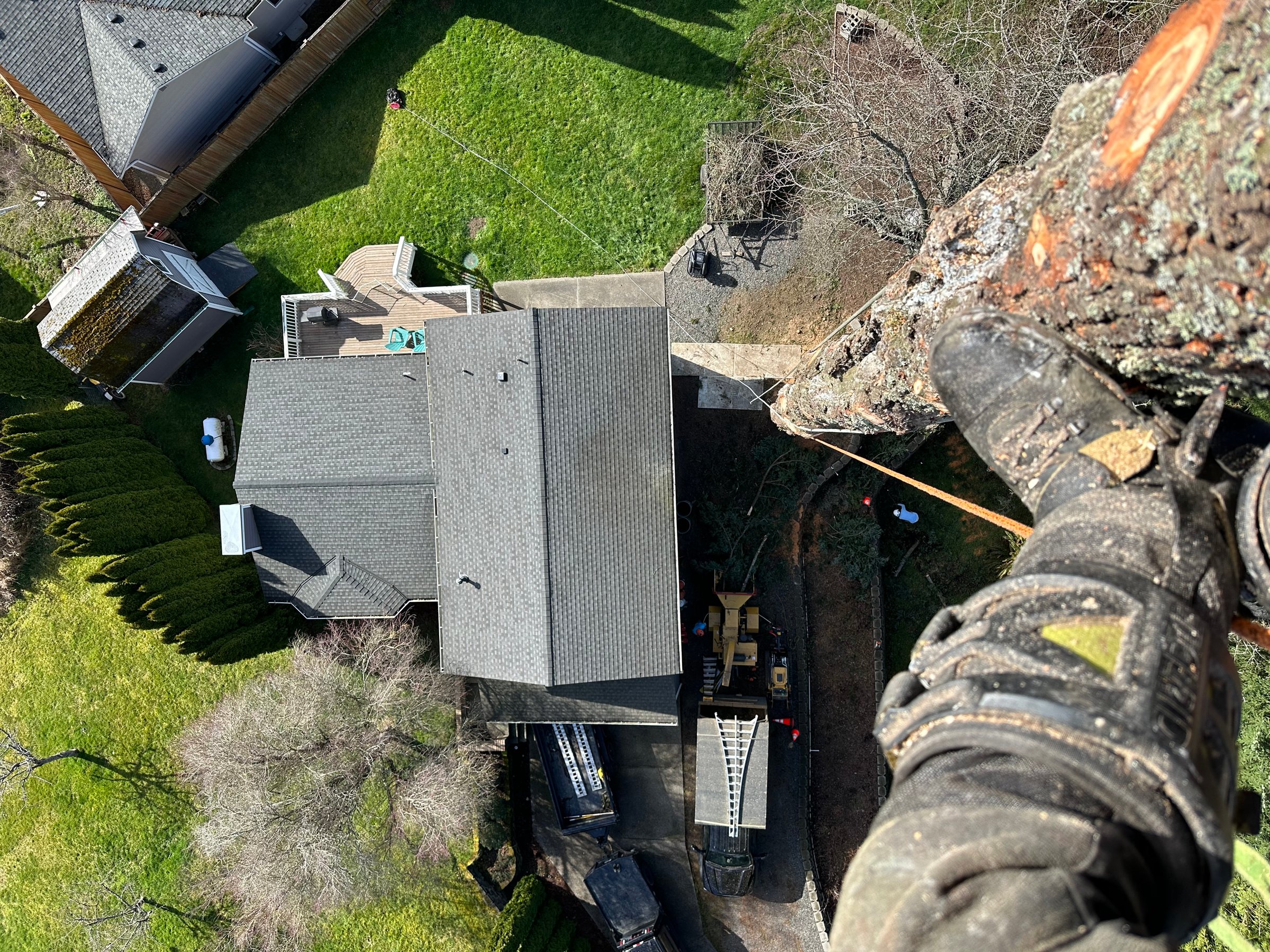
- Burke-Gilman Trail Adjacency: The Burke-Gilman Trail runs the length of Kenmore, often within a few feet of residential property lines. Trees that overhang or extend toward the trail need extra rigging discipline because the work has to be done without dropping debris on the trail or interrupting cyclist and pedestrian traffic. We typically schedule trail-adjacent work for early-morning weekday windows when trail traffic is lightest, and we coordinate flagging when sectional dismantling requires brief trail closures.
- Inglewood Neighborhood Mature Canopy: The Inglewood area carries some of Kenmore's oldest mature conifers — 70 to 90 years of Douglas fir and western red cedar growing on mid-century lots. The combination of large trees, narrow rear lot lines, and proximity to either the lake or Swamp Creek means almost every Inglewood tree job involves precision rigging and sometimes neighbor coordination.
- Wind Across Open Water: Westerly and southerly winds get a long open-water fetch across Lake Washington before they hit Kenmore's north-shore properties. Tall trees on lakefront lots face wind loading that inland Kenmore properties do not experience, and the failure pattern is typically a leaning fir or cedar pulling out of the saturated bank soil during a storm sequence.
How We Handle Shoreline Tree Removal Without Putting Debris in the Lake
Lakefront work in Kenmore follows a tighter sequence than upland work because of the regulatory and physical reality of the Shoreline:
- Pre-Quote Critical-Area Check: Before we visit, we cross-check the property against King County wetland and shoreline mapping so the on-site walk-through happens with the right context. We arrive knowing whether the work falls in regulated buffer, what city review might be required, and what alternatives we should be evaluating.
- Lake-Side Containment Setup: On any lakefront tree removal, we set up containment between the tree and the water before any cuts. Tarps under the work zone catch sawdust and small debris. Floating booms can be deployed in the water for trees overhanging the lake. The goal is zero wood waste entering the water column.
- Rigging Away from the Water: Branches and trunk sections come down on ropes lowered to the upland side, never dropped toward the lake. This adds time to the job but is non-negotiable for shoreline work and for protecting any neighbor docks downwind.
- Final Cleanup and Bank Restoration: After removal, we rake the work area thoroughly, blow hard surfaces, and check the lake edge for any debris that escaped containment. Where removal exposed bare soil on the bank, we leave erosion-control matting or replanting recommendations to keep the next storm from washing the disturbed soil into the lake.
Kenmore Shoreline Tree Care Questions We Hear Most
- Do I need a permit to remove a tree on my Kenmore lakefront lot?
- Probably yes if the tree is within 200 feet of the lake's ordinary high water mark or within designated wetland buffer. The exact requirement depends on tree size, species, and what role the tree plays in bank stabilization. Hazard trees can typically be removed with documentation, but routine removals in the shoreline buffer usually require city review. We help homeowners figure out which path applies before quoting work.
- Will removing the trees on my bank cause erosion?
- It depends on the species, slope, and what is below the tree. Willow and alder roots actively hold the bank, and removing them can trigger erosion within a single rainy season if no replacement planting is established. Setback firs and cedars contribute less directly to bank stability and can usually be removed with minimal erosion risk. We assess each tree's bank-stabilization role before recommending removal.
- Can you do tree work on my lakefront without disturbing the dock or moorage?
- Yes, with planning. We coordinate with the homeowner on dock and boat positioning before the job, set up tarps and booms to catch debris, and rig branches away from the water and dock structures. Dock-adjacent work is one of the most planned-out parts of any Kenmore lakefront job, and we have the rigging gear and experience to do it cleanly.
- How much does a typical shoreline tree removal cost in Kenmore?
- Lakefront removals in Kenmore typically run 25 to 40 percent more than comparable upland work in nearby Bothell or Shoreline. The added cost reflects shoreline-safe rigging, containment setup, longer cleanup discipline, and any documentation we provide for city review. A 60- to 80-foot Douglas fir on a lakefront lot typically runs $2,200 to $3,500 depending on dock proximity and access.
- What is the best time of year for tree work on a Kenmore lakefront property?
- Late summer through early fall is ideal. Lake levels are at seasonal lows, the ground around the bank is at its most stable, and the dry weather gives us flexibility on multi-day jobs. Winter storm response runs November through March, but planned lakefront work scheduled for August through October goes more smoothly in almost every case.
Lakefront or Shoreline Tree Concerns in Kenmore?
K&J Tree Works has handled lakefront removals, view pruning, and shoreline-buffer tree work on Kenmore properties along the lake, the Sammamish River mouth, the Burke-Gilman corridor, and the Inglewood and Moorlands neighborhoods. We provide free on-site assessments and will work through the regulatory and rigging questions before quoting. Call (425) 223-7904 or request an estimate online. Monday through Saturday, 8 AM to 5 PM.