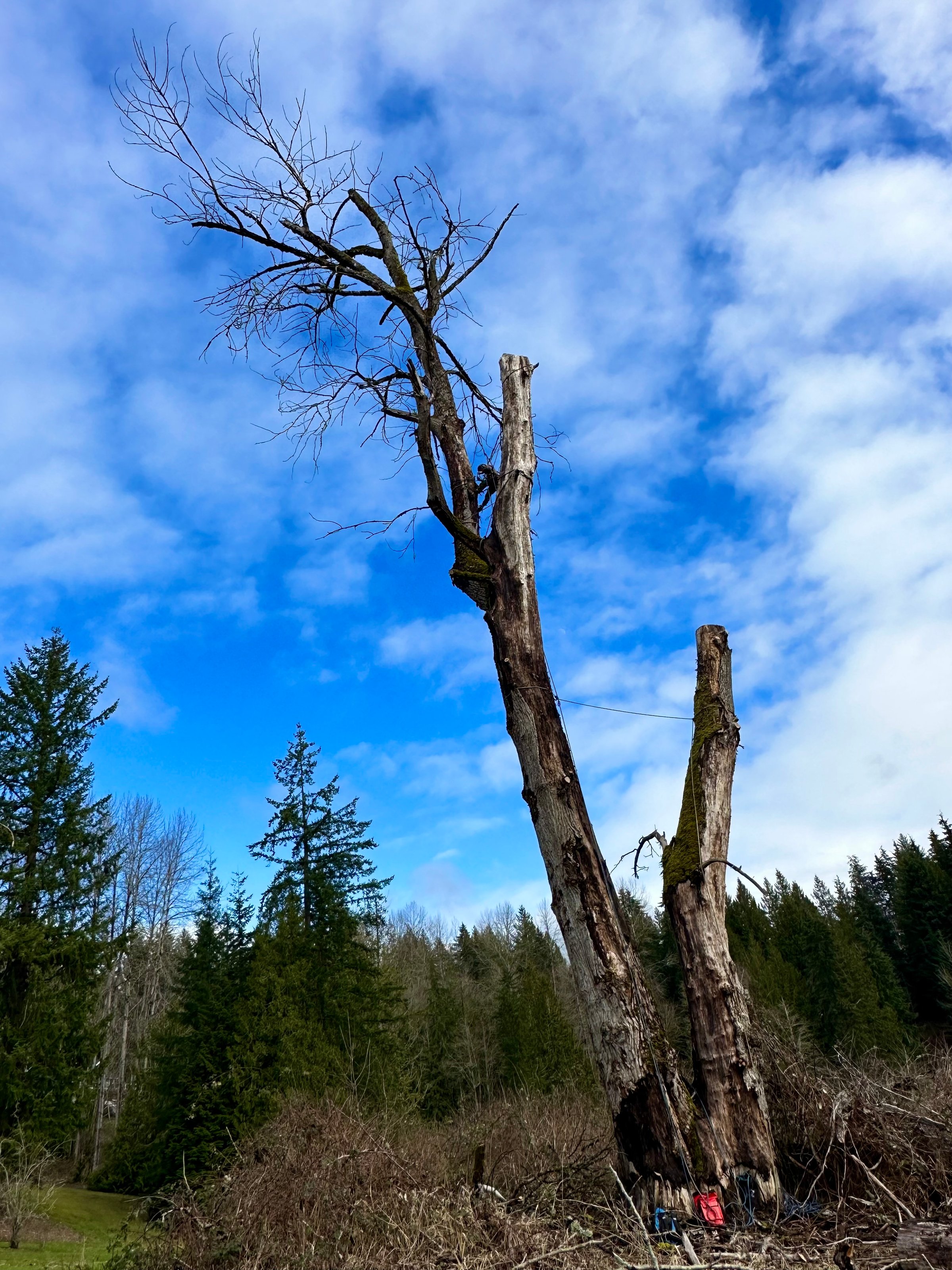
Tree Hazards at the Mountain-Lowland Transition in Granite Falls
Granite Falls, WA — April 6, 2026
Granite Falls occupies the transition zone where Cascade foothill terrain meets lowland Stillaguamish valley. This elevation boundary creates tree hazards that neither mountain nor lowland communities face alone.
What Makes the Mountain-Lowland Transition Zone Hazardous for Trees?
Granite Falls is the gateway to the Mountain Loop Highway — the road that climbs from the Stillaguamish River valley into the Cascades past Verlot, Big Four Ice Caves, and eventually to Darrington. The town itself sits at 350 to 600 feet elevation, spanning the boundary where lowland weather patterns give way to mountain conditions. This transition zone is geographically narrow — in the span of just 2 miles from the Pilchuck River bridge on the west side of town to the Mountain Loop Highway junction on the east, the landscape shifts from flat dairy-farm valley floor to rocky foothill terrain with exposed bedrock and thin, gravelly soils. Trees growing in this transition experience the worst of both worlds. They receive the heavy, sustained rainfall of the lowlands — Granite Falls gets 55 to 65 inches annually — but on soils that drain rapidly or sit on shallow bedrock, preventing the deep root development that lowland trees achieve. They also experience weather events that do not reach communities just 5 miles to the west: rain-on-snow events where warm rain falls on accumulated snow, adding tremendous weight to canopies that are already loaded; freezing rain that coats branches in a half-inch of ice; and wind channeled through the Pilchuck River valley that accelerates as it exits the mountains.
- Elevation band of 350-600 feet creates a weather transition zone unique to Granite Falls
- Rain-on-snow events add extreme weight to canopies already stressed by mountain weather
- Pilchuck River corridor channels and accelerates winds exiting the Cascades
- Shallow foothill soils over bedrock limit root depth on the east side of town
Hazard Patterns Specific to Granite Falls' Transition Zone
The combination of mountain weather, variable soils, and mature second-growth forest creates hazard patterns that tree care professionals see more frequently here than in either pure lowland or pure mountain settings:
- Rain-on-Snow Canopy Overload: Granite Falls is just high enough to accumulate 4 to 8 inches of wet Cascade snow 3 to 5 times per winter — snow that does not accumulate in Marysville or Lake Stevens at 100 feet elevation. When a warm front follows the snow — common in Pacific Northwest weather — rain falls on the snow-loaded canopy. A Douglas fir carrying 2 tons of snow on its branches suddenly gains another ton of water weight soaking into the snow. This combined load snaps branches and splits trunks. The January 2024 snow-then-rain event broke limbs across Granite Falls while Marysville, 10 miles west, received only rain.
- Pilchuck River Wind Channeling: The Pilchuck River flows through a valley that narrows as it passes through Granite Falls, entering from the broad farmland at Lake Stevens and compressing through the rocky terrain at the Mountain Loop Highway junction. Wind following this corridor accelerates through the constriction — the same atmospheric river storm producing 30 mph winds in Lake Stevens can generate 45 to 55 mph gusts at Granite Falls. Properties along the Pilchuck, particularly in the Robe Valley area east of town, bear the brunt of this amplified wind.
- Shallow Soils on the East Side of Town: The east side of Granite Falls — from the Mountain Loop Highway junction up Menzel Lake Road and along the South Fork Stillaguamish corridor — sits on glacial outwash and weathered bedrock with soil depths of 12 to 24 inches. Trees here root shallowly, similar to the granite-anchored trees in Index but on different substrate. During prolonged wet periods, these thin soils saturate quickly, and root plate failure is common for large conifers that have outgrown their soil's anchoring capacity.
- Ice Storm Damage: Granite Falls is at the elevation where winter storms occasionally produce freezing rain — an event that rarely affects Everett or Marysville at lower elevations and falls as snow at higher elevations. A half-inch of ice accumulation on tree branches adds roughly 5 pounds of weight per foot of branch length. For a mature Douglas fir with 200+ feet of total branch length, that is over 1,000 pounds of added weight distributed asymmetrically through the canopy. Ice storms are infrequent but devastating when they hit Granite Falls.
Higher-Risk Areas Within the Granite Falls Community
Some parts of Granite Falls are more prone to tree hazards than others based on their position in the transition zone:
- Mountain Loop Highway Properties: Homes along the first 2 miles of the Mountain Loop Highway east of town sit in the narrowing Pilchuck valley where wind acceleration is strongest and elevation is high enough for regular snow events. These properties have the highest incidence of storm-related tree failures in the Granite Falls area. Mature second-growth Douglas fir from the 1930s and 1940s — now 80 to 90 years old and 100+ feet tall — line this corridor.
- Menzel Lake Road and East Hill: The residential area climbing the hill east of Granite Falls' downtown on Menzel Lake Road transitions rapidly from valley-floor soils to thin mountain soils. Properties at the top of this climb, around 550 to 600 feet elevation, have trees growing in the shallowest soils in the Granite Falls area. These lots experience the most windthrow during major storms.
- Pioneer Street and Downtown Core: Granite Falls' historic downtown along Pioneer Street has mature ornamental and street trees — Norway maple, black walnut, and various shade trees — that are susceptible to ice storm damage because their broad, open branching catches ice efficiently. These trees also shade the main commercial district and are valued by the community, making management decisions more visible and consequential than on private rural lots.
- Pilchuck River Corridor: The riparian zone along the Pilchuck River through Granite Falls supports cottonwood, alder, and willow that grow aggressively in the river's alluvial deposits. These fast-growing, weak-wooded species drop branches and topple during ordinary wind events — and the river corridor funnels wind directly through their canopies. Properties along South Alder Avenue and River Road get the most frequent tree debris from this corridor.
How We Assess and Address Tree Hazards in Granite Falls
Hazard assessment in Granite Falls requires evaluating each tree in the context of its specific elevation, soil, and exposure conditions:
- Elevation and Exposure Mapping: We note the property's elevation and position relative to the Pilchuck valley wind corridor. A tree at 350 feet on the sheltered west side of town faces different wind and weather loads than the same species at 550 feet on an exposed slope near Menzel Lake Road. The assessment accounts for these microclimatic differences.
- Soil Depth Evaluation: We probe soil depth around target trees to determine root zone conditions. On Granite Falls' east side, we often find 12 to 18 inches of soil over compacted glacial gravel or weathered bedrock. This information directly affects our assessment of windthrow risk — a tree with 12 inches of root zone on an exposed slope gets a higher hazard rating than the same tree in 36 inches of soil in a sheltered position.
- Snow and Ice Load History: We look for evidence of previous snow and ice damage — broken stubs, split forks, and repaired wounds in the upper canopy. Trees that have experienced multiple winter loading events accumulate structural weaknesses. Each healed break point is weaker than the original wood and more likely to fail in the next event. These indicators inform our recommendations for crown weight reduction.
- Prioritized Hazard Mitigation: Based on the assessment, we create a prioritized plan: trees with structural failures or root plate movement that threaten structures come first; trees with significant deadwood or storm damage history come second; routine maintenance comes third. This lets Granite Falls homeowners address the most serious hazards immediately and schedule lower-priority work over time.
Granite Falls Tree Hazard Questions
- Why do trees fail during rain-on-snow events more than during pure windstorms?
- Rain-on-snow loading is a compressive force — it pushes down on branches from above, loading them beyond their structural capacity. Branches that can flex and survive 50 mph wind gusts may snap under the static weight of 6 inches of snow saturated with warm rain because the load is constant and uniformly distributed. Granite Falls gets 3 to 5 of these events per winter, each one stressing already-weakened branch attachments. Cumulative damage over multiple events creates the failures.
- Is there a snow load threshold where I should be worried about my trees?
- Four inches or more of wet Cascade snow on tree canopies is the threshold where we start seeing branch failures in Granite Falls. If warm rain follows before the snow melts naturally, the risk escalates significantly. When these conditions occur, stay indoors and away from windows facing large trees. After the event passes, walk your property from a safe distance and look up — broken branches and hangers in the canopy need professional removal before they fall.
- Do the soils on the east side of Granite Falls really make that much difference?
- Absolutely. A 100-foot Douglas fir in 36 inches of deep glacial till soil develops a root plate that resists 80+ mph winds. The same tree species and size in 12 to 18 inches of soil over bedrock on Granite Falls' east side develops a root plate that may fail at 55 to 60 mph gusts — the amplified speeds that the Pilchuck valley regularly channels through during winter storms. Soil depth is the single most important factor in tree stability, and it varies dramatically within the Granite Falls city limits.
- Should I proactively remove trees near my house before storm season in Granite Falls?
- Pre-storm removal makes sense for trees that already show structural weaknesses — significant deadwood, trunk cracks, lean changes, or root plate movement. Removing a compromised tree in September when weather is dry and access is good costs less and is safer than emergency removal after it fails in a January rain-on-snow event. We recommend scheduling hazard assessments in late summer so any recommended removals can be completed before storm season begins in November.
- What is the difference between the tree risks on the east and west sides of Granite Falls?
- The west side of Granite Falls sits on deeper glacial till soils — 4 to 8 feet of compacted sediment that provides excellent root anchorage. Trees here are more wind-resistant but can still develop crown and stem defects that cause failure. The east side, toward the Pilchuck River and Mountain Loop Highway, transitions to shallower soils over bedrock with thinner profiles and more exposed rock. This eastern transition zone is where trees have the least root support and the highest wind exposure from valley channeling. Properties on the east side require more frequent hazard assessment because the combination of shallow roots and amplified wind creates failure conditions faster than the west side.
- How does the Mountain Loop Highway affect tree service access in Granite Falls?
- The Mountain Loop Highway provides access to properties east and south of town, but it narrows to a single lane in places and can be temporarily blocked by rockfall, flooding, or downed trees during winter storms. For properties along the Mountain Loop, we plan work with contingency timing — if road conditions deteriorate during the day, we need enough time to complete the current tree and clear equipment before conditions worsen. During summer months, access is straightforward and we can work full days. Winter access to remote Mountain Loop properties requires weather-window scheduling — we watch the 3-day forecast and mobilize when a dry window opens.
Concerned About Tree Hazards on Your Granite Falls Property?
K&J Tree Works understands the mountain-lowland transition conditions that create unique tree risks in Granite Falls. We provide free hazard assessments for homeowners along the Mountain Loop Highway, Menzel Lake Road, and throughout the Granite Falls area. Call (425) 223-7904 or request an estimate online. Monday through Saturday, 8 AM to 5 PM.