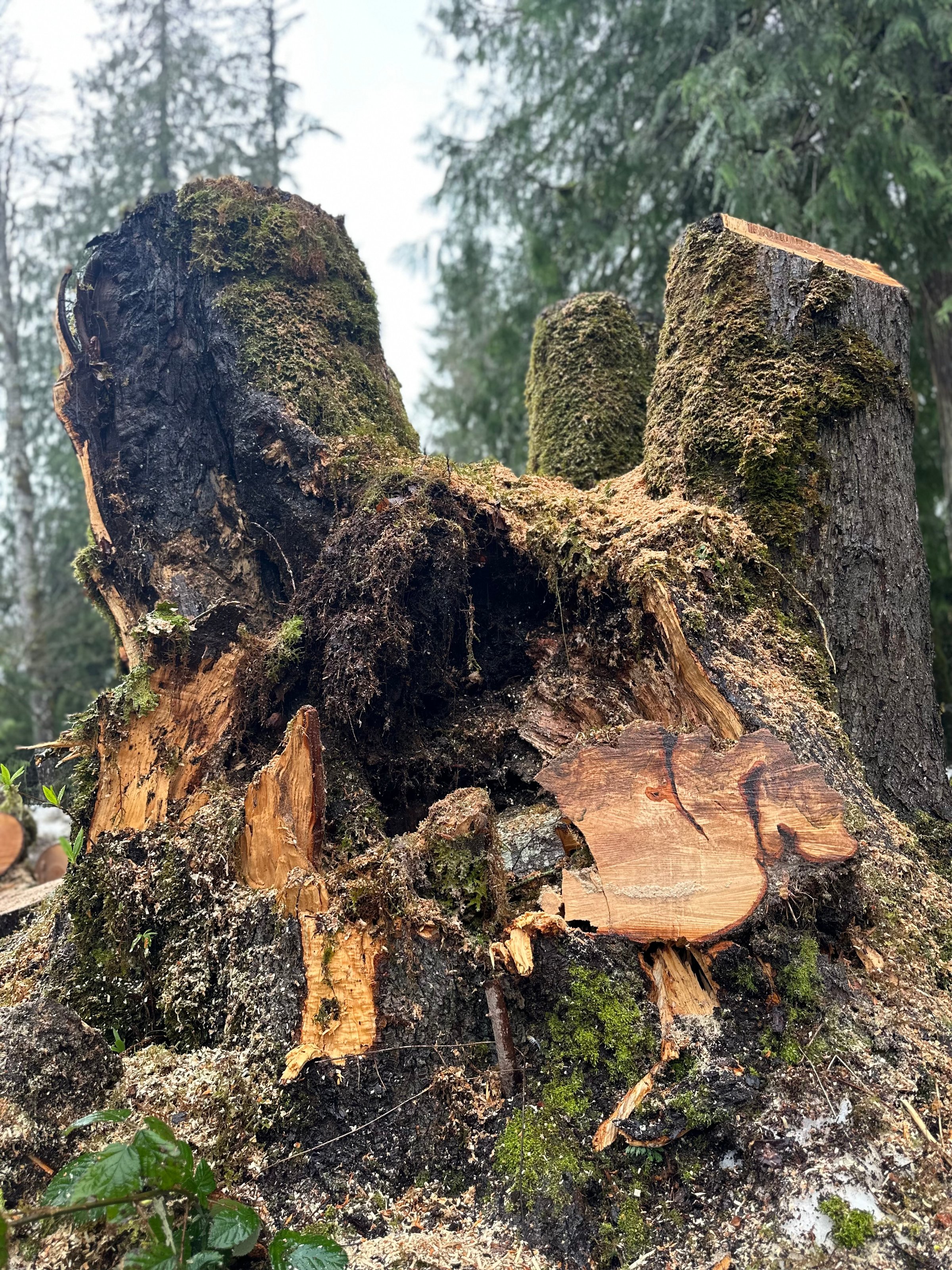
Tree Service Along the Highway 2 Corridor: Baring Property Guide
Baring, WA — April 3, 2026
Baring straddles Highway 2 in the upper Skykomish valley where old-growth Douglas fir and cedar, limited winter access, and power line proximity create a distinct set of tree service challenges.
What Defines Tree Service in Baring?
Baring is not a town with city services, municipal code, or a planning department — it is an unincorporated King County community that exists because Highway 2 passes through the upper Skykomish valley here on its way to Stevens Pass. Properties cluster along 682nd Avenue NE and the small roads that branch off Highway 2, most of them on narrow lots wedged between the highway corridor and the Skykomish River or Barclay Creek. The trees are commensurate with the setting: old-growth and mature second-growth Douglas fir and Western red cedar that predate every structure in the community, many exceeding 140 feet in height with 48- to 60-inch trunk diameters. These trees grow in alluvial and glacial soils deposited by the Skykomish River system, with the Barclay Creek drainage adding moisture from the Mount Baring and Baring Mountain drainages to the north. Power service comes via Snohomish County PUD overhead lines that follow Highway 2 — lines that share the corridor with these massive trees, creating a chronic tension between canopy growth and electrical infrastructure. Winter access is another defining factor: Baring receives 70 to 90 inches of rain annually, Highway 2 is the only route in or out, and snow events that close Stevens Pass can leave the valley floor with 6 to 12 inches of wet Cascade snow that complicates equipment staging.
- Unincorporated King County — no municipal tree code, but county critical area rules apply
- Highway 2 is the only access route, requiring WSDOT coordination for road-adjacent work
- Snohomish County PUD power lines share the corridor with massive old-growth conifers
- Barclay Creek drainage creates exceptionally moist soils that support rapid tree growth
The Tree Landscape Around Baring
Baring's upper valley position produces a forest character that differs from the lowland communities most of our clients live in:
- Old-Growth Douglas Fir and Cedar: Baring was too remote and too difficult to log efficiently during the early 20th century timber boom that cleared most of western Washington's lowland forests. As a result, scattered old-growth Douglas fir and Western red cedar still stand on private parcels here — trees 200 to 400+ years old, 140 to 180 feet tall, with trunks 4 to 6 feet in diameter. These are the largest trees in our regular service area and require our most experienced climbers, the heaviest rigging, and in some cases crane assistance to manage safely.
- Western Hemlock Dominance in Understory: Hemlock fills the understory in Baring's forests, growing densely in the shade of the old-growth canopy. These 60- to 80-foot hemlocks lean toward any light gap, often growing toward houses, driveways, and clearings. Hemlock's shallow root system and brittle wood make it the most failure-prone species in the valley — windstorms regularly drop hemlocks across driveways and power lines in Baring.
- Barclay Creek Riparian Zone: Barclay Creek flows through the Baring community before joining the Skykomish River. The creek supports a riparian corridor of red alder, Pacific willow, and vine maple that is subject to King County's Critical Areas Ordinance. Trees within 100 feet of Barclay Creek's ordinary high water mark are in a regulated buffer — removal of even hazard trees may require county review and documentation.
- Avalanche Zone Influence: The steep slopes of Baring Mountain above the community channel avalanches through established slide paths that reach the valley floor. Trees in and near these paths show characteristic damage — snapped tops, swept lower branches, curved trunks from snow creep. These avalanche-influenced trees are under mechanical stress that weakens them over time, and their proximity to properties and Highway 2 makes them a management priority.
Highway 2 Staging and Power Line Coordination
Two infrastructure elements — the highway and the power lines — shape how every tree job in Baring is planned and executed:
- Highway 2 Traffic Management: Trees on the highway side of Baring properties require traffic management when branches or sections could fall into the travel lanes. WSDOT does not require a formal traffic control plan for private tree work adjacent to Highway 2, but we set up cone tapers and flagging when any work activity approaches the highway right-of-way. Weekend staging reduces traffic conflicts — Highway 2 carries Stevens Pass ski traffic on winter Saturdays and Sundays, but weekday traffic through Baring is light.
- Snohomish County PUD Coordination: The overhead power lines along Highway 2 and up 682nd Avenue NE pass directly through or adjacent to many of Baring's mature trees. PUD maintains a clearance zone around their lines, but homeowners are responsible for trees that could fall onto lines. For removals near energized lines, we coordinate with PUD's vegetation management team — they can de-energize lines for the duration of our work, which we schedule in advance. We do not cut within 10 feet of energized lines under any circumstances.
- Equipment Access via Highway Pullouts: Baring does not have city streets with cul-de-sacs and wide driveways. Equipment staging often uses Highway 2 pullouts or the shoulder near the Baring Store. From there, we move material to and from the work site using the property's driveway — which may be a single-lane gravel road through the trees. We scout these access routes during the estimate visit and plan equipment placement that works within the available space.
How We Plan and Execute Tree Work in Baring
Baring's remote location and large trees require a more thorough planning process than closer communities:
- Site Visit and Logistics Planning: We visit the property — a 50-minute drive from our Sultan base — to assess the target trees, evaluate access, check power line proximity, and plan equipment staging. For large old-growth removals, this site visit may include discussions with PUD about de-energization scheduling and an assessment of ground conditions for potential crane placement.
- Seasonal Scheduling: We schedule major Baring projects for late spring through early fall when weather is most reliable, daylight is longest, and ground conditions support equipment. Emergency work happens year-round, but planned removals benefit from dry conditions that make the gravel driveways and staging areas more stable and reduce the time crews spend managing wet conditions.
- Crew and Equipment Mobilization: A Baring job requires self-sufficient crews — there is no hardware store or fuel station in Baring to resupply mid-job. We carry backup equipment, extra fuel, sharpened chains, and rigging supplies sufficient for the full scope of work. For multi-day projects, we stage equipment on-site overnight rather than making the 100-minute round trip to our base each day.
- Large-Tree Sectional Removal: Old-growth fir and cedar in Baring come down in small sections because of their proximity to structures and power lines. A 160-foot Douglas fir might require 30 to 40 individual cuts, with each section rigged and lowered. The climber works from the top, establishing rigging points as the tree gets shorter. For the largest bottom trunk sections — 4- to 6-foot diameter — we may use a crane to lift pieces if ground conditions and access allow crane positioning.
- Material Management: The wood volume from old-growth Baring trees is enormous — a single large Douglas fir can produce 20+ cords. We discuss wood disposition with the homeowner before the job. Some Baring residents want firewood rounds left on-site. Others want everything removed. Brush goes through the chipper, and chips can be spread on driveways or hauled away. Log-quality wood from old-growth fir and cedar has value, and we can connect homeowners with portable mill operators who will process logs on-site.
Baring Tree Service Questions
- Does King County regulate tree removal in Baring?
- Baring is in unincorporated King County, which does not have a comprehensive tree removal code for developed residential lots like some incorporated cities do. However, King County's Critical Areas Ordinance applies — trees in wetland buffers, steep slope hazard areas, and within 100 feet of streams like Barclay Creek are regulated. The Shoreline Management Program also applies to trees near the Skykomish River. For most developed lots in Baring's core along 682nd Avenue, standard residential tree removal does not require a county permit unless the tree is in a mapped critical area.
- What if a tree falls across Highway 2 from my Baring property?
- WSDOT is responsible for clearing trees and debris from Highway 2. If a tree from your property falls across the highway, WSDOT maintenance crews will respond to clear the road. You are not liable for storm-event tree failures of healthy trees under Washington State law. However, if the tree was visibly dead or hazardous and you were aware of the condition, liability could shift to the property owner. Proactive removal of hazard trees near the highway protects both you and traveling public safety.
- Can you work on trees in Baring during winter?
- Yes, with caveats. The valley floor at Baring's 700-foot elevation receives heavy rain and occasional snow from November through March. Highway 2 stays open year-round (though Stevens Pass above may close), so access is reliable. However, wet ground conditions can limit equipment placement, and shorter daylight reduces productive work hours. We schedule planned work during dry-season windows when possible but respond to emergencies year-round.
- How do you handle the really large trees — 150+ feet — in Baring?
- Trees exceeding 150 feet require our most experienced climbing crew — typically two climbers working in tandem. One climber operates at the working height while the other manages rigging below. For trees over 5 feet in diameter at the base, the volume and weight of each trunk section exceeds what standard rigging can handle — we may bring in a crane positioned on Highway 2 or a cleared staging area. Planning these jobs takes 2 to 3 weeks of advance coordination for equipment scheduling and, when needed, PUD de-energization.
- What wildlife regulations apply to tree removal in Baring?
- Baring is within the range of several protected species. Northern spotted owls use old-growth and mature second-growth forest in the upper Skykomish drainage, and marbled murrelets nest in large conifers within 50 miles of Puget Sound — Baring falls within this range. Both species are protected under the Endangered Species Act. Before removing large conifers with wide platforms or cavities that could support nesting, we check for signs of occupation — whitewash on branches below potential nest sites, pellet accumulations, and direct observation during active nesting season from April through September. If protected species are using a tree, removal must wait until the nesting period ends.
- Is there cell service during tree emergencies in Baring?
- Cell coverage in Baring is unreliable. T-Mobile has the strongest signal in the valley but drops frequently in the draw west of the Baring Store. Verizon and AT&T coverage is spotty to nonexistent east of the Baring bridge. During storm emergencies when communication matters most, we recommend Baring property owners have a landline if available or a satellite communicator as backup. When we schedule work in Baring, we coordinate timing and check-in procedures with the property owner before arriving, since calling from the site to confirm details may not be possible.
Need Tree Service at Your Baring Property?
K&J Tree Works serves the Highway 2 corridor from Sultan through Baring and beyond. We provide free on-site assessments and understand the logistics that Baring's remote mountain valley location demands. Call (425) 223-7904 or request an estimate online. Monday through Saturday, 8 AM to 5 PM.