Storm-Damaged Trees in Lynnwood: Assessment and Next Steps
Lynnwood, WA — March 30, 2026
Lynnwood's position in the Puget Sound Convergence Zone means it gets hit harder by windstorms than most neighboring cities. Here is how to assess storm-damaged trees and what to do next.
Why Do Lynnwood Trees Take More Storm Damage?
The Puget Sound Convergence Zone is a weather phenomenon unique to the central Puget Sound lowlands. When prevailing winds from the Pacific hit the Olympic Mountains, they split around the range and reconverge over the lowlands roughly between Lynnwood and Everett. This convergence creates a band of intensified weather — stronger winds, heavier precipitation, and occasionally localized thunderstorms and even small tornadoes — that sits directly over Lynnwood during many fall and winter storm events. The November 2024 atmospheric river that dropped 4 inches of rain in 36 hours hit Lynnwood harder than communities just 5 miles north or south. Trees in Lynnwood face this amplified weather on soils that were heavily compacted during the city's rapid suburban development in the 1960s through 1990s. Native trees that were retained during construction — Douglas fir, Western red cedar, big leaf maple — now grow in soil profiles where the upper 18 to 24 inches were compressed by heavy equipment. Roots cannot penetrate compacted layers easily, so they spread laterally in the shallow topsoil, creating the same windthrow vulnerability as trees in Gold Bar's alluvial soils but for entirely different geological reasons.
- Convergence Zone weather delivers stronger winds to Lynnwood than surrounding cities
- Suburban soil compaction from 1960s-1990s development creates shallow root systems
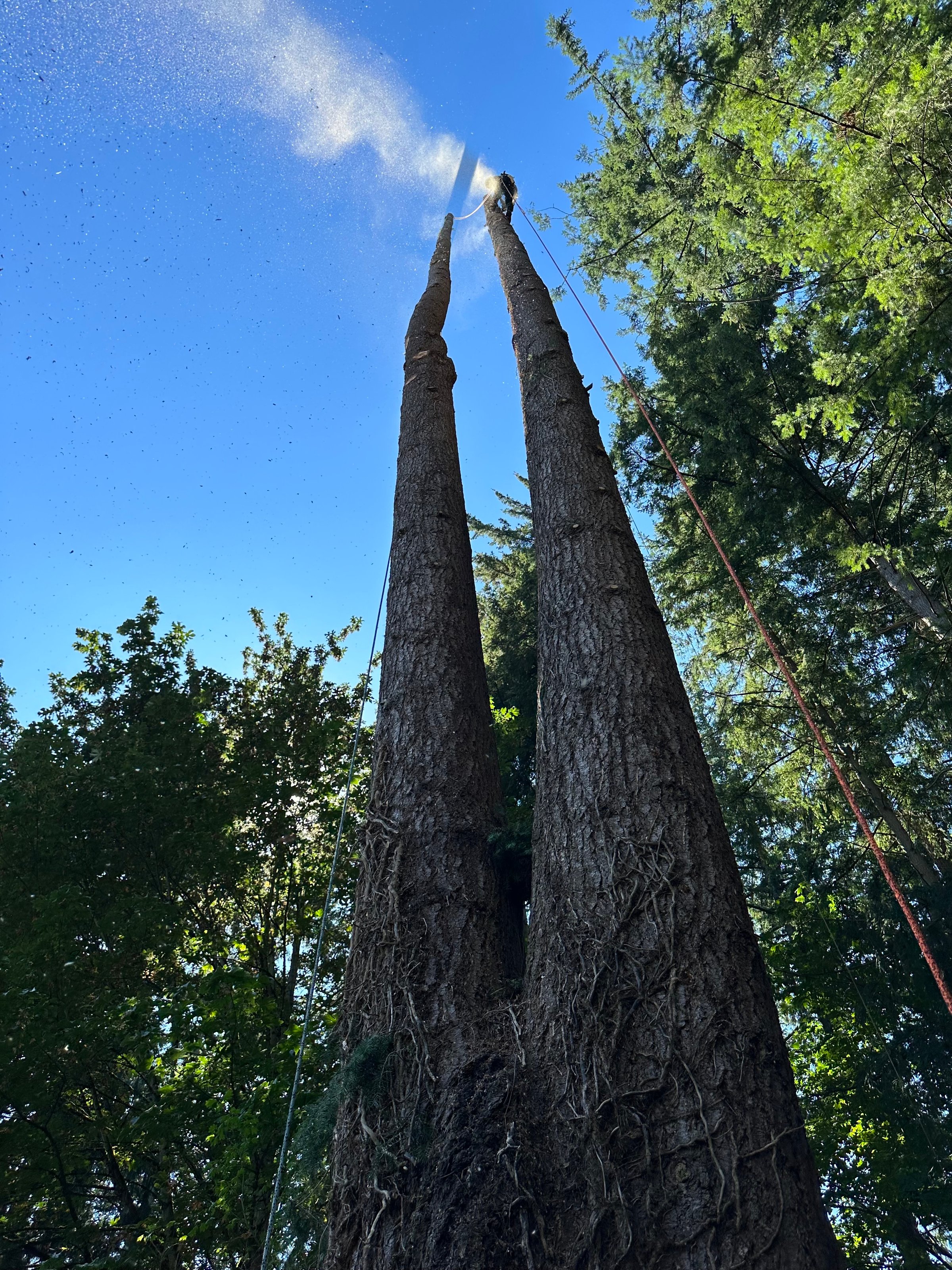
- Trees retained during construction now tower 80-100 feet over homes built beneath them
- Post-storm assessment must distinguish between repairable damage and structural failure
How to Assess Storm Damage on Your Lynnwood Trees
After a storm passes, homeowners in Lynnwood neighborhoods like Alderwood Manor, Meadowdale, and Martha Lake need to evaluate their trees carefully. Not all storm damage requires removal — but some damage that looks minor is actually serious:
- Crown Damage — Broken Limbs and Hangers: Broken branches lodged in the canopy — arborists call them hangers — are the most visible storm damage and the most immediately dangerous. A broken Douglas fir limb 30 feet up can weigh 200 to 500 pounds and fall without warning. After every significant storm, walk your property and look up. Any broken branches still in the tree should be removed by a professional before they fall on their own. This is the most common post-storm call we get from Lynnwood neighborhoods.
- Trunk Cracks and Splits: Windstorms can open vertical cracks in trunks or split forks apart. A crack that extends more than one-third of the trunk circumference compromises structural integrity — the tree may not survive the next storm. Splits at major forks are particularly dangerous in big leaf maples, which commonly develop codominant stems with included bark. Many of Lynnwood's street maples and yard maples have this defect, and storm loading is what finally opens them.
- Root Plate Movement: The most serious storm damage is often at ground level. If the soil around a tree's base has cracked, heaved, or shows a gap on the side opposite the lean, the root plate has partially failed. In Lynnwood's compacted soils, a tree with root plate movement rarely recovers — the severed roots will not re-establish in compressed soil. This tree will come down in a future storm and should be removed promptly.
- Lean Changes After Wind: A tree that was vertical before the storm but now leans is in a different category than a tree that has always grown at an angle. New lean indicates root failure or trunk base damage. Even a 5-degree lean change on a 90-foot tree means the crown has shifted 8 feet — creating a moment arm that puts tremendous force on the weakened root system. We assess lean changes on Lynnwood properties by comparing current trunk angles against fence lines, house corners, and other reference points.
Repair vs. Remove: Making the Right Call After Storm Damage
After a Convergence Zone storm hits Lynnwood, homeowners face a critical decision: can this storm-damaged tree be saved, or does it need to come down? Here is how to evaluate the damage on trees growing in Lynnwood's compacted suburban soils:
When Storm-Damaged Trees Can Be Saved
Trees that retain structural integrity after a Convergence Zone storm can often recover with professional pruning and monitoring.
- Less than 25 percent of the crown was lost or broken
- No trunk cracks extending more than one-third of circumference
- No root plate movement — soil around base is undisturbed
- The tree had no pre-existing structural defects that the storm worsened
- Remaining crown is balanced — not heavily one-sided after breakage
When Storm-Damaged Trees Should Be Removed
Trees with compromised structural systems after storm damage in Lynnwood's compacted soils are unlikely to recover and will fail again.
- Root plate has visibly shifted — cracked soil, lifted roots, new lean
- Trunk split at a major fork, especially with included bark
- More than 50 percent of crown lost, leaving a stub with minimal foliage
- Multiple large broken limbs on the same side, creating severe imbalance
- Pre-existing decay or root rot visible now that storm opened the trunk
The Bottom Line: The dividing line is structural integrity. A tree that lost some branches but has solid roots and trunk will recover. A tree with root plate failure or trunk splits has lost the structure that holds it up — it cannot recover and will fail again.
How We Handle Emergency Storm Calls in Lynnwood
When a storm drops trees across Lynnwood, here is how our emergency response works:
- Prioritize Life Safety and Access: Trees on houses, blocking driveways, or threatening power lines come first. We coordinate with Snohomish County PUD when downed trees are near power lines — we do not cut within 10 feet of energized lines. For Lynnwood neighborhoods along 196th Street SW and the Alderwood Mall area, traffic management is part of the emergency response because storm debris often affects busy roads.
- Rapid Damage Assessment: We walk the property and assess every tree, not just the one that failed. Storm events often damage multiple trees, and a tree that looks intact from the ground may have broken hangers or new cracks visible only from above. On Lynnwood lots with multiple mature trees — common in Meadowdale and Lund's Gulch — a thorough post-storm assessment can prevent the next failure.
- Emergency Removal and Debris Clearing: For trees on structures, we work from the top down, removing weight incrementally to prevent further structural damage to the building. We section the trunk, chip brush, and clear the area. For trees across driveways, we buck the trunk and clear a lane, then return for full cleanup when conditions allow. Most emergency clearing in Lynnwood can be completed the same day.
- Insurance Documentation: We photograph the damage before, during, and after the work. We provide detailed invoices that describe the emergency conditions, the scope of work, and the species and size of the trees involved. This documentation supports your homeowner's insurance claim. Most Lynnwood-area policies cover storm damage tree removal when the tree threatens or has struck a structure.
Lynnwood Storm Damage Questions
- How quickly can you respond to a storm emergency in Lynnwood?
- During active storm events, we respond to Lynnwood calls within the same day for trees on structures or blocking access. Lynnwood is 15 minutes from our base, so response time is fast once we can safely operate. During major events that affect the entire region, we triage by severity — trees on occupied structures come first. Less urgent situations like a tree across a fence are typically addressed within 24 to 48 hours of the storm passing.
- Will my insurance cover storm damage tree removal in Lynnwood?
- Most homeowner policies cover the cost of removing a tree that has fallen on an insured structure — your house, garage, fence, or vehicle. Policies typically do not cover removing a tree that fell in the yard without hitting anything. The coverage often includes a per-tree limit of $500 to $1,000 for debris removal. We provide itemized invoices that clearly distinguish between structural impact removal and yard debris clearing to help maximize your covered amount.
- Should I remove other large trees after one failed during a storm?
- Not automatically, but a post-storm assessment is wise. When one tree fails on a Lynnwood lot, it changes the wind dynamics for neighboring trees — they lose the buffering effect that the failed tree provided and may now be exposed to direct wind loads they have never experienced. We assess remaining trees for the same failure indicators: shallow roots in compacted soil, heavy lean, crown asymmetry, and pre-existing decay. Sometimes a proactive removal of one more compromised tree prevents the next emergency.
- Why did my neighbor's tree survive the same storm that toppled mine?
- Tree survival during Convergence Zone storms depends on the individual tree's root architecture, soil conditions, and exposure angle. On the same Lynnwood street, one lot might have retained native soil structure while the neighboring lot was heavily graded during construction. A tree in undisturbed soil with a deep, symmetric root plate can handle winds that uproot a tree 50 feet away in compacted fill. Species matters too — deep-rooted Douglas fir generally outperforms shallow-rooted Western hemlock in windstorms.
- Can I prevent storm damage to trees on my Lynnwood property?
- Prevention means reducing the forces that cause failure. Crown thinning — removing 15 to 25 percent of the live canopy — reduces the sail effect that catches wind and is the single most effective preventive measure. Removing dead branches prevents falling debris hazards. For trees with structural defects like codominant stems, cabling systems can reduce the chance of splitting under wind load. We recommend scheduling preventive pruning in late summer or early fall, before Lynnwood's storm season begins in November, so the crew can work in dry conditions and the tree enters winter with reduced wind resistance.
- What specific neighborhoods in Lynnwood have the highest storm damage risk?
- Meadowdale and Lund's Gulch along Puget Sound have wind exposure from the west combined with bluff-edge instability. Alderwood Manor — the neighborhoods between 196th Street SW and 208th Street SW — has some of the oldest suburban development in Lynnwood, with mature trees growing in heavily compacted 1960s-era construction soils. Martha Lake properties near the I-5 corridor experience Convergence Zone effects intensely because the terrain between Lynnwood and Everett is relatively flat and unobstructed, allowing convergence winds to accelerate. Each of these areas benefits from proactive tree assessment before storm season. We have worked extensively in all of these neighborhoods and can provide specific risk assessments based on the tree species, soil conditions, and exposure patterns unique to each area of Lynnwood.
Storm Damage on Your Lynnwood Property?
K&J Tree Works provides same-day emergency response for storm-damaged trees in Lynnwood and throughout south Snohomish County. We also offer post-storm assessments to identify compromised trees before the next event. Call (425) 223-7904 or request an estimate online. Monday through Saturday, 8 AM to 5 PM.