Managing Old-Growth Conifers on Remote Darrington Properties
Darrington, WA — March 26, 2026
Darrington sits at the edge of the Mount Baker-Snoqualmie National Forest where old-growth Douglas fir and Western red cedar can exceed 150 feet. Managing these giants on remote parcels requires specialized planning.
What Sets Darrington's Tree Management Apart?
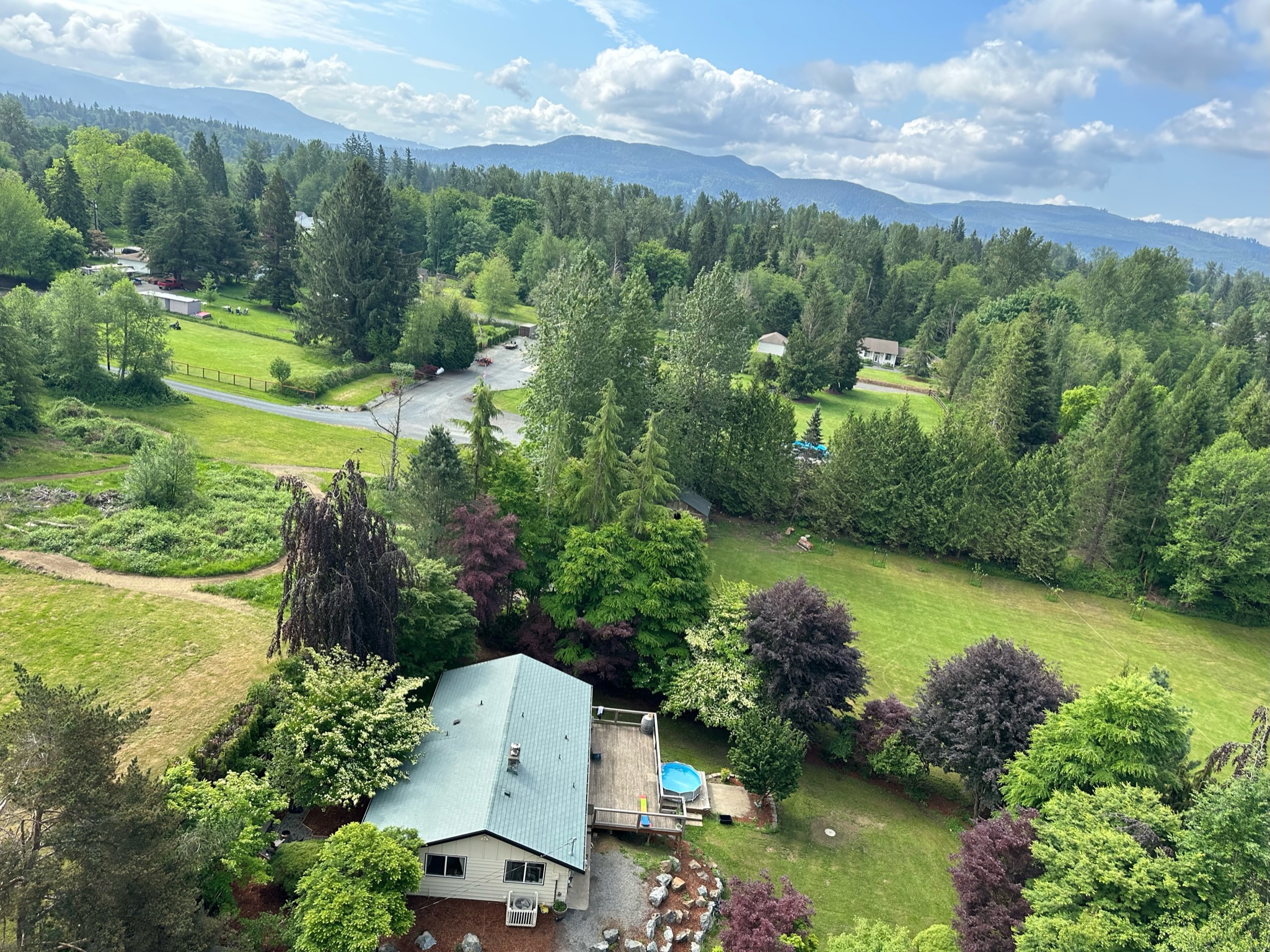
Darrington occupies a mountain valley at roughly 550 feet elevation where the North Fork Stillaguamish River meets the Sauk River, surrounded on three sides by the Mount Baker-Snoqualmie National Forest. This is not suburban tree work. Properties here range from in-town lots on Emens Avenue and Darrington Street to 5-, 10-, and 20-acre parcels accessed by gravel Forest Service roads off the Mountain Loop Highway. The trees match the landscape — Douglas fir and Western red cedar that were seedlings when the original timber claims were staked in the 1890s now tower 140 to 180 feet over homesteads. Western hemlock fills the understory, and at higher elevations above 1,500 feet, mountain hemlock and Pacific silver fir take over. These are not trees you manage with a bucket truck and a pickup. The trunk diameters can reach 60 to 72 inches, the wood weight of a single tree can exceed 30,000 pounds, and the nearest hospital is 30 miles away in Arlington. Every job in Darrington demands careful planning, self-sufficient crews, and equipment scaled to the task.
- Conifers on Darrington properties routinely exceed 150 feet with 48-72 inch trunk diameters
- Remote parcels accessed via Forest Service roads require self-sufficient crew staging
- Proximity to national forest means additional considerations for boundary trees
- Mountain valley terrain creates unpredictable wind patterns during storms
Understanding the Trees That Grow Around Darrington
The species mix in Darrington differs significantly from what grows in lowland Snohomish County communities like Marysville or Lake Stevens:
- Old-Growth Douglas Fir: True old-growth Douglas fir — trees 200 to 500+ years old — still stand on private parcels in the Darrington area, particularly along the Sauk River valley and in the Whitehorse area northeast of town. These trees have massive buttressed trunks, bark up to 12 inches thick, and canopies that start 80 to 100 feet above the ground. Removing one requires a full day with a two-person climbing team or a crane capable of reaching above the canopy. The wood volume from a single old-growth fir can fill a log truck.
- Western Red Cedar at Scale: Darrington-area cedars grow in the wettest microsites — along stream corridors, in natural drainage swales, and on north-facing slopes where moisture persists year-round. Old cedars here develop fluted, buttressed trunks that can be 8 feet across at the base but taper rapidly. This irregular shape makes them difficult to predict during felling because the weight distribution is asymmetric. They also tend to develop heart rot — the interior wood decays while the outer shell remains sound, which means the tree can look healthy while being structurally compromised from the inside.
- Mountain Hemlock at Higher Elevations: Properties above the town proper — toward Whitehorse Mountain and along the upper Sauk — transition into mountain hemlock zone. These trees are smaller than the valley-floor Douglas fir but grow in thin, rocky soils on steep slopes. Snow loading is the primary hazard: mountain hemlock develop one-sided crowns from decades of prevailing snowfall, and heavy snow years can snap leaders and shatter canopies.
- Red Alder in Disturbed Areas: Darrington's logging history left many areas that regenerated as alder stands in the 1950s through 1970s. These trees are now reaching maturity at 50 to 70 years old and entering decline — alder is relatively short-lived. Entire stands of 60-foot alders can deteriorate simultaneously, dropping limbs across driveways, power lines, and roofs. Clearing declining alder stands is one of the most common jobs we do in the Darrington area.
Access and Logistics on Darrington's Remote Parcels
Getting crew and equipment to many Darrington properties is itself a significant part of the job:
- Forest Service Road Access: Properties south of Darrington along the Mountain Loop Highway and east toward Suiattle River are accessed via Forest Service roads — gravel surfaces, single-lane with turnouts, and seasonal gate closures above certain elevations. Our crew trucks and chippers need 14 feet of road width for safe passage. We scout access routes before scheduling work to confirm bridge weight limits, gate status, and turnaround points.
- Equipment Transport Time: Darrington is 75 minutes from our Sultan base in dry conditions. A round trip with equipment consumes three hours of crew time before any tree work begins. For large projects, we stage equipment on-site overnight and plan multi-day work sessions to maximize productive time. This logistics reality is reflected in our pricing for Darrington jobs — not because the tree work itself costs more, but because the mobilization commitment is greater.
- No City Water or Fire Hydrants: Properties outside Darrington town limits typically have well water and no municipal fire protection. This means our crew operates self-sufficiently — we carry our own first aid and emergency response equipment, and we maintain communication with Snohomish County dispatch. The nearest hospital, Cascade Valley Hospital in Arlington, is a 35-minute drive, which influences how we manage risk on every job.
- Seasonal Access Windows: Upper-elevation properties near Whitehorse Mountain and along the Suiattle can be inaccessible from November through April due to snow, ice, and road closures. We schedule large projects on these parcels during the dry season from June through October when road conditions are reliable and daylight hours are long enough for full work days.
How We Plan a Large Tree Job in the Darrington Area
Remote, large-tree work requires more planning than typical suburban removal. Here is our process for Darrington projects:
- Pre-Job Site Visit and Access Assessment: We drive the access route, verify bridge and road capacity for our equipment, and walk the property to assess every tree in the scope. For Darrington jobs, this site visit is often a half-day commitment because of travel time and the detailed evaluation these large trees require. We document species, size, lean, decay indicators, and proximity to structures or boundaries.
- Equipment and Crew Planning: Based on the site assessment, we determine whether the job needs standard climbing gear, a crane, or both. For trees over 120 feet or 48 inches in diameter, we typically plan for two climbers working in tandem. We coordinate equipment delivery — getting a crane to a Forest Service road site east of Darrington requires advance planning for transport permits and road conditions.
- Work Zone Establishment: On remote Darrington properties, the work zone extends well beyond the tree itself. We establish landing areas for lowered sections, designate equipment staging zones, and clear safe retreat paths. On parcels bordering national forest, we flag the property boundary to ensure no work, felling, or equipment operation encroaches on federal land.
- Sectional Removal of Large Conifers: For 150-foot conifers, we remove the tree in stages over the course of a day. The climber starts at the top, removing limbs and cutting 4- to 6-foot sections that are lowered on rope. Trunk sections below the canopy can weigh 2,000 to 4,000 pounds each and require heavy rigging or crane lifts. Every cut is planned for the specific lean, wind conditions, and wood density of that individual tree.
- Material Processing and Site Restoration: The wood volume from large Darrington trees is substantial. A single 150-foot Douglas fir can produce 15 to 20 cords of wood. We buck trunk wood into manageable rounds, chip brush on-site, and work with the landowner on wood disposal — many Darrington residents keep firewood, and some have arrangements with local mill operators for usable logs.
Questions Darrington Property Owners Ask
- Can I remove trees on my property that are near the national forest boundary?
- You can remove trees on your private land regardless of proximity to the national forest boundary. However, no part of the tree — trunk, canopy, or root system — can be cut, disturbed, or felled onto national forest land without permission from the Mount Baker-Snoqualmie National Forest ranger district. We flag the property boundary before work begins and plan every felling direction and rigging system to keep all material on private land.
- How much does it cost to remove a 150-foot Douglas fir in Darrington?
- Large old-growth or mature second-growth Douglas fir removal in the Darrington area typically runs $3,500 to $8,000 per tree depending on diameter, lean, proximity to structures, and access conditions. The higher end applies to trees requiring crane assistance on remote parcels with long mobilization drives. Trees in open areas with good access are on the lower end. We provide exact quotes after a site visit because every large tree in Darrington presents different challenges.
- Is there a best season for tree work in Darrington?
- For properties in town, we work year-round. For remote parcels accessed via Forest Service roads, the best window is June through October when roads are open, ground is dry enough for equipment, and daylight allows full work days. Winter work is feasible in the lower valley but not at upper elevations where snow and ice make road access unreliable or impossible.
- What about the eagles and owls that nest in large trees around Darrington?
- Bald eagles, Northern spotted owls, and marbled murrelets all use large conifers in the Darrington area. Federal protections under the Bald and Golden Eagle Protection Act and the Endangered Species Act prohibit disturbing active nests. We look for nesting activity during our site assessment and schedule work outside nesting seasons — typically avoiding February through July for eagles and April through August for owls — when active nests are present in or near target trees.
- How do you handle the wood from old-growth trees removed in Darrington?
- Old-growth Douglas fir and Western red cedar produce exceptionally valuable wood — tight grain, clear boards, and large dimensional timber that cannot be replicated from second-growth trees. A single old-growth fir can produce lumber worth $2,000 to $5,000 or more at current milling prices. We discuss wood disposition with the property owner before the job. Some Darrington residents have relationships with local portable mill operators who will process logs on-site into usable lumber. Others prefer firewood rounds — old-growth fir makes excellent, long-burning firewood. We accommodate whatever arrangement the landowner prefers.
- What is the difference between old-growth and mature second-growth conifers in the Darrington area?
- Old-growth conifers around Darrington are typically 200 to 500+ years old, with trunk diameters exceeding 48 inches, bark 8 to 12 inches thick, and canopies that begin 80 to 100 feet above the ground. The wood has tight, dense growth rings. Mature second-growth trees regenerated after early 20th century logging and are 80 to 120 years old — still large at 24 to 40 inch diameters and 100 to 140 feet tall, but with faster-grown wood that is less dense. The rigging and removal approach is similar for both, but old-growth trees weigh significantly more per foot of height due to the denser wood, which affects our rigging capacity calculations.
Have Large Trees on Your Darrington Property?
K&J Tree Works handles the big trees that other companies pass on. We provide free on-site assessments for properties in Darrington, along the Mountain Loop Highway, and throughout the upper Stillaguamish and Sauk River valleys. Call (425) 223-7904 or request an estimate online. Monday through Saturday, 8 AM to 5 PM.